Water Security is National Security

Water resources and how they are managed impact almost all aspects of society and the economy, in particular health, food production and security, domestic water supply and sanitation, energy, industry, and the functioning of ecosystems. Under present climate variability, water stress is already high, particularly in many developing countries, and climate change adds even more urgency for action. Without improved water resources management, the progress towards poverty reduction targets, the Millennium Development Goals, and sustainable development in all its economic, social and environ- mental dimensions, will be jeopardized. UN Water.Org

Showing posts with label nicaragua. Show all posts

Friday, January 2, 2015

A New Canal Through Central America Could Have Devastating Consequences

When construction crews begin digging a new canal this month across Nicaragua, connecting the Pacific and Atlantic, it’ll be a boon to global shipping and, the government says, to the economy of the second-poorest nation in the Americas.
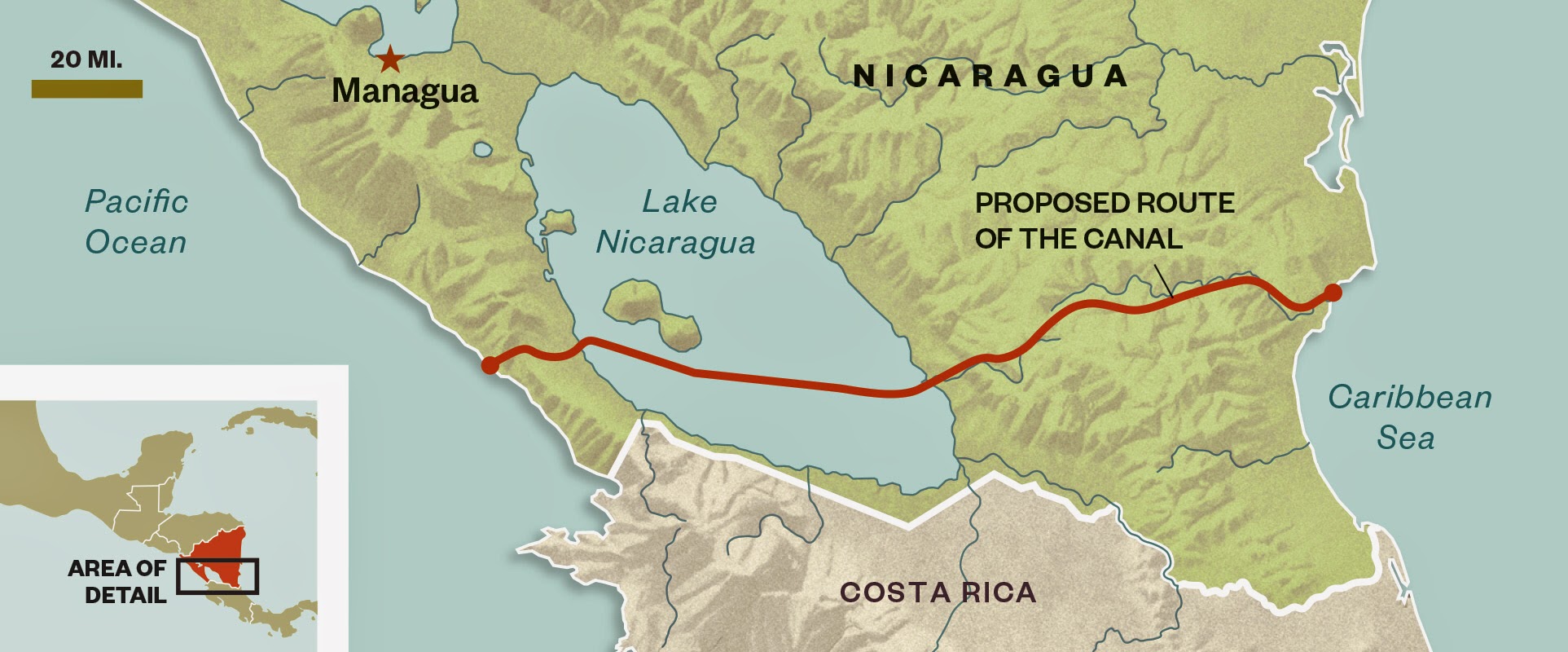
But activists, scientists and others are increasingly alarmed by the environmental impact of a 173-mile artificial waterway—wider, deeper and three and a half times the length of the Panama Canal.

Developed by Wang Jing, an enigmatic Chinese industrialist with ties to China’s ruling party, the Grand Nicaragua Canal will cost an estimated $40 billion and take five years to build. At 90 feet deep and 1,706 feet across at its widest, the channel will accommodate the newest cargo supertankers, which are longer than the Empire State Building is tall and carry 18,000 shipping containers. The vessels are too big to pass through the Panama Canal (even after a $5 billion expansion is completed) or to dock in any U.S. port.

The new canal and its infrastructure, from roads to pipelines to power plants, will destroy or alter nearly one million acres of rainforest and wetlands. And that doesn’t include Lake Nicaragua, a beloved 3,191-square-mile inland reservoir that provides most Nicaraguans with drinking water. The canal cuts through the lake, and critics say ship traffic will pollute the water with industrial chemicals and introduce destructive invasive plants and animals.

Plus, the canal route lies in the middle of a hurricane belt, says Robert Stallard, a research hydrologist with the U.S. Geological Survey and the Smithsonian Tropical Research Institute. “You’re likely going to be looking at hurricanes vastly more powerful than anything that ever hit Panama, and ever will,” Stallard says. A storm like Hurricane Mitch, which killed 3,800 people in Nicaragua in 1998, would probably cause the canal to flood, triggering mudslides that would breach locks and dams. Communities, homes, roads and power lines would be swamped.

The Nicaraguan government has yet to release promised analyses of the canal’s likely environmental impacts, and has even dodged neighboring Costa Rica’s request to share disaster plans. “We’ve got a lack of information and a potentially big threat to the environment,” says Jorge A. Huete-Pérez, vice president of the Academy of Sciences of Nicaragua. “The government just wants to rush the thing through.” The canal’s true benefits can’t be calculated, Huete-Pérez and others argue, as long as the costs to Nicaragua’s forests, waterways and wildlife remain hidden. More


Sunday, August 17, 2014

Central America braces for drought-linked food crisis

Low rainfall linked to the El Nino weather phenomenon has led to drought in parts of Central America, causing widespread damage to crops, shortages and rising prices of food, and worsening hunger among the region’s poor.

An unusually hot season and extended dry spells have brought drought to areas in eastern and western Guatemala and El Salvador, southern Honduras and northern and central Nicaragua, destroying swathes of bean and maize crops, the region’s staple foods, and putting pressure on subsistence farmers and food prices.

“Extremely poor households across large areas of Guatemala, Nicaragua, Honduras, and El Salvador will experience a rapid deterioration in their food security in early 2015.

“Atypically high levels of humanitarian assistance, possibly the highest since Hurricane Mitch in 1998, will likely be required in order to avoid a food crisis,” said a recent report by the Famine Early Warning Systems Network (FEWS NET), run by the US Agency for International Development (USAID).

Thousands of families in the region have become too poor to buy enough food for survival because poor harvests are pushing up prices of staple foods while coffee producers are hiring fewer seasonal coffee pickers and paying lower wages because of a coffee leaf rust or roya epidemic across Central America.

In Nicaragua and Honduras, red bean prices rose by up to 129 percent between January and June 2014, according to FEWS NET.

Other livelihoods in Central America, including fishing and livestock breeding, have also been hard hit by the recent drought and the El Nino weather phenomenon, FEWS NET said.

El Nino, which can last more than a year, significantly raises surface temperatures in the central and eastern areas of the tropical Pacific Ocean, a phenomenon linked to major climate fluctuations around the world.

In response to the drought, the Guatemalan government has said it will begin distributing 4,000 tonnes of food aid to more than 170,000 families affected by the drought from early October, using government and United Nations World Food Programme (WFP) food reserves.

One of the poorest countries in Central America, Guatemala already struggles to feed its population, particularly those impoverished indigenous communities living in rural areas.

Around half Guatemala’s population of 15 million lives in poverty and the country has the world’s fourth highest rate of chronic malnutrition, which affects almost half the children under five, according to the WFP.

In neighboring Honduras, the government is distributing food, including rice, beans and flour, and vitamin supplements to 76,000 families, many subsistence farmers, affected by the drought.

First Blogged on http://robinwestenra.blogspot.com/