Water Security is National Security

Water resources and how they are managed impact almost all aspects of society and the economy, in particular health, food production and security, domestic water supply and sanitation, energy, industry, and the functioning of ecosystems. Under present climate variability, water stress is already high, particularly in many developing countries, and climate change adds even more urgency for action. Without improved water resources management, the progress towards poverty reduction targets, the Millennium Development Goals, and sustainable development in all its economic, social and environ- mental dimensions, will be jeopardized. UN Water.Org

Showing posts with label potable water. Show all posts

Wednesday, June 24, 2015

Parched Caribbean faces widespread drought, water shortages

The worst drought in five years is creeping across the Caribbean, prompting officials around the region to brace for a bone dry summer.

From Puerto Rico to Cuba to the eastern Caribbean island of St. Lucia, crops are withering, reservoirs are drying up and cattle are dying while forecasters worry that the situation could only grow worse in the coming months.

Thanks to El Nino, a warming of the tropical Pacific that affects global weather, and a quieter-than-normal hurricane season that began in June, forecasters expect a shorter wet season. That means less rain to help refill Puerto Rico's thirsty Carraizo and La Plata reservoirs as well as the La Plata river in the central island community of Naranjito. A tropical disturbance that hit the U.S. territory on Monday did not fill up those reservoirs as officials had anticipated.

Puerto Rico is among the Caribbean islands worst-hit by the , with more than 1.5 million people affected by the drought so far, according to the U.S. National Drought Mitigation Center.

Tens of thousands of people receive water only every third day under strict rationing recently imposed by the island government. Puerto Rico last week also activated National Guard troops to help distribute water and approved a resolution to impose fines on people and businesses for improper water use.

The Caribbean's last severe drought was in 2010. The current one could grow worse if the hurricane season ending in November produces scant rainfall and the region enters the dry season with parched reservoirs, said Cedric Van Meerbeeck, a climatologist with the Caribbean Institute for Meteorology and Hydrology.

"We might have serious water shortages ... for irrigation of crops, firefighting, domestic consumption or consumption by the hotel sector," he said.

The Caribbean isn't the only area in the Western Hemisphere dealing with extreme water shortages. Brazil has been struggling with its own severe drought that has drained reservoirs serving the metropolis of Sao Paulo.

In the Caribbean, the farm sector has lost more than $1 million in crops as well as tens of thousands of dollars in livestock, said Norman Gibson, scientific officer at the Trinidad-based Caribbean Agricultural Research and Development Institute.

On St. Lucia, which has been especially hard hit, farmers say crops including coconuts, cashews and oranges are withering.

"The outlook is very, very bad," said Anthony Herman, who oversees a local farm cooperative. "The trees are dying, the plants are dying ... It's stripping the very life of rivers."

Officials in Cuba say 75 percent of the island is enduring a drought that has killed cattle and destroyed thousands of hectares (acres) of crops including plantains, citrus, rice and beans. Recent heavy rains in some areas have alleviated the problem some, but all 200 government-run reservoirs are far below capacity.

In the nearby Dominican Republic, water shortages have been reported in hundreds of communities, said Martin Melendez, a civil engineer and hydrology expert who has worked as a government consultant. "We were 30 days away from the entire water system collapsing," he said.

The tourism sector has also been affected.

Most large hotels in Puerto Rico have big water tanks and some recycle wastewater to irrigate green areas, but many have curtailed water use, said Frank Comito, CEO of the Florida-based Caribbean Hotel & Tourism Association.

Other hotels have cut back on sprinkler time by up to 50 percent, said Carlos Martinez of Puerto Rico's Association of Hotels. "Everybody here is worried," he said. "They are selling water tanks like hot cakes ... and begging God for rain."

Guests at Puerto Rico's El Canario by the Lagoon hotel get a note with their room keys asking them to keep their showers short amid the water shortage. "We need your cooperation to avoid waste," says the message distributed at the front desk of the hotel in the popular Condado district.

At the Casa del Vega guesthouse in St. Lucia, tourists sometimes find the in their rooms turned off for the day, preventing them from taking a shower. "Even though we have a drought guests are not sympathetic to that," hotel manager Merlyn Compton said. More


Thursday, May 7, 2015

This machine makes salty water drinkable

The American engineers who traveled to rural India two years ago believed they were going to help poor villagers get rid of microbes in their drinking water. But soon after their arrival, they began hearing about a different problem: salt.

“People kept talking about the salt in the water,” recalled Natasha Wright, a doctoral candidate who was part of the team from Massachusetts Institute of Technology that made the journey in 2013. “The groundwater beneath the villages was brackish.”

Those complaints inspired new technology that could some day supply water to thirsty villages and drought-stricken farms in other parts of the world. The MIT team developed a solar-powered water desalination system that uses the sun’s energy to turn brackish liquid into contaminant-free water safe for drinking and for crops.

While there are dozens of different desalination systems in use around the world, MIT’s is uniquely designed to be small, relatively cheap and 100-percent solar-powered, making it suitable for remote areas where the electricity supply is unreliable or non-existent, Wright said.

The panel of judges last month deemed the machine’s potential so impressive that they gave the inventors the $140,000 “Desal Prize,” an award sponsored by Securing Water for Food, a joint project of the U.S. Agency for International Development and the governments of Sweden and the Netherlands. Some 68 engineering teams from 29 countries competed in the contest, hosted by the Interior Department’s Bureau of Reclamation in Alamogordo, N.M.

“Providing a sustainable water supply is important for the West, the country and the world,” Esteva Lopez, the department’s reclamation commissioner, said after the top prize was awarded to MIT and its research partner, Jain Irrigation Systems.

Wright said she and fellow engineers from MIT’s Global Engineering and Research Laboratory became aware the extent of saltwater intrusion in northern and central Indian aquifers during visits to investigate solutions for widespread water contamination in India. In addition to problems with bacterial contamination, the groundwater in much of rural India is brackish, having a salt content lower than seawater but still high enough to cause problems. In some of the villages visited by the MIT researchers, locals were trying unsuccessfully to remove the salt using filters and chemicals.

“People complained about the salty taste,” Wright said, “and the salt ruined their cooking pots.”

Traditional desalination systems are expensive and require substantial amounts of electricity to operate, making them impractical for India’s remote farming communities. Instead, the MIT researchers designed a system that removes salt through a process called electrodialysis, using a series of electrodes and membranes to remove the salt. They added solar panels and batteries to run the pumps and charge the electrodes. Then, in a final step, they installed ultraviolet light arrays to kill any microbes remaining in the water.

The finished prototype is small enough to fit in a tractor-trailer and includes photovoltaic cells to supply the electricity. The system, when fully operational, can supply the basic water needs of a village of between 2,000 and 5,000 people, MIT officials said. Although the prototype was more expensive, Wright said the team is hopes to lower the costs of a village-sized unit to about $11,000.

Such a lower-power system is useful mainly for treating brackish water and not seawater, which contains far more salt. But the prototype now being tested could handle water that contains salt concentrations of up to 4,000 parts per million, meaning it would work in about 90 percent of India’s wells, Wright said. Seawater’s salt concentration averages about 35,000 parts per million.

“There are places where this kind of system won’t work, but the advantage is, it uses half the energy of other systems,” said Wright. And, thanks to solar cells, “you can be fully off the grid.” More


Friday, January 2, 2015

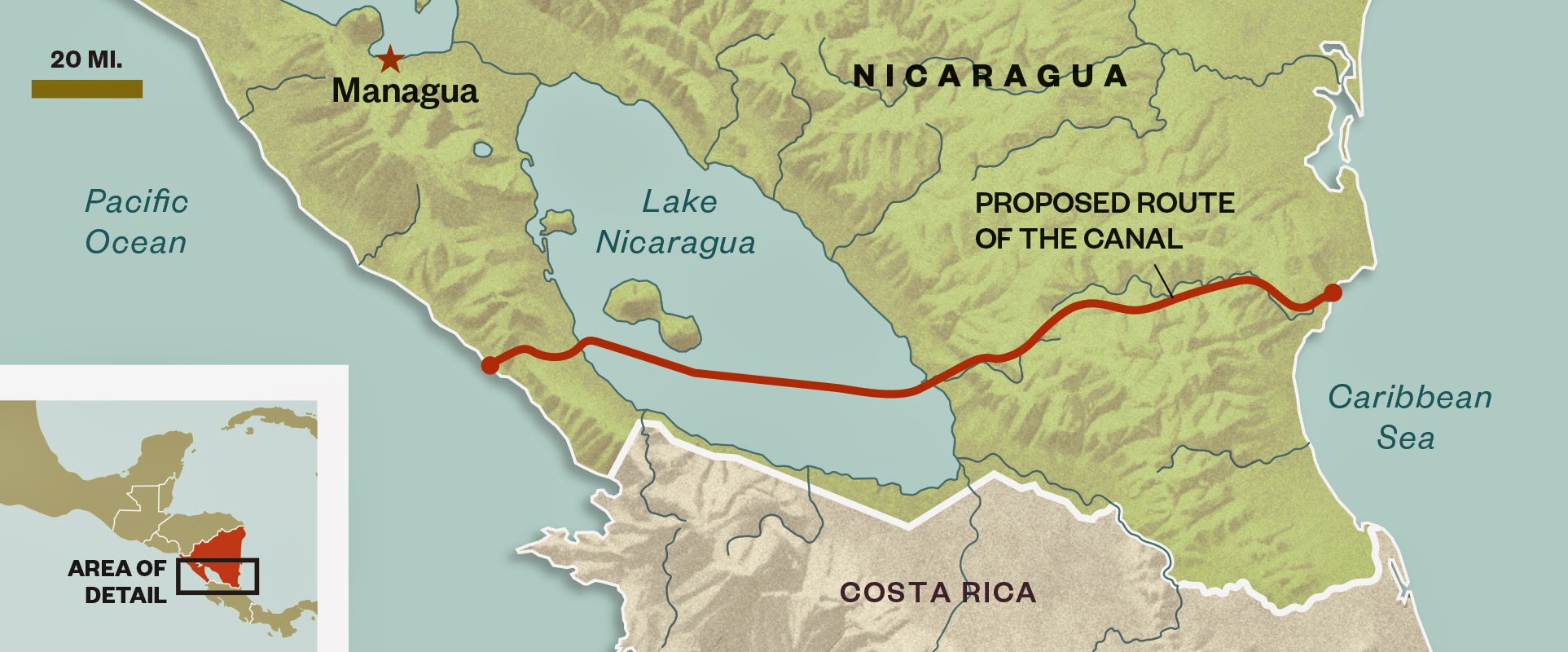
A New Canal Through Central America Could Have Devastating Consequences

When construction crews begin digging a new canal this month across Nicaragua, connecting the Pacific and Atlantic, it’ll be a boon to global shipping and, the government says, to the economy of the second-poorest nation in the Americas.

But activists, scientists and others are increasingly alarmed by the environmental impact of a 173-mile artificial waterway—wider, deeper and three and a half times the length of the Panama Canal.

Developed by Wang Jing, an enigmatic Chinese industrialist with ties to China’s ruling party, the Grand Nicaragua Canal will cost an estimated $40 billion and take five years to build. At 90 feet deep and 1,706 feet across at its widest, the channel will accommodate the newest cargo supertankers, which are longer than the Empire State Building is tall and carry 18,000 shipping containers. The vessels are too big to pass through the Panama Canal (even after a $5 billion expansion is completed) or to dock in any U.S. port.

The new canal and its infrastructure, from roads to pipelines to power plants, will destroy or alter nearly one million acres of rainforest and wetlands. And that doesn’t include Lake Nicaragua, a beloved 3,191-square-mile inland reservoir that provides most Nicaraguans with drinking water. The canal cuts through the lake, and critics say ship traffic will pollute the water with industrial chemicals and introduce destructive invasive plants and animals.

Plus, the canal route lies in the middle of a hurricane belt, says Robert Stallard, a research hydrologist with the U.S. Geological Survey and the Smithsonian Tropical Research Institute. “You’re likely going to be looking at hurricanes vastly more powerful than anything that ever hit Panama, and ever will,” Stallard says. A storm like Hurricane Mitch, which killed 3,800 people in Nicaragua in 1998, would probably cause the canal to flood, triggering mudslides that would breach locks and dams. Communities, homes, roads and power lines would be swamped.

The Nicaraguan government has yet to release promised analyses of the canal’s likely environmental impacts, and has even dodged neighboring Costa Rica’s request to share disaster plans. “We’ve got a lack of information and a potentially big threat to the environment,” says Jorge A. Huete-Pérez, vice president of the Academy of Sciences of Nicaragua. “The government just wants to rush the thing through.” The canal’s true benefits can’t be calculated, Huete-Pérez and others argue, as long as the costs to Nicaragua’s forests, waterways and wildlife remain hidden. More