Water Security is National Security

Water resources and how they are managed impact almost all aspects of society and the economy, in particular health, food production and security, domestic water supply and sanitation, energy, industry, and the functioning of ecosystems. Under present climate variability, water stress is already high, particularly in many developing countries, and climate change adds even more urgency for action. Without improved water resources management, the progress towards poverty reduction targets, the Millennium Development Goals, and sustainable development in all its economic, social and environ- mental dimensions, will be jeopardized. UN Water.Org

Showing posts with label peru. Show all posts

Sunday, November 26, 2017

In Peru's deserts melting glaciers are a godsend - until they are gone

Using some of the glacial water to ‘Green’ the Peruvian the desert, as is being done in China and North Africa would be a smart move. See LOESS PLATEAU WATERSHED REHABILITATION PROJECT


Yet climate change now threatens some of these ambitious undertakings, reducing lakes, diminishing aquifers and shrinking glaciers that feed crops. Here in Peru, the government irrigated the desert and turned it into farmland through an $825 million project that, in a few decades, could be under serious threat.

“We’re talking about the disappearance of frozen water towers that have supported vast populations,” said Jeffrey Bury, a professor at the University of California at Santa Cruz who has spent years studying the effects of glacier melt on Peruvian agriculture. “That is the big picture question related to climate change right now.”

A changing climate has long haunted Peru. One past civilization, the Moche people, built cities in the same deserts, only to collapse more than a millennium ago after the Pacific Ocean warmed, killing fish and causing flash floods, many archaeologists contend.

Now dwindling water is the threat. While more than half of Peru sits in the wet Amazon basin, few of its people ever settled there. Most inhabit the dry northern coast, cut off from most rain by the Andes range. While the region includes the capital, Lima, and 60 percent of Peruvians, it holds only 2 percent of the country’s water supply.

The glaciers are the source of water for much of the coast during Peru’s dry season, which extends from May to September. But the icecap of the Cordillera Blanca, long a supply of water for the Chavimochic irrigation project, has shrunk by 40 percent since 1970 and is retreating at an ever-faster rate. It is currently receding by about 30 feet a year, scientists say. https://goo.gl/Wa1JyK

Thursday, December 11, 2014

Water woes in Lima: A glimpse of our future?

As UN negotiators meet in Lima to work out a plan for dealing with rising temperatures, Matt McGrath visited a community paying a high price for water supplies threatened by climate change and increasing demand. Is Peru's experience a sign of things to come?

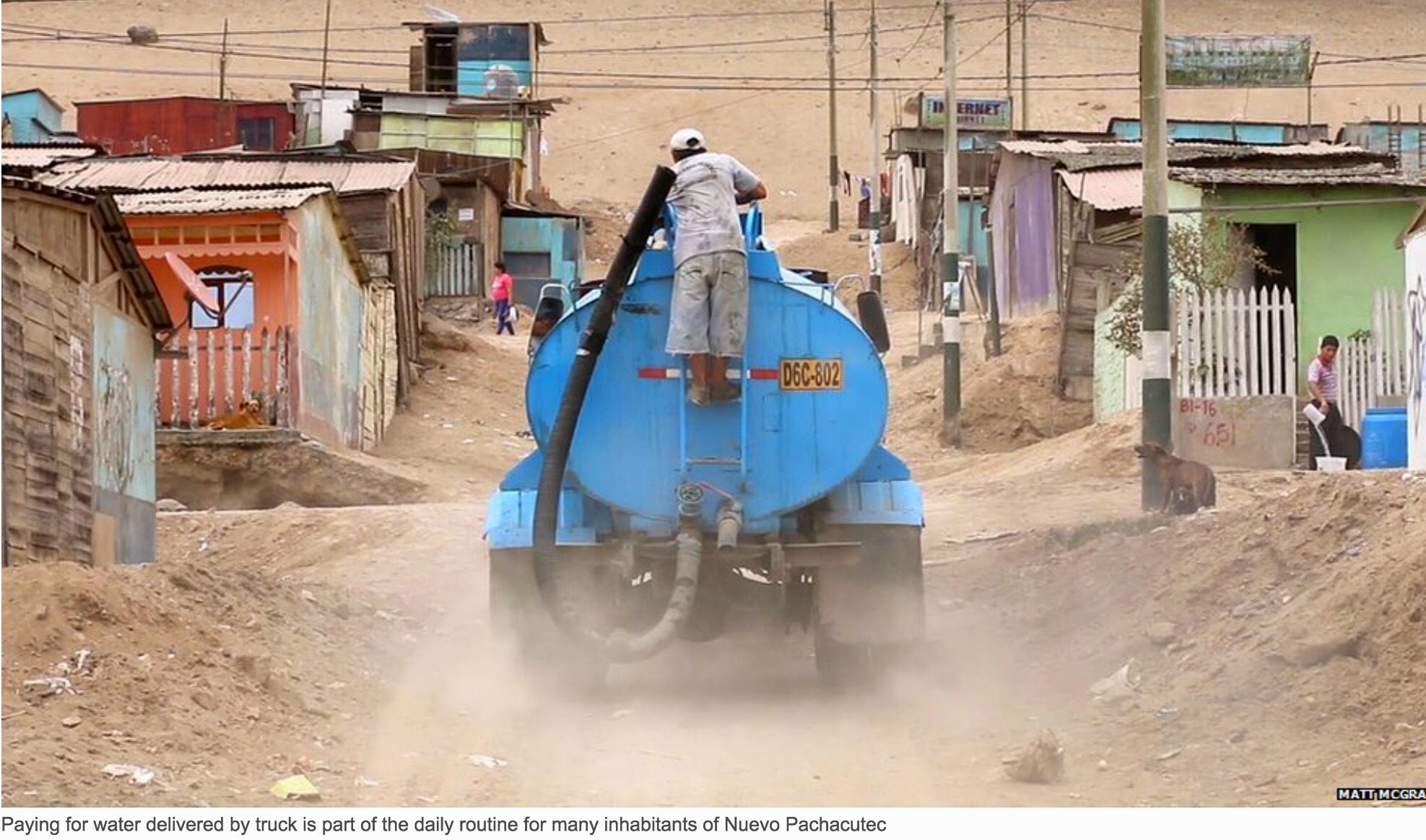
Snarling and screeching, the bouncing water truck speeds backwards down the steep hill, in a cloud of coarse dust.

It halts with a judder and a wild eyed, sweaty man jumps from the cab, grabs a large plastic pipe on the back and starts to fill a series of plastic containers on the ground, with little care.

Dressed in bright pink, a woman looks on nonchalantly.

The man runs up to her and holds out his hand. She drops some coins and away he goes, jumping onto the running board of his vehicle, already snorting its way to the next stop.

This is daily routine for tens of thousands of people who live in this sprawling hillside settlement that looks down on the Pacific Ocean, less than an hour north of Lima, Peru.

Water in Nuevo Pachacutec is not just the vital substance for life, it is a measure of social status and progress.

People first came to these hazy hills in the 1980s, in response to politicians who promised them land in return for votes.

When they first arrived the women said their feet would just sink in the sand. That's all that was here.

The politicians allowed them to take the ground - but most of the 160,000 people here do not have legal title. They are "possessors of the land" but not the owners.

And land is too grand a word. This is really a desert. After Cairo, Lima is said to be the world's second biggest city built in one. Rainfall here amounts to just 50mm of water per year.

A river runs through it

A few kilometres south of Nuevo Pachacutec, a miserable, dirty stream meanders under a motorway.

Bags of rubbish sit alongside the ubiquitous tractor tyres.

This is the Chillon river, the sole water source for around two million people in northern Lima.

The waters of the Chillon are fed by glaciers in the Andes. And this is a source of concern.

"We are worried here in Peru because climate change is already having a huge impact on our access to water," says Armando Mendoza a research officer with Oxfam in the country.

"In the last 40 years, the glacial coverage has retreated by 40% more or less, because of the increase in global warming.

"The predictions are that in the future access to water will become even more difficult and the ones who are most vulnerable to this are the poor."

These longer term water issues with glaciers are not the immediate priority in Nuevo Pachacutec.

As well as the speeding tuktuks, the sandy roads are festooned with signs for car washes, even private schools.

Despite the fact that 80% of the homes are made of wood, incomes and aspirations are rising here.

Access to water is critical in this development, as it is in developing nations all over the world.

With funding from the German government, a green group called Alternativa has helped build networks of white water tanks, connected by underground tubes that bring water directly to the houses.

They have also installed 900 outside water points in this sprawling settlement.

Their efforts to date have brought the vital liquid to 9,000 households.

In this community, water is more than just a key ingredient for life, it is a reflection of harsh social divisions.

The blue barrels

Despite the fact that 80% of the homes are made of wood, incomes and aspirations are rising here.

Access to water is critical in this development, as it is in developing nations all over the world.

With funding from the German government, a green group called Alternativa has helped build networks of white water tanks, connected by underground tubes that bring water directly to the houses.

They have also installed 900 outside water points in this sprawling settlement.

Their efforts to date have brought the vital liquid to 9,000 households.

In this community, water is more than just a key ingredient for life, it is a reflection of harsh social divisions.

Radios and children play loudly on the street where Daniza Cruz Navarro lives.

The homes on this stretch are known as the "casas azules" - the blue houses.

Outside many sit blue plastic barrels, some with lids, some without, that hold the water residents get from the trucks that constantly career about the local roads.

Dogs lap from the open containers. Mosquitoes lay their eggs in the water.

"You can see the effects of the way the water is being stored in the kids' health," says Daniza.

"They often get sick, there is often misuse and mismanagement of the water here."

She has moved on from the blue barrel and is now the owner of a more effective and efficient water tank that she has bought through the efforts of Alternativa.

However, as she still gets water directly from the delivery trucks, she has to pay significantly more than her neighbours.

Daniza says she pays 120 Nuevo Soles (£26; $40) per month for the precious water. This is about 10% of her household income.

Those who are connected to the main water grid pay just 6-12 Soles per month.

These are big sums of money and the differences can be a source of friction between neighbours.

Despite these problems, those who work with the people in Nuevo Pachacutec say progress is being made. It's really a story of local self-empowerment.

"Even if they are not perfect, they have bettered considerably," says engineer Osvaldo Caceres who works with Alternativa.

"This infrastructure is managed by them, for them. The local population know what they want, but they know and understand they have to participate to get it.

Plug and pay


"When we first got here it was all desert - there were no roads, it was pure sand," says Ycella Bonilla a resident of Nuevo Pachacutec.

She stands proudly in the doorway of her recently built bathroom cum laundry room, completed with the help of microfinance.

Ycella calls it her "unit of dignity".

Despite this advance, Ycella and her family are still paying heavily for water. She has a hose and a key that allows her family to plug into a water point. For this she pays 80 Nuevo Soles a month (£18; $27) a month.

Despite the gripes over cost, Ycella recognises that water is the bedrock of development for the community.

"We have roads, we have schools, we have a lot of the basic necessities now, including water."

The struggle for development and the need to have resources like water to empower that development is not just on the minds of those in Nuevo Pachacutec.

An hour down the road in Lima itself, UN climate negotiators are struggling with that same dilemma. How to balance the burgeoning needs of a growing population, with the need to limit those same enriching activities because they threaten the future of the planet.

Osvaldo Caceres says that as in solving the water stresses of Nuevo Pachacutec, the climate battle can be won, by everyone playing their part now. It's no use passing the buck down the generations.

"Every actor in this chain must take responsibility for what they have to do," he says.

"The governments, the authorities, and obviously the people, they all need to act." "There is no other way." More


Tuesday, March 12, 2013

South Americans Face Upheaval in Deadly Water Battles

People streamed into the central square in Celendin, a small city in the Peruvian Andes, the morning of July 3, 2012. They were protesting the government’s support for Newmont Mining Corp. (NEM)’s plan to take control of four lakes to make way for a new gold and copper mine. By midday, there were 3,000.

This lake in the Peruvian Andes, once the water supply for farms and villagers, is drying up after Newmont’s Yanacocha mine drained its water

Some hurled rocks at police and brandished clubs. Then assailants shot two officers and an Army soldier in the leg.

Blocks away, construction worker Paulino Garcia left home on foot to buy groceries. As he approached the central square, he encountered chaos. People ran for cover as federal troops fired their weapons,

It was the deadliest clash in 18 months of protests in Peru’s Cajamarca region, where many residents say Newmont’s $5 billion Conga mine will take water their villages and farms need to survive.

“He died in a pool of blood,” says Adelaida Tabaco, Garcia’s widow, 38, sobbing inside her half-built adobe house in Celendin. “The only thing the people want is water for families, but the mining companies want to take it. And soldiers will kill if you get in the way.”

The injured and dead in Celendin, 800 kilometers (500 miles) north of Lima, are victims in a continent-wide conflict that pits South American governments and big, often foreign- based companies against people who stand to lose their homes as water is diverted to industrial uses.

Leaders across the region, elected on promises to fuel economic growth and lift their populations out of poverty, are fast tracking water-use approvals for projects like the Conga mine. Helped by mining and agriculture exports, Brazil’s gross domestic product increased 43 percent from 2002 to 2012, after adjusting for inflation, while Chile’s economy grew 58 percent.

Peru is on target to expand 6 percent in 2013, the fastest pace in South America, driven by investments in gold, silver and copper mines.

South America has more water than any other region on earth, with 29 percent of the world’s reserves, according to the United Nations Food and Agriculture Organization. The rub is that the water isn’t always where the best mineral or agricultural resources are located.

Mines consume huge amounts of water to separate minerals from rock. It takes 28 liters (7.4 gallons) of water to make 0.5 kilogram (1 pound) of copper in Chile. After processing, the water at some mines is so toxic that it can’t be reused. Peru’s biggest mines, such as Conga, are high in the Andes, where there’s almost no rain from May to October.

In Chile, the world’s largest copper producer, vast deposits of copper, gold and silver lie under the Atacama Desert, which is so dry that rainfall has never been recorded in some places. And higher demand means there’s less water to go around.

Growing populations have pushed the amount of usable water per person down by more than one-fifth since 1992 in Brazil, Chile and Peru, according to the UN group.

National leaders in Latin America are weighing short-term economic growth against the public’s future needs for water, and the consequences can be deadly. In Chile, the nation’s drinking supply is threatened by past policies of allotting too much water to companies to spur the economy, Public Works Minister Loreto Silva says.

Water is already running out in places like Copiapo, a city of 158,438 people in the Atacama Desert, 800 kilometers north of Santiago, because of mining and agricultural expansion, she says.

“In some areas of the country, like Copiapo, we have a reduction or an exhaustion of the resource,” Silva says. “If we don’t make decisions today, we’ll be short of water in about a decade. That forces us to take a long-term, strategic view in terms of water.”

Peru faces similar long-term needs because water is in short supply in areas where mines are expanding, says Hugo Jara, head of the country’s National Water Authority. The government needs to build $394 million of reservoirs and canals by 2016 for annual water shortages in the dry season in the Andes, he says.

“The government has declared water its first priority,” Jara says. “These protests helped to spur our attention.”

Governments are making the right decision in providing water to industries that benefit the majority of their populations, even if that means displacing some people, says John Briscoe, a Harvard University professor who specializes in water policy. More


Wednesday, July 25, 2012

Faced with drought, Peru's highlanders revive ancient water harvesting

PUNO, Peru (AlertNet) – From the air above the town of Puno, the Peruvian Altiplano appears an endless plain where only clumps of ichu grass withstand the harshness of the sun and lack of water.

But looks deceive: these parched lands in the country’s southeast, located at 4,000 metres altitude (13,000 feet), are home to thousands of poor farmers who for centuries have managed to grow potatoes and grain in this rugged environment.

Today, as droughts become longer, Puno’s inhabitants are relearning ancestral practices of cooperative farming and water harvesting to cope with the challenges associated with climate change.

“We cannot wait for the regional or national government to help us solve our problems,” says Zenon Gomel Apaza, an agronomist and farmer. “The consequences of climate change are occurring now. We have to cope with what we know and have.”

The agronomist won a Rolex Award for Enterprise in 2006 for helping 500 families in Pucara, 60 km (38 miles) north of Lake Titicaca, to widen the genetic variety of their crops to increase food security.

For the past two years, the Asociacion Savia Andina Pucara (ASAP), a nongovernmental organisation focused on agriculture and food security and founded by Gomel Apaza, also has been working to improve water security in Peru’s highlands. In April, the new venture garnered him an Indigenous and Traditional Peoples Conservation Fellowship from the US-based NGO Conservation International.

BUILDING RESERVOIRS

In the village of Quenauni Alto, 20 km (13 miles) from Pucara, Mario Arapa has constructed several cochas (small ponds) on his land under the guidance of ASAP.

Each cocha is no more than two metres by four metres in size (6.5 feet by 13 feet) and only one metre (3.25 feet) deep, but for Arapa and his eight children these traditional reservoirs make the difference between surviving in a harsh environment and capitulation to worsening conditions.

“Frosts are (now) more frequent and last longer. The sun burns harder,” says Arapa. “Before (washed) clothes took two days to dry, now just one day.”

Eddy Wilber Ramos, an agronomist and Gomel Apaza’s assistant, says tougher times mean “there are dozens of families who are migrating from these areas because they are no longer able to tolerate the climate conditions in which they must work.” More