Water resources and how they are managed impact almost all aspects of society and the economy, in particular health, food production and security, domestic water supply and sanitation, energy, industry, and the functioning of ecosystems. Under present climate variability, water stress is already high, particularly in many developing countries, and climate change adds even more urgency for action. Without improved water resources management, the progress towards poverty reduction targets, the Millennium Development Goals, and sustainable development in all its economic, social and environ- mental dimensions, will be jeopardized. UN Water.Org
Showing posts with label water companies. Show all posts
Showing posts with label water companies. Show all posts
On the March 21st, International Day of Forests, FAO HQ will host a special celebration in recognition of ‘Forests and Water’. During the event the Land and Water Division will present ‘Forests and Water in Practice’ with examples of watershed management dealing with changes in rural production processes in a framework of market-driven agricultural development.
Thirsty cities, fields and livestock drink deeply from aquifers, natural sources of groundwater. But a study of three of the most-tapped aquifers in the United States shows that overdrawing from these resources could lead to difficult choices affecting not only domestic food security but also international markets.
University of Illinois professors of civil and environmental engineering Ximing Cai and Megan Konar, along with graduate student Landon Marston and Lehigh University professor Tara Troy, studied groundwater consumption from three main systems. Reliance on these aquifers intensified so much from 2000 to 2008 that it accounted for 93 percent of groundwater depletion in the U.S. They published their findings in the Proceedings of the National Academy of Sciences.
The U.S. Geological Survey identifies the Central Valley aquifer in California, the High Plains aquifer in the Great Plains states, and the Mississippi Embayment aquifer in the lower Midwest as being managed unsustainably, which means that is being extracted from the aquifer faster than it is replenishing.
"Deep groundwater is like natural gas. If you use it, it takes a while to recharge," Cai said. "Unsustainable usage means the water table is lowered, which makes it more difficult and more expensive to pump water since we have to keep going deeper. It also affects ecosystems associated with the water table, such as streams and wetlands."
The researchers tracked water consumption from the aquifers to see where the water was going, both in terms of geography and usage. For example, when water was used to irrigate a crop, the researchers tracked where those crops were shipped.
"When we think of water, we think of direct water, the water that comes out of our faucets. But we actually use a lot of embodied water in our everyday lives – the water footprint to produce a product," Konar said. "We looked at the water implicitly being transferred between states and countries in the products."
The researchers found that the vast majority – 91 percent – of embodied groundwater from these three aquifers stayed within the U.S. The remaining 9 percent was exported internationally. They identified the states most heavily reliant on each aquifer, and the breakdown of what was produced using water from each aquifer. For example, the largest percentage of water from the High Plains aquifer irrigated grains, while the largest contribution from the Central Valley aquifer in California went to producing meat. See the infographic for the detailed findings.
The researchers hope that having detailed information on how aquifer water is used, and the complex economic and environmental implications of that use, can help policy makers in their decisions about water resource management.
"The issue here is the tradeoffs. That's the difficulty for the decision makers," Cai said. "There is a tradeoff between the environment and economic profit, and there is a trade-off between the current use and future use. The environment is affected, the food markets are affected, the resources for fisheries are affected. That helps the decision makers understand the issue. I think this information is also important for the public to understand the issue."
The researchers feel that the study is also important for international leaders, as any decisions will affect global food production and prices. Although the international exports represented a small percent of the overall water consumption, the exported goods account for a large market share in the countries that import them, the study found.
Next, the researchers plan to study major watersheds in the U.S. to gain a more comprehensive picture of natural water resources in the United States. They are interested in detailing water use under variable conditions, both in terms of economic and environmental impact.
"Managing water resources for the future is especially important because future rainfall patterns are going to be more variable, with more droughts predicted," Konar said. "As we're seeing in California, they were really lucky to have aquifers to rely on during a drought. We don't want to deplete these aquifer supplies, so that when we get into these drought situations, we have some emergency backup." More
More information: "Virtual groundwater transfers from overexploited aquifers in the United States" PNAS 2015 ; published ahead of print June 29, 2015, DOI: 10.1073/pnas.1500457112
So says a protester walking though the streets of Sao Paul as water service is being drastically cut due to a relentless drought in Brazils most populous state. The 20 million people that live in Sao Paulo, Brazil have run out of water and things are starting to get ugly really fast.
Secretly recorded, Paulo Massato, the metropolitan director of the São Paulo state-run water utility, said that people might have to flee the city. "There's not enough water, there won't be water to bathe, to clean," says Massato. Fears of what comes next has begun and thousands took to the streets recently walking from the poor neighborhoods and marching past wealthy residential towers most of which have their own water tanks, to the Bandeirantes Palace in Morumbi, where the official residence of the governor (State of Sao Paolo Geraldo Alckmin) is located.
A demonstrator holds up a bucket with a sign reading "Water, Yes," in reference to water rationing in Sao Paulo January 29, 2015. Residents of Brazil's largest city, Sao Paulo, could soon only have running water two days a week. (REUTERS/Nacho Doce)
São Paulo, along with 93 smaller localities around Brazil, is facing drastic water shortages that could mean up to five days a week without running water starting in April. The mega-city’s largest reservoir, which supplies about 30 percent of the 20 million people living in the metropolitan region, is currently at only 5.1 percent of its capacity. It’s all the result of a severe drought that has extended throughout Brazil’s Southeastern region, and could soon lead to water rationing for as much as 40 percent of the population.
Aside from practical residential concerns, the shortage has affected industry and agriculture across the region, including the production of hydroelectricity, a key component of Brazil’s power grid. Even the carnaval is threatened—celebrations have been cancelled in some dry municipalities and the Río samba groups are altering their choreography to eliminate traditionally prominent water us.
The latest must-have item in the city is a rainwater cistern. A local group created in October, Cisterna Já, teaches city residents how to make their own mini-cisterns, allowing them to cut back on increasingly expensive and scarce public water supplies.
Consumption in the metropolitan region has already been reduced by a quarter, according to the president of Sabesp, the city’s water utility. Yet the main water loss culprit isn’t long showers, but rather leaky pipes. In order to address the problem, he explained in a recent op-ed, about 64,000 kilometers of buried pipes would have to be replaced.
Experts say they are concerned there is little practical preparation for upcoming shortages and argue that few relevant policy measures are being put into place.
The roots of the water shortage can be traced back to deforestation and industrialization across the region, according to Marcos Sorrentino, a professor of education and environmental policy at the University of São Paulo. A lack of political will to address the problem has led São Paulo to maintain a system of wasteful water distribution and consumption, and the city has missed opportunities to implement water saving and reuse technologies, Sorrentino says.
Residential water use only accounts for an estimated 6 percent of water usage in the region, which means that even if Paulistas stopped bathing altogether they won’t be able to resolve the “crisis de agua,” as it’s called locally. “Agriculture and industry, the biggest consumers, are only now being mobilized to commit to reducing consumption,” says Sorrentino.
A recent study found that 95 percent of businesses, industries, hospitals and hotels in the state of São Paulo don’t have a water supply contingency plan. “Lack of water will certainly compromise the operations of places that depend on the public water system,” says Rodnei Domingues, the study’s coordinator.
Sorrentino is particularly concerned about the drought’s impact on food prices, and notes that there have already been several water shortage-related protests. “The discontent of the population of the cities in which rationing has started is very large and it is not difficult to predict effects on public health and the expansion of urban violence,” he says.
The drought began last austral summer (December to February), when São Paulo state received about one-third to half of its usual amount of rain during what should have been its wettest season. In the seven months since, rainfall has been about 40 percent of normal. Across southeastern Brazil, production of key crops like coffee and sugar are in steep decline, and citizens are facing periodic outages in the water supply—even as news agencies report that local water authorities have not instituted conservation measures.
“The climate of the region is seasonal, with a rainy summer and a dry winter, and the drought has extended through the current dry season and the past rainy season,” noted Marcos Heil Costa, climate scientist at the Universidade Federal de Viçosa. “To make things worse, the onset of the rainy season—which usually happens in late September or early October—has not happened yet.”
“For the last rainy season, the pattern [of reduced rainfall] has been observed in the past, though the intensity was unprecedented this year,” Costa added. “For the dry season, coincidence or not, it looks exactly like what has been predicted by IPCC for a warmer climate. And it is now clear that our policies on management of water resources are unsustainable. No city in southeast Brazil seems prepared to handle a drought like this one. It is a mix of a lack of preparation for low levels of rain and a lack of environmental education in the population. Most people continue to use water as if we were in a normal year.” More
LAS VEGAS – The patroller stopped his water district truck and grabbed his camcorde "Here we go," he said, sliding from the cab and pointing his lens at the fine spray of water and rainbow rising from pop-up sprinklers on the lawn of a low-slung ranch home.
Central Arizona Project Canal
"Thursday," he spoke, recording the day as evidence. No watering allowed on Thursdays.
Welcome to the future, where every drop of Colorado River water is guarded and squeezed. Only here, in the city that gets 90 percent of its water from the fickle and fading river, the future is now.
The vast and highly urbanized Southwest, built on the promise of a bountiful river propped up by monumental dams, is up against its limits. Already tapped beyond its supply, the river is now threatened by a warming climate that shrinks its alpine source.
To support fast-growing urban populations in a time of dwindling supply, the Southwest is due for rapid and revolutionary changes.
A region that uses two-thirds of its water outdoors, and mostly for agriculture, will have to find ways of sharing and boosting efficiency — a shift that many experts believe will mean city dwellers paying to upgrade rural irrigation systems.
Cities such as Phoenix and Las Vegas, which have reduced their per-person water usage through better landscaping and appliances, will have to do better. They lag behind Los Angeles, whose growing population, by necessity, uses no more water than it did 40 years ago.
Water suppliers from Denver to San Diego will spend billions of dollars to squeeze more out of each drop, and to clean and use wastewater and salt water. It means a future of higher water bills, further promoting conservation.
Problem can't be deferred
"We're in a drought," water patroller Robert Kern said after hanging a warning notice on the home's doorknob. Two more violations and the water district will fine the owner $80.
"Everyone has to do their part."
Residents in this part of town — known as Zone C to the Las Vegas Valley Water District — may only water on Monday, Wednesday and Friday from fall through spring. They're freer to soak their grass at will in summer, when the withering heat demands it.
The cooler months are for austerity, to give the plummeting water levels behind Hoover Dam a break. The river's massive storage tub, Lake Mead, is draining.
The Colorado isn't all that we thought it would be when we divvied up the rights in the Roaring '20s. Most years, it gives less than it once did, and there are more users taking from it.
A 2012 government study of supply and demand predicted a 2060 annual shortfall of nearly a trillion gallons — enough to cover the sprawling city of Phoenix 9 feet deep or to supply 6 million Southwestern households for a year.
How the Southwest's leaders, farmers and lawn waterers respond will help decide how many millions of people this drying corner of the continent can sustain in the next century.
Throughout this year, The Arizona Republic will examine the twin stresses of climate change and population growth, and ways to ensure reliable water for the next generation of Southwesterners.
"This is not one of the problems you can defer and let your grandkids deal with," said Doug Kenney, a University of Colorado law professor.
Last year, the Arizona Department of Water Resources published a "strategic vision" for the coming century. The department stopped short of calling the state's current situation a "crisis," but said Arizona is at a "crossroads" and needs to decide on actions to secure new water.
Many potentially costly steps for metro Phoenix were included: conservation, treated water recycling, watershed forest thinning, cloud seeding and seawater desalination among them.
Kenney chairs the newly formed Colorado River Research Group, an independent group of 10 river and climate experts from regional universities. This winter, they made a simple recommendation that would have sounded outlandish in the past century.
Use no more water.
Cities will have to grow within their means, through conservation and by paying farmers to save and transfer water, he said. When the river already falls short of supplying everyone who has a legal right to it, there's no sensible way of taking more from it.
"If everyone takes what they're legally entitled to," Kenney said, "the system crashes."
That's true even if the wetter 20th century hydrology repeats. But that's not what the big water suppliers are expecting.
Actual flow of Colorado River versus water promised for Southwest
Agreements have promised 16.5 million acre-feet of water annually to come out of the Colorado River for use by Western states and Mexico. But in many years, the actual flow of the Colorado has been lower than what’s promised, which is marked by the solid line. The 110 year average is shown by the dotted line.
"In my opinion, the future of the Colorado Basin is a future where we have less water than we have right now," said John Entsminger, general manager of the Southern Nevada Water Authority.
"The future of the Colorado Basin also has less grass."
But it won't be just the urban lawns that attract scrutiny. Farmers from Wyoming to Mexico — by far the biggest users of the river — will have to back off on hay production
They'll also have to embrace expensive but efficient drip irrigation, Entsminger said. Urban water users will help pay for that through higher rates.
"Everybody's going to have to figure out how to do the same or more with less water."
Robert Kern, a Waster Water Investigator for the Las Vegas Valley Water District, documents a watering restriction violation in a west-central Las Vegas neighborhood. Las Vegas residents are only allowed to water on assigned days, Kern issued a warning to the homeowner.
At Lake Mead, America's most voluminous water impoundment when it was full and a lifeline to everyone from Phoenix to San Diego, the crisis has already arrived.
Lake Mead Water Level
Desiccated palm trees flap over the cracked and peeling shell of a resort hotel at Echo Bay Marina at the northern end of the lake, the tattered banners of a man-made oasis now drained and vacant. Dormant boat docks lie stacked against each other.
To nearby innkeeper Chris Wiggins, it's a sign of government mismanagement.
"Climate change?" he scoffed. "That's the biggest joke."
You don't have to believe in a climate connection to recognize the risks in doling out on paper more water than a river can give.
"In the lower basin, we use more water than in a normal year we receive," said Chuck Cullom, Colorado River program manager for the Central Arizona Project, whose canal pumps water to Phoenix and Tucson.
"Even absent the drought we would still be facing a declining Lake Mead."
A sustained regional drought that started in the late 20th century shrank the reservoir to its record low by last summer. Federal officials say there's a 1-in-4 chance it will sink low enough — to 1,075 feet above sea level — by next year that Arizona will have to cut back substantially on what it takes from the river.
After that, the government projects, the odds are better than even — about 60 percent — for a declared shortage and restrictions in 2017.
The reservoir has fallen by more than 100 feet since 2000. Its stored water, paired with upriver sister reservoir Lake Powell, is at about half-capacity.
The water's retreat is a slow-blooming crisis that many have seen coming for years. Some communities have used the time to curb their thirst.
Los Angeles residents use 129 gallons a day each. That's stingier than the 160-gallon average in Phoenix, whose use rate has nonetheless plummeted in recent years.
Now, though, even conservation-minded Los Angeles is following the unlikely lead of a gaudy, electrified billboard for sustainability. Still ridiculed in some corners as a wasteful and whimsical boomtown in the desert, metro Las Vegas has nonetheless turned its precarious relationship with the river into a powerful incentive to cut back.
Southern Nevadans use 212 gallons a day, which is more than their counterparts in either Los Angeles or Phoenix. But they also return almost 40 percent of that to the river as treated and reusable wastewater, making their net usage rate 124 gallons.
They have slashed usage steeply and deeply, by more than 100 gallons in about a decade.
Las Vegas has cut use of the river by nearly a third in a 12-year period that saw its metro population grow by 25 percent.
Vegas did it by regulating outdoor watering, and by paying $205 million — up to $2 a square foot — to entice people to remove lawns and "embrace living in the Mojave Desert," Entsminger said.
That was crucial, because in 2002, Nevada was using more than its legal entitlement to the river.
Now Los Angeles is following, paying homeowners even more money to strip lawns.
For decades, the Colorado River hasn't typically flowed as high as it did about a century ago, when Congress authorized impounding it at what would become Hoover Dam.
Climate scientists say there's a strong chance it never — or rarely — will again. Yet unlike in those pioneering days of last century, more than 30 million people and several billion dollars in farm production are now counting on a river that is so tapped that in most years it no longer reaches the sea.
What's left after the U.S. uses most of the water is diverted to farmers in Mexico.
"The Colorado River Compact appears to have been negotiated during an unusually wet period," said Connie Woodhouse, a University of Arizona geosciences professor who has studied historic flows on the river. "I don't think anyone would argue with that."
The 1922 agreement split the river's flow between upper- and lower-basin states, with the divide just upstream of Grand Canyon, at Lees Ferry. In the first few decades of the 20th century, an average approaching 17 million acre-feet — each acre-foot gushing 326,000 gallons, 51/2 trillion gallons in all — flowed past Lees Ferry every year.
For most of the past 90 years, though, the average flows have sagged below even the 15 million acre-feet that the states legally share, let alone the 1.5 million owed to Mexico by treaty.
The enormous but shrinking reservoirs at Lake Mead and Lake Powell, capturing spikes in runoff during occasional wet years, have forestalled shortages. The flow was 20 million acre-feet in 2011, and just half that in 2013.
That Colorado, Wyoming and Utah weren't using their full shares also postponed a reckoning.
Until now.
The drought that started in 2000 and sent the reservoir holdings plunging is a preview of expected dry spells unprecedented in recent centuries, Woodhouse said. Temperatures are higher than those of the last century's droughts, compounding the intensity.
"The (rising) temperatures are only going to exacerbate conditions that we would normally expect under natural conditions," she said.
There are lots of reasons to think the droughts of coming decades will be worse than anything we've ever experienced — regardless of whether there's any change in precipitation.
The first is that as the region warms, the trees and plants using the snowmelt will need and tap more of it before it ever reaches the river or pipes.
The next and arguably bigger threat is that the warmth will melt snow faster or even make it fall instead as rain. Either change will lead to more evaporation and less seepage into the soils that, in turn, release water to streams feeding the river.
Four years ago, the U.S. Bureau of Reclamation — the Southwest's federal water managers — crunched all of the climate model projections for the Colorado River watershed and determined the average outlook was for a river pumping 9 percent less water through the region by 2050.
There is always a chance that monstrous snowstorms and winter rains will bring enough new winter precipitation to offset the warming's worst effects, said Jeff Lukas, climate scientist with the University of Colorado's Western Water Assessment team.
"Increasing flow isn't precluded," he added. "It just appears to be less likely."
Past warm spells, etched as living history in the West's tree rings and lake beds, indicate that where there's heat there's often stinging drought, according to Woodhouse's work.
She co-authored a 2010 study using regional tree rings from an unusually long and hot medieval drought to project that each increase of a degree Celsius results in a decrease in Colorado River flows of between 2 percent and 8 percent.
Most of the region already has warmed by more than a degree on average in the past quarter-century, according to last year's U.S. National Climate Assessment. Further warming of at least a couple of degrees in a few decades and up to 5 degrees by 2100 is expected even if global carbon emissions are substantially reduced.
The medieval drought, in its worst decade, baked the river down to about two-thirds of what the U.S. and Mexico draw out of it today.
The drought lasted 60 years, but it was not as hot as today. So it seems the next time there's a repeat of whatever natural phenomena conspired back then to produce such a long, dry spell, the river will be even drier.
Since Woodhouse's study, a team of 14 university and government researchers has conducted what Woodhouse calls the "best synthesis" of existing climate and flow models — with jaw-dropping, if imprecise, predictions.
The river's flow probably will drop between 5 percent and 35 percent in response to warming by midcentury, according to that team, which published a January 2014 report in the Bulletin of the American Meteorological Society.
Lukas' University of Colorado colleague, snow researcher Jeffrey Deems, said there's reason to believe the bureau's predicted 9 percent reduction in flow is optimistic.
Already, the Rocky Mountain snowpack is melting three to six weeks earlier than before American settlement of the region, Deems' studies have found, because dust drifting up from grazing lands and other disturbances collects solar heat on the snow's surface. Today's snowmelt is measured by direct observation and compared with computer models of older trends.
Without emissions curbs, Deems said, his modeling and others project flows slashed by about a fifth on average by midcentury.
"Even if it's only 9 percent," he said, in a nod to the Bureau of Reclamation study, "that's a huge shock to any overallocated system."
A 9 percent reduction would roughly equal the 1.5 million acre-feet that Arizona is allowed to pump through CAP's 336-mile canal every year.
But that's a midcentury outlook with lots of climate variables. What about the near-term effects of the existing drought?
If the government declares a Lake Mead shortage because the water drops below the mandated trigger elevation of 1,075 feet — the 58 percent probability that managers have projected by 2017 — then Arizona would lose 320,000 acre-feet every year that the water is so low.
An acre-foot of water is about the amount two Southwest families use each year. So the loss would be about three times the potable water that Tucson Water pumps to customers each year. But it's not the cities and their residents who will suffer first or most.
CAP was built largely to fuel growth in metropolitan areas of Arizona. The farmers who have used what until now was excess water have the lowest legal priority. Some of them will voluntarily cut back on watering hay and other crops this year, in an effort to help keep Lake Mead from falling.
In December, CAP signed an agreement with the Bureau of Reclamation and water providers for Southern California and Nevada to save 740,000 acre-feet over the next three years, and to keep it in Lake Mead. Each of those organizations would sacrifice water or improve efficiency.
Arizona, with the most to lose from a shortage, is responsible for the largest share: 345,000 acre-feet.
Of that, the deepest cuts — nearly half — will come out of farm irrigation districts. But CAP will pay those farmers $5 million.
"It could actually protect us (from shortage) for a couple of years, and that would more than repay our efforts." said Cullom, CAP's Colorado River program manager.
But in the same agreement, the states predicted that these savings might be only half the job of restoring reliable water by 2019. So they also will join Denver Water in sponsoring $11 million in pilot programs that other customers can use to suppress their needs — some of it perhaps for farm upgrades such as drip irrigation or laser field leveling.
If Lake Mead drops another 25 feet after the first shortage, central Arizona would lose nearly a third of what it draws off the Colorado. Farmers there would get nothing from the river, and cities such as Phoenix, Mesa and Scottsdale could start to lose some of the canal water they're now leasing from Indian tribes.
Best to act now, Cullom said, and reload Lake Mead.
"It's like a scene from 'Jaws,' when one of the characters says, 'We need a bigger boat,' " he said. "We're trying to find ways to get a bigger boat."
Some water managers and politicians have mused about importing the solution, from the Great Lakes or the Mississippi River Basin by pipe, or even from Alaska by ship. But the U.S. Interior Department effectively called those schemes pipe dreams, in a study of options for the Southwest.
For one thing, other states may guard their resources as jealously as Arizona would covet them in a water-strapped future. The Great Lakes states even have a compact prohibiting export, and it is being invoked to prevent a Wisconsin county that touches on the drainage from piping water over the line.
Also, the costs, both environmental and financial, caused the Obama administration to reject the idea. Pumping water from the Missouri River to Denver would cost 21/2 times the predicted price to conserve the same amount within the Southwest.
Conservation probably can provide only a third of the new water needed in 50 years.
Environmentalists generally have recommended starting there, though, and then adding treatment plants to clean salt from used irrigation water and return it to the river. Utility managers are also looking to add costlier, more energy-intensive seawater desalination, which could reduce coastal cities' reliance on the river.
An old car on the Baker Ranch near Baker, Nev.
The biggest sponge out there, though, is agriculture. Its use of two-thirds of the Colorado's bounty offers future urban residents a tantalizing buffer for growth — or a water grab — if it can be reallocated.
About a third of the Colorado River's annual flow goes just to alfalfa, pasture and other forage for livestock, according to a 2013 analysis of farming in the 256,000-square-mile watershed, conducted by the Pacific Institute.
Much of that grass is flood-irrigated, putting to work water that farmers earned through settlement claims under a "use it or lose it" system that predates the West's urban population explosion.
The institute modeled other options for ranchers — modern irrigation equipment and a more judicious schedule for watering — and projected a potential savings of 1 million acre-feet a year.
Farmers won't give up water if they think it means losing their rights to it, and to the income it can bring them, said Kenney, the University of Colorado law professor. But states are free to change the laws, to ditch "use it or lose it." They can ensure that farmers and rural areas are compensated.
Kenney expects change to come, and city dwellers to pay up, as the Central Arizona Groundwater Replenishment District is doing in an experimental program that gives 33 farmers $750 per acre per year for three years to cut and fallow some citrus orchards.
"Scarcity drives innovation," he said.
Back in Las Vegas, water patroller Robert Kern spotted a wet sidewalk near the first violator he nabbed. It wasn't a sprinkler, though. What grass the lawn had was yellowed and crisp.
"I had to mow her lawn the other day because I was afraid there'd be a fire," said a neighbor, Danny Hinchcliffe, standing on his own dewy grass.
Kern climbed from the truck, knelt to find moss growing in a slight but steady stream of water flowing from a broken underground pipe. He attached another warning to her doorknob.
Hinchcliffe said his own yard used to be rock, but he switched to grass because it helped cool his home and keep down the electric bill.
Reminded that his grass blades shouldn't be glistening with water on a day when sprinkling is banned, he said his landscaper likely hadn't had a chance to adjust his timer for the season.
But he didn't get a citation.
Kern can't issue a warning or a ticket unless he actually sees the water spraying.
"Our biggest thing is education," he said. "Without the water, we're not going to be here.
The long and severe drought in the US southwest pales in comparison with what’s coming: a “megadrought” that will grip that region and the central plains later this century and probably stay there for decades, a new study says.
Thirty-five years from now, if the current pace of climate change continues unabated, those areas of the country will experience a weather shift that will linger for as long as three decades, according to the study, released Thursday.
Researchers from Nasa and Cornell and Columbia universities warned of major water shortages and conditions that dry out vegetation, which can lead to monster wildfires in southern Arizona and parts of California.
“We really need to start thinking in longer-term horizons about how we’re going to manage it,” said Toby R Ault, an assistant professor in the department of Earth and atmospheric sciences at Cornell, one of the co-authors. “This is a slow-moving natural hazard that humans are used to dealing with and used to managing.”
Megadroughts are sustained periods of sparse precipitation and significant loss of soil moisture that span generations, about 10 times as long as a normal three-year drought.
Tucson had less than 80 percent of its normal rainfall for long stretches in the 1990s. If that were to last for two decades, “that’s a megadrought,” Ault said.
Based on climate models the researchers used for the study, there is an 80 percent chance that such an extended drought will strike between 2050 and 2099, unless world governments act aggressively to mitigate impacts from climate change, the researchers said.
North America’s last megadroughts happened in medieval times, during the 12th and 13th centuries. They were caused by natural changes in weather that give megadroughts a 10 percent chance of forming at any time.
But climate change driven by human activity dramatically increases those chances. “With climate change, the likelihood of a megadrought goes up considerably,” Ault said.
The other writers for the study were its lead author, Benjamin I Cook, a research scientist for NASA’s Goddard Institute for Space Studies, and co-author Jason E Smerdon, a research professor at Columbia’s Lamont-Doherty Earth Observatory. The report was published Thursday in the journal Science Advances.
“We got some exciting, thrilling and important research,” said Marcia Kemper McNutt, a geophysicist and editor in chief of the journal Science. “We are facing a water situation that hasn’t been seen in California for 1,200 years.”
At the study’s presentation, Ault had a word of caution. Weather conditions can vary, climate impacts can be mitigated, and the warnings of the study might not come to pass. A single El Niño weather pattern in the West could interrupt periods of prolonged drought.
Smerdon said the researchers went back over a thousand years’ worth of data to look at conditions that caused drought in North America and observing patterns in tree rings to determine wet and dry periods.
After 2050, there is “overwhelming evidence of a dry shift,” he said, “way drier than the megadroughts of the 1100s and 1200s.” The cause, Smerdon continued, “is twofold, reductions in rainfall and snowfall. Not just rainfall but soil moisture and changes in evaporation that dry out the soil much more than normal.”
The research is newly published, but its findings are not dramatically different from similar studies in the past. Beverly Law, a specialist in global change biology at Oregon State University’s College of Forestry, co-authored a study of megadroughts three years ago.
It showed that a drought that affected the American West from 2000 to 2004 compared to conditions seen during the medieval megadroughts. But the predicted megadrought this century would be far worse. Law said Thursday’s study confirmed her previous findings.
“We took the climate model and compared” two periods, 2050 to 2099 and 1950 to 1999, she said. “What it showed is this big, red blotch over Southern California. It will really impact megacities, populations and water availability.”
Law is also co-author of an upcoming study commissioned by the U.S. Geological Survey about forest mortality later this century, and the preliminary findings are disturbing, she said.
According to predictions, the amount of precipitation in Arizona will be half of what it was between 1950 and 1999.
“We have drinking water to be concerned about,” she said. “That area’s really vulnerable.” More
As UN negotiators meet in Lima to work out a plan for dealing with rising temperatures, Matt McGrath visited a community paying a high price for water supplies threatened by climate change and increasing demand. Is Peru's experience a sign of things to come?
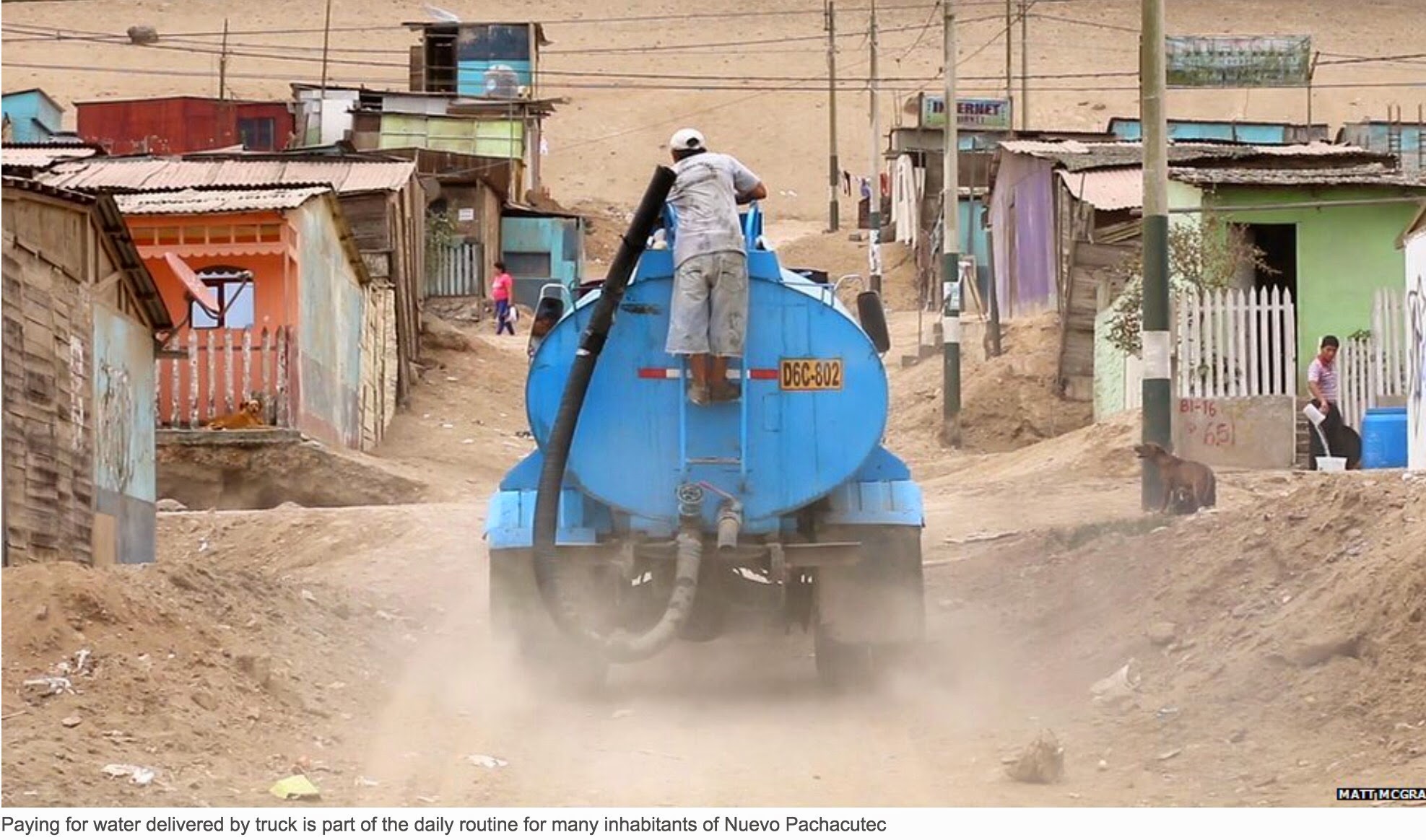
Snarling and screeching, the bouncing water truck speeds backwards down the steep hill, in a cloud of coarse dust.
It halts with a judder and a wild eyed, sweaty man jumps from the cab, grabs a large plastic pipe on the back and starts to fill a series of plastic containers on the ground, with little care.
Dressed in bright pink, a woman looks on nonchalantly.
The man runs up to her and holds out his hand. She drops some coins and away he goes, jumping onto the running board of his vehicle, already snorting its way to the next stop.
This is daily routine for tens of thousands of people who live in this sprawling hillside settlement that looks down on the Pacific Ocean, less than an hour north of Lima, Peru.
Water in Nuevo Pachacutec is not just the vital substance for life, it is a measure of social status and progress.
People first came to these hazy hills in the 1980s, in response to politicians who promised them land in return for votes.
When they first arrived the women said their feet would just sink in the sand. That's all that was here.
The politicians allowed them to take the ground - but most of the 160,000 people here do not have legal title. They are "possessors of the land" but not the owners.
And land is too grand a word. This is really a desert. After Cairo, Lima is said to be the world's second biggest city built in one. Rainfall here amounts to just 50mm of water per year.
A river runs through it
A few kilometres south of Nuevo Pachacutec, a miserable, dirty stream meanders under a motorway.
Bags of rubbish sit alongside the ubiquitous tractor tyres.
This is the Chillon river, the sole water source for around two million people in northern Lima.
The waters of the Chillon are fed by glaciers in the Andes. And this is a source of concern.
"We are worried here in Peru because climate change is already having a huge impact on our access to water," says Armando Mendoza a research officer with Oxfam in the country.
"In the last 40 years, the glacial coverage has retreated by 40% more or less, because of the increase in global warming.
"The predictions are that in the future access to water will become even more difficult and the ones who are most vulnerable to this are the poor."
These longer term water issues with glaciers are not the immediate priority in Nuevo Pachacutec.
As well as the speeding tuktuks, the sandy roads are festooned with signs for car washes, even private schools.
Despite the fact that 80% of the homes are made of wood, incomes and aspirations are rising here.
Access to water is critical in this development, as it is in developing nations all over the world.
With funding from the German government, a green group called Alternativa has helped build networks of white water tanks, connected by underground tubes that bring water directly to the houses.
They have also installed 900 outside water points in this sprawling settlement.
Their efforts to date have brought the vital liquid to 9,000 households.
In this community, water is more than just a key ingredient for life, it is a reflection of harsh social divisions.
The blue barrels
Despite the fact that 80% of the homes are made of wood, incomes and aspirations are rising here.
Access to water is critical in this development, as it is in developing nations all over the world.
With funding from the German government, a green group called Alternativa has helped build networks of white water tanks, connected by underground tubes that bring water directly to the houses.
They have also installed 900 outside water points in this sprawling settlement.
Their efforts to date have brought the vital liquid to 9,000 households.
In this community, water is more than just a key ingredient for life, it is a reflection of harsh social divisions.
Radios and children play loudly on the street where Daniza Cruz Navarro lives.
The homes on this stretch are known as the "casas azules" - the blue houses.
Outside many sit blue plastic barrels, some with lids, some without, that hold the water residents get from the trucks that constantly career about the local roads.
Dogs lap from the open containers. Mosquitoes lay their eggs in the water.
"You can see the effects of the way the water is being stored in the kids' health," says Daniza.
"They often get sick, there is often misuse and mismanagement of the water here."
She has moved on from the blue barrel and is now the owner of a more effective and efficient water tank that she has bought through the efforts of Alternativa.
However, as she still gets water directly from the delivery trucks, she has to pay significantly more than her neighbours.
Daniza says she pays 120 Nuevo Soles (£26; $40) per month for the precious water. This is about 10% of her household income.
Those who are connected to the main water grid pay just 6-12 Soles per month.
These are big sums of money and the differences can be a source of friction between neighbours.
Despite these problems, those who work with the people in Nuevo Pachacutec say progress is being made. It's really a story of local self-empowerment.
"Even if they are not perfect, they have bettered considerably," says engineer Osvaldo Caceres who works with Alternativa.
"This infrastructure is managed by them, for them. The local population know what they want, but they know and understand they have to participate to get it.
Plug and pay
"When we first got here it was all desert - there were no roads, it was pure sand," says Ycella Bonilla a resident of Nuevo Pachacutec.
She stands proudly in the doorway of her recently built bathroom cum laundry room, completed with the help of microfinance.
Ycella calls it her "unit of dignity".
Despite this advance, Ycella and her family are still paying heavily for water. She has a hose and a key that allows her family to plug into a water point. For this she pays 80 Nuevo Soles a month (£18; $27) a month.
Despite the gripes over cost, Ycella recognises that water is the bedrock of development for the community.
"We have roads, we have schools, we have a lot of the basic necessities now, including water."
The struggle for development and the need to have resources like water to empower that development is not just on the minds of those in Nuevo Pachacutec.
An hour down the road in Lima itself, UN climate negotiators are struggling with that same dilemma. How to balance the burgeoning needs of a growing population, with the need to limit those same enriching activities because they threaten the future of the planet.
Osvaldo Caceres says that as in solving the water stresses of Nuevo Pachacutec, the climate battle can be won, by everyone playing their part now. It's no use passing the buck down the generations.
"Every actor in this chain must take responsibility for what they have to do," he says.
"The governments, the authorities, and obviously the people, they all need to act." "There is no other way." More
21 November 2014: The UN Educational, Scientific and Cultural Organization (UNESCO), the Centre for Natural Resources and Development (CRND), the Climate Services Partnership, the International Centre for Integrated Water Resources Management (ICIWaRM) and the government of Flanders, Belgium, organized an international symposium on ‘Building a Community of Practice on Drought Management Tools'.
The meeting aimed to: develop project proposals and solutions to promote international cooperation on drought; and establish a community of practice to share information and develop drought management tools. The community of practice will be integrated into existing regional networks, including: Aridas-Latin America and the Caribbean (LAC); CNRD; the UNESCO Global Network for Water and Development Information in Arid Lands (G-WADI); and Columbia University Global Centres.
ROME, Nov 7 (Thomson Reuters Foundation) - Global ground water supplies, crucial for sustaining agriculture, are being depleted at an alarming rate with dangerous security implications, a leading scientist said.
Cracked ground of the Atibainha dam Brazil
"It's a major cause for concern because most of the places where it (ground water depletion) is happening are major food producing regions," James Famiglietti, a University of California professor who conducts research for the National Aeronautics and Space Administration (NASA), said in an interview with the Thomson Reuters Foundation.
"India is the worst off, followed by the Middle East, and the U.S. is probably number three ... the Chinese, particularly on the north China plain, are more water limited than people believe."
Famiglietti's conclusions are based on his latest research paper "The global ground water crisis" published in the journal Nature Climate Change last month.
The study uses analysis of satellite images to warn that ground water in many of the world's largest aquifers is being exploited at a far faster rate than it can be naturally replenished.
Farming accounts for more than 80 percent of the United States' water use, according to the U.S. Department of Agriculture, and the figures are similar globally.
Famiglietti has been called to the Pentagon a number of times to discuss the potential impact of groundwater scarcity with leading military planners.
Water-related conflicts are already happening, he said, and security experts are bracing for more.
"In 90 percent of the world where there are violent conflicts, there are water scarcity issues," he said.
Water scarcity has been one component driving Syria's civil war, he said. The agricultural sector lacks sufficient water to farm, and a "young generation of unhappy farmers moved to the city and conflict ensued".
Oil-rich, water scarce countries in the Gulf currently rely on desalinated sea water for much of their water consumption.
Some analysts suggest that more countries will embrace energy-intensive desalination, particularly using nuclear technology, if current trends continue.
Famiglietti said this would not be a good option, as it requires too much energy, and won't be able to efficiently provide the volumes of water needed for large-scale agriculture.
Governments first need to acknowledge there is a problem, he said, and then factor scarcity into pricing, while investing in conservation and new technologies to promote efficiency. More
We need a single post-2015 Sustainable Economic and Social Development Goal for Water with four concrete targets responding to the major challenges: access to truly safe water for basic needs, access to decent sanitation, primary treatment of all wastewater (see my previous post), and, last but not least, rebalancing overdraft of freshwater.
I made my proposals already on several occasions and would like to use this platform to bring them to the attention of an even wider group of people. They are based on a broad consultationearlier this year and then further developed in many discussions with persons from civil society, private sector and government. A single goal for water with four concrete targets as part of the Post-2015 UN Sustainable Development GoalsThe discussion on the post-2015 Goals is ongoing both in New York and in capitals of UN member countries.
The proposals of a single water goals with the four targets as specified below need, if you agree with them, your support whenever and wherever possible
1) Water as a human right – implement the universal accesses to safe drinking water bringing ‘improved’ water to all people by 2025 at the latest, with a parallel focus and longer-term perspective (i.e., beyond 2025) on quality, i.e., moving from an ‘improved’ water perspective to ‘truly safe drinking water’, and on bringing this water actually to the homes of individual citizens. While it is essential for achieving this target that infrastructure costs (including capital costs) are fully covered, water to cover the very basic needs must be free for those who are unable to pay
2) Accelerate the provision of access to improved sanitation to at least 120 million additional people per year, aiming for universal access before 2050. Data on actual improvements achieved show that this is realistically possible; with further strengthened efforts political leaders might aim for even more ambitious targets.
3) Adequate treatment of all municipal and industrial wastewater prior to discharge by 2030. Best practice initiatives and learning to reduce groundwater pollution by agricultural production (traditional, organic, etc.). According to FAO only about half of the 285 cubic-kilometres of wastewater are treated, and only some 10% of treated municipal wastewater is directly re-used. This means there is potential here to close the gap – as outlined in my previous post here on LinkedIn
4) Finally, yet fundamentally, we must address the water overdraft, i.e., bringing freshwater use/waste (initially measured as withdrawals) back into line with sustainable supply (natural renewal minus environmental flows). Without change in the way we are using water today, we risk shortfalls of up to 30% of global cereal production due to water scarcity by 2030. First priority must be on this target 4, if we can’t overcome water overuse, water shortage will impact all other targets above. Cost effective and comprehensive actions are needed, combining the supply side and demand side by increasing the efficiency of water use and managing wastewater as a reusable resource. The 2030 Water Resources Group that I am chairing, a disruptive public-private partnership, is participating in these efforts. But it is an initiative that still needs more support – we are looking for more companies and other stakeholders to join.
Need for reality checks of goals, need for good management, and need for a broader policy context.
All of these targets need to be checked against reality: we did it with data of improvements of the past. But then it is also about good management of their local implementation, rather than solemn declarations, that is what is most needed in the coming years.
And they need to be put in the context of other policies and urgent policy changes:
more efforts to reduce loss and waste of food, again a management task, also with the necessary investment in infrastructure, and more responsibility of consumers in advanced economies;
we must further liberalise international trade (of virtual water) so, water intensive staple food, for instance, can be grown in regions where water is abundant;
land and other property, but also usage rights, for instance private rights to use water particularly of small farmers must be better protected;
and governments must no longer wait and stop mandates and subsidies for biofuels.
Water plays a complex role in society and human life, which makes its management quite challenging. This means further discussion on all the points I’ve made over the past few posts remains necessary. More
After the report on mountaineering and my experiences on the ascent to Mount Aconcagua, I return to the subject of water, and the opportunities and challenges in recycling it.
In earlier posts here I wrote about a very sophisticated system of wastewater recycling in Singapore, which turns it back into drinking water.
And at this year’s Singapore International Water Week, the Californian Orange County received the highest recognition, for a scheme where perfectly treated wastewater is pumped back into underground aquifers, to be later pumped up again as drinking water. It also serves as a barrier to seawater intrusion.
These two examples, especially Singapore, are probably the most far-reaching examples I know of achievement in water recycling.
Places like San Diego, hit by a drought, are now re-considering again the idea to follow the Singapore example, despite some opposition from civil society. So, to what extent is it possible to scale up these kinds of activities globally; is there potential for wastewater to contribute in a substantial way to closing the gap of some 300 cubic kilometres between the level of water withdrawals and sustainable supply?
Estimates show close to 300 cubic kilometres of wastewater is generated by municipalities per year (average 2003-12). This is the equivalent of some 50% of global average annual withdrawals for household use.
Part of the other 50% of withdrawals not counted as ‘wastewater’ may well be lost in leakage in pipes (in some countries this accounts for up to 70% of the water withdrawn by the municipal water supply schemes). Another part could be ‘used’ through evapotranspiration in lawns and gardens, etc.
As the table below shows, only about half of this wastewater is actually collected and treated, but less than 10% of the treated wastewater is directly reused.
Table 1: Municipal wastewater generation and treatment data 2003-2012, country groups by income per capita
Source: FAO aquastat
To get an idea of how municipal water could contribute to closing the gap between withdrawals and sustainable supply, let me go through the water supply chain.
The first step would require a better understanding of what happens with the 50% of municipal water apparently ‘disappearing’. Where this is down to leakage, governments have to set the right incentives so municipal water authorities address the issue.
One way proposed by the 2030 Water Resources Group (2030 WRG) in South Africa, which has been implemented by the government there, is to measure both water delivery and water intake, and to pay a premium to the schemes where the difference (i.e., water unaccounted for) gets smaller.
According to 2030 WRG cost-curve estimates, the cost savings would by far exceed the necessary spending to reduce the leakage.
As part of my proposals for targets within the water goal for post-2015 sustainable development, I suggest primary treatment of all wastewater by 2030 - an idea I will come back to in a later post.
So, what happens with 285 km³ of estimated wastewater generated, and what needs to be done? We will first have to increase collection, particularly in economically deprived areas, to make sure wastewater is collected and available for proper treatment.
Actually, only 36% of the world’s population has a sewage connection; this leaves 4.6 billion people unconnected. According to a WHO study, initial investment to set up a sewer connection is about USD 170 per capita; so the investment cost to connect them would be somewhere close to USD 800 billion. The annual cost of capital, repayment and operating cost is estimated at USD 1 per m³.
Next: treatment of both the up-to-now untreated collected – and the newly collected – wastewater. Estimates amount to USD 0.35 per m³. A big part of this cost is energy, an often forgotten link in the water-food-energy nexus framework.
And last but not least: less than 10% of treated wastewater is used directly. This can and must be increased. Direct use is, for instance, the Singapore approach, bringing treated water back to consumers as so-called ‘NEWater’.
Another example is Australia: around 1.4 cubic kilometers of municipal wastewater are treated, of which 0.4 cubic kilometers are used directly, mostly in agriculture.
At Nestlé we have a similar approach. All our factories treat wastewater (in fact the first wastewater treatment plant in the group was built in the 1930s, so we understood the need for this very early) and as much of this treated wastewater as possible is used directly.
At the same time, we should keep in mind indirect use, even though it’s often difficult to measure. Treated wastewater is returned to rivers and then often withdrawn again and treated further for human consumption.
One might, for instance, assume that a significant part of the water in the River Thames, once it reaches London, is treated wastewater from communities further up the river. Increasing the share of direct use of wastewater should clearly be encouraged – in a form accepted by local communities.
So, all in all there are some significant opportunities to use treated wastewater as a resource, helping to close the gap between freshwater withdrawals and sustainable supply. But these opportunities need to be carefully evaluated, to make sure they are fully accepted, but also cost and energy effective when compared to other solutions. Via Peter Brabeck-Letmathe - Linkedin More

 © Climate War Room