Water Security is National Security

Water resources and how they are managed impact almost all aspects of society and the economy, in particular health, food production and security, domestic water supply and sanitation, energy, industry, and the functioning of ecosystems. Under present climate variability, water stress is already high, particularly in many developing countries, and climate change adds even more urgency for action. Without improved water resources management, the progress towards poverty reduction targets, the Millennium Development Goals, and sustainable development in all its economic, social and environ- mental dimensions, will be jeopardized. UN Water.Org

Showing posts with label rains. Show all posts

Thursday, January 1, 2015

Behind the veil of the Islamic State is a war for water

A little known fact of the war in Syria is that it started at the end of the worst drought in Syrian history, a biblical drought which forced over 1 million farmers into the cities.

Pulitzer Prize-winner Thomas L. Friedman interviewed Syrian refugees and farmers in Syria about the link between this drought and the start of the civil war. He comes to the conclusion that the drought certainly played some role and was probably a key tipping point for a bad situation to turn into a full scale war. In the documentary “Years of living dangerously” we see how wiki-leaked diplomatic cables and high level US officials such as Condoleezza Rice acknowledge this link.
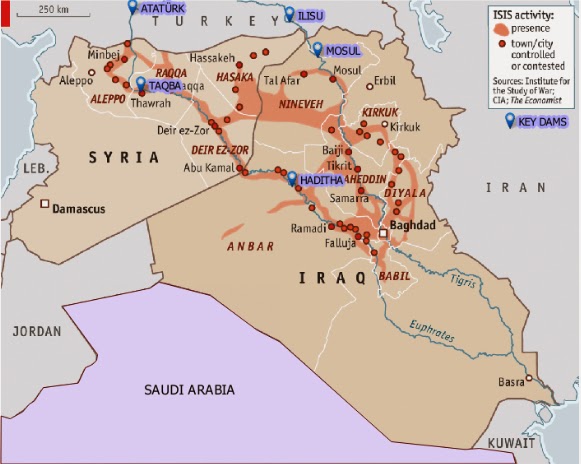
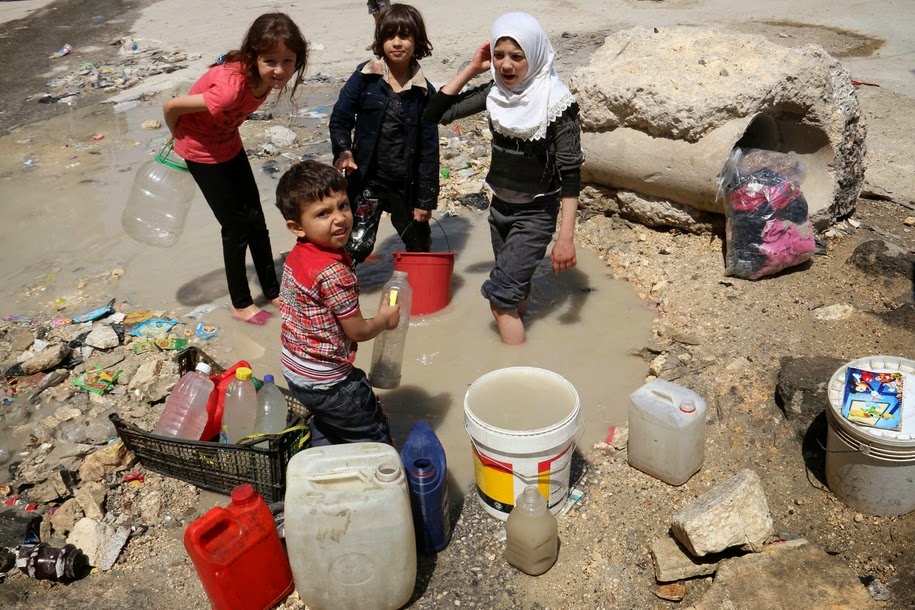
But there’s a lot more happening to explain why behind the veil of a quest for an Islamic State (IS), there’s also a war for water in Syria and Iraq. Making the plight of citizens worse is the continued targeting of water supply networks by both regime and opposition forces, which have attacked strategic lifelines, such as water channels, to gain control of territory and to punish and put pressure on their opponents.

Opening the flood gates …

The Islamic State’s quest for hydrological control began in Syria, when it captured the Tabqa Dam in 2013. Rebel-held areas had been systematically denied electricity by President Bashar al-Assad’s forces in their effort to turn the population against the insurgency. The Tabqa Dam was built more than 40 years ago with Russian help and aimed to make Syria self-sufficient in energy production. Behind the dam is Lake Assad, which provides millions of Syrians with drinking water and is a vital irrigation source for farms. After the capture of the dam, IS opened the flood-gates to get maximum electricity supply for the areas they control and win favour with the local population. As a result, the lake dropped six metres, to a record low in May, which worsened the plight of millions of already destitute Syrians as severe water cuts began to hit Aleppo province.
Conflict over the water flowing though the Euphrates and Tigris is of course nothing new and predates religious wars. They were the first rivers to be used for large scale irrigation, in the region once known as the Fertile Crescent. Somewhere between 1720 and 1684 BC, a grandson of Hammurabi dammed the Tigris to prevent the retreat of rebels led by Iluma-Ilum, who declared the independence of Babylon. The Euphrates was already used as a weapon somewhere around 2500 BC, in another fight for Babylon, when the king of Umma cut the banks of irrigation canals alongside the Euphrates dug by his neighbor, the king of Girsu.

The Euphrates and Tigris are the two major and longest rivers in the Middle East. They both originate in Turkey. The Euphrates flows through Syria and Iraq to reach the Persian Gulf while the Tigris flows through Kurdish territory, meeting up with the Euphrates in the Southern Mesopotamian Marshes of Iraq. There are currently at least 46 dams in the Tigris-Euphrates basin, with at least 8 more planned or under construction. These dams have become key pieces of geo-political control in the region.

… and shutting down the flows

While one act of war is opening the flood gates, another is closing them. In 1974, Iraq threatened to bomb the same Tabqa Dam in Syria, alleging that the dam had reduced the flow of Euphrates River water to Iraq. But between then and now, Turkey, through its position upstream, has taken over as the most powerful regional commander of water, by completing the giant Ataturk Dam. In 1990 Syria and Iraq protested that Turkey now has a weapon of war: by closing the gates they could leave them dry. They had good reason to protest. In mid-1990 Turkish president Turgut Özal threatened to restrict water flow to Syria to force it to withdraw support for Kurdish rebels operating in southern Turkey.

In April 2014, the Islamic State blamed the low water levels in Lake Assad to Turkey’s closure of the Ataturk Dam. Sources found by Al Jazeera said that these claims are disputed. But even if the allegations are only partly true: they were used by the Islamic State to issue threats to ‘liberate Istanbul’, if that was necessary. So while Turkey, IS and Assad fight over water, millions of ordinary Syrians and Iraqi’s see their water levels drop dramatically. Not just by a new drought, with rainfall down by 50-85 percent since October 2013, but mostly due to a power struggle.

Tensions over water control in the region are set to heat up further if Turkey completes the Ilisu Dam on the Tigris River near the border of Syria. The Ilisu Dam will generate 1,200 MW and is part of the vast and ambitious Southeastern Anatolia Project, known as GAP after its Turkish title (Guneydogu Anadolu Projesi): a network comprising 22 dams and 19 power plants. The Ilisu reservoir will flood 52 villages and 15 towns, including Hasankeyf, a Kurdish town of 5,500 people, which is the only town in Anatolia that has survived since the Middle Ages and is under archaeological protection. It will displace approximately 16,000 people in the troubled Kurdish region.

The World Bank (WB), the British construction company Balfour Beatty and the Italian company Impreglio have all withdrawn from the problematic project. So have international funds and export credit from Austria, Germany and Switzerland. However, the project is currently funded by Turkish banks. Iraq and also Syria will be the most heavily impacted if the dam and others go through, with the most extreme projections holding that, owing to a combination of climate change and upstream dam activity, the Tigris and Euphrates rivers won’t have sufficient flow to reach the sea by as early as 2040.

If you live in Syria or Iraq and the water irrigating your field stops coming you might join the ranks of any army promising to attack those who kept the water for themselves – no matter if they tell you the truth or not. As is often the case in conflicts or epidemics it is not the facts themselves that count most but what people believe to be the facts. Those who can convince it’s the enemies fault that there’s not enough water will have the key to where the hearts and minds of the people will go to – no matter what the facts are.

The US finally finds a Weapon of Mass Destruction in Iraq

The Tabqa Dam is not the only dam attacked by IS. They are also trying to take the Haditha Dam, the second-largest in Iraq, raising the possibility of catastrophic damage and flooding. On Sunday, the US was bombing IS positions close to the dam. The IS militants are also fighting for control of the Euphrates River Dam, about 120 miles northwest of Baghdad and government forces were fighting to halt their advance. Insurgents from IS seized the Falluja Dam in Iraq in February and closed the floodgates to cause upstream flooding and to cut downstream water supply. Some 40.000 people were displaced just to flood the area around the city of Falluja to force government troops to retreat and lift a siege, while cutting water supplies and hydroelectricity generation for other parts of the country. All that was peanuts compared to what IS did next.

On August 7 IS captured the 1GW Mosul Dam on the Tigris – sending shock waves through Bagdad, Kuwait and the US. Whoever controls the Mosul Dam, the largest in Iraq, controls most of the country’s water and power resources. Located on the Tigris River upstream of Mosul, the dam, 3.6 km long and with 320 MW of capacity daily, formerly known as the Saddam dam, was built beginning in 1980 at a cost of 1.5$ billion USD, to bolster the regime during the Iran-Iraq war by a German-Italian consortium that was led by Hochtief Aktiengesellschaft. Its construction submerged many archaeological sites in the region yet more troubling is that because the dam was constructed on a foundation of soluble gypsum, it requires continuous grouting of the dam’s foundation to promote stability. Due to the engineering problems it presents it has been described recently by US engineers as “the most dangerous dam in the world.” And that was before the “most dangerous terror group ever” captured it.

A senior U.S. administration official said that “The failure of the Mosul Dam could threaten the lives of large numbers of civilians, threaten U.S. personnel and facilities – including the U.S. Embassy in Baghdad – and prevent the Iraqi government from providing critical services to the Iraqi populace,” (Source: Reuters). A 2006 U.S. Army Corps of Engineers report obtained by the Washington Post said the dam, which blocks the Tigris and holds 12 billion cubic meters of water, could flood two cities killing over a half a million people if it were destroyed or collapsed. The tsunami going to Mosul, a city of 1.7 million people, can be 20m high if the dam breaks with a full reservoir.

But even without a catastrophic failure, the dam is already at the epicenter of the war. Soon after the Islamic State captured the Mosul Dam they cut supplies to some villages in the north of the country that have not joined their cause. Recapturing this instrument of war was a sufficient reason for US forced to deploy air power to support Kurdish forces to recapture the dam. Saving the Yazidis from their mountain captured most media attention, but a key reason for the US to bomb Iraqi soil for the first time since 2011 was the fact that IS took the Mosul Dam. After bombing IS positions for several days, freshly re-equipped Kurdish fighters recently regained control of the dam.

Mega Dams & Water Management Practices

The importance of hydro-infrastructure in these battles and how it can be wielded firstly underlines the need for a serious re-appraisal of water management practices. Big dams (with funding from Multilateral agencies such as the WB, national and regional development banks, private equity and pension funds as well as from the Clean Development Mechanism, etc.) cause large scale displacement of populations, are ecologically destructive, wash away any other source of livelihood, and often saddle countries with debt while performing well below planned outputs as regards electricity generation. Moreover, compounded by climate change, contemporary ecological crises are leading to ever more conflict over trans-boundary water rights, such as for example between Ethiopia and Egypt, which are also on the verge of war over the construction of the Grand Renaissance and Gibe 3 dams, which would become Africa’s tallest. The world’s Big Dam Fan Club should take note of what has just happened in Syria and Iraq and realise that once disaster hits, hatred will not go to any God but to those who constructed the weapon of mass destruction. Water, rather than oil, is shaping up to be the key strategic resource in the region. More


Friday, November 21, 2014

IWMI Launches Book on Developing Water-Related SDGs


IWMI logo20 October 2014: The International Water Management Institute (IWMI) has released a book, titled ‘On Target for People and Planet: Setting and Achieving Water-Related Sustainable Development Goals (SDGs),' which highlights that framing water-related SDGs in a water security context provides a more comprehensive framework than the human-needs approach of the Millennium Development Goals (MDGs).


The book calls for: recognizing economic water scarcity; balancing development and conservation needs; and exploring pragmatic solutions. The book also identifies four key challenges: development of broad partnerships within the water sector and beyond; accommodation of growth requirements particularly in Asia and Africa; large-scale investments in water resources and agriculture need to complement, rather than undermine small-scale producers; and integration of policies for coherent water management across sectors. Next steps are also identified in the book: supporting governments to set national targets; achieving water and food security-related SDGs; and measuring and tracking progress.


The book includes chapters on: water-food-energy nexus; water governance; water metrics; social inclusion; sustainable development and ecosystem services; managing water variability; water quality; and accessing and putting water to productive use in Sub-Saharan Africa. [Publication: On Target for People and Planet: Setting and Achieving Water-Related SDGs] More


Thursday, November 20, 2014

Wells Dry, Fertile Plains Turn to Dust

HASKELL COUNTY, Kan. — Forty-nine years ago, Ashley Yost’s grandfather sank a well deep into a half-mile square of rich Kansas farmland. He struck an artery of water so prodigious that he could pump 1,600 gallons to the surface every minute.

Last year, Mr. Yost was coaxing just 300 gallons from the earth, and pumping up sand in order to do it. By harvest time, the grit had robbed him of $20,000 worth of pumps and any hope of returning to the bumper harvests of years past.

“That’s prime land,” he said not long ago, gesturing from his pickup at the stubby remains of last year’s crop. “I’ve raised 294 bushels of corn an acre there before, with water and the Lord’s help.” Now, he said, “it’s over.”

The land, known as Section 35, sits atop the High Plains Aquifer, a waterlogged jumble of sand, clay and gravel that begins beneath Wyoming and South Dakota and stretches clear to the Texas Panhandle. The aquifer’s northern reaches still hold enough water in many places to last hundreds of years. But as one heads south, it is increasingly tapped out, drained by ever more intensive farming and, lately, by drought.

Vast stretches of Texas farmland lying over the aquifer no longer support irrigation. In west-central Kansas, up to a fifth of the irrigated farmland along a 100-mile swath of the aquifer has already gone dry. In many other places, there no longer is enough water to supply farmers’ peak needs during Kansas’ scorching summers.

And when the groundwater runs out, it is gone for good. Refilling the aquifer would require hundreds, if not thousands, of years of rains.

This is in many ways a slow-motion crisis — decades in the making, imminent for some, years or decades away for others, hitting one farm but leaving an adjacent one untouched. But across the rolling plains and tarmac-flat farmland near the Kansas-Colorado border, the effects of depletion are evident everywhere. Highway bridges span arid stream beds. Most of the creeks and rivers that once veined the land have dried up as 60 years of pumping have pulled groundwater levels down by scores and even hundreds of feet.

On some farms, big center-pivot irrigators — the spindly rigs that create the emerald circles of cropland familiar to anyone flying over the region — now are watering only a half-circle. On others, they sit idle altogether.

Two years of extreme drought, during which farmers relied almost completely on groundwater, have brought the seriousness of the problem home. In 2011 and 2012, the Kansas Geological Survey reports, the average water level in the state’s portion of the aquifer dropped 4.25 feet — nearly a third of the total decline since 1996.

And that is merely the average. “I know my staff went out and re-measured a couple of wells because they couldn’t believe it,” said Lane Letourneau, a manager at the State Agriculture Department’s water resources division. “There was a 30-foot decline.”

Kansas agriculture will survive the slow draining of the aquifer — even now, less than a fifth of the state’s farmland is irrigated in any given year — but the economic impact nevertheless will be outsized. In the last federal agriculture census of Kansas, in 2007, an average acre of irrigated land produced nearly twice as many bushels of corn, two-thirds more soybeans and three-fifths more wheat than did dry land.

Farmers will take a hit as well. Raising crops without irrigation is far cheaper, but yields are far lower. Drought is a constant threat: the last two dry-land harvests were all but wiped out by poor rains.

In the end, most farmers will adapt to farming without water, said Bill Golden, an agriculture economist at Kansas State University. “The revenue losses are there,” he said. “But they’re not as tremendously significant as one might think.”

Some already are. A few miles west of Mr. Yost’s farm, Nathan Kells cut back on irrigation when his wells began faltering in the last decade, and shifted his focus to raising dairy heifers — 9,000 on that farm, and thousands more elsewhere. At about 12 gallons a day for a single cow, Mr. Kells can sustain his herd with less water than it takes to grow a single circle of corn.

“The water’s going to flow to where it’s most valuable, whether it be industry or cities or feed yards,” he said. “We said, ‘What’s the higher use of the water?’ and decided that it was the heifer operation.”

The problem, others say, is that when irrigation ends, so do the jobs and added income that sustain rural communities.

“Looking at areas of Texas where the groundwater has really dropped, those towns are just a shell of what they once were,” said Jim Butler, a hydrogeologist and senior scientist at the Kansas Geological Survey.

The villain in this story is in fact the farmers’ savior: the center-pivot irrigator, a quarter- or half-mile of pipe that traces a watery circle around a point in the middle of a field. The center pivots helped start a revolution that raised farming from hardscrabble work to a profitable business.

Since the pivots’ debut some six decades ago, the amount of irrigated cropland in Kansas has grown to nearly three million acres, from a mere 250,000 in 1950. But the pivot irrigators’ thirst for water — hundreds and sometimes thousands of gallons a minute — has sent much of the aquifer on a relentless decline. And while the big pivots have become much more efficient, a University of California study earlier this year concluded that Kansas farmers were using some of their water savings to expand irrigation or grow thirstier crops, not to reduce consumption.

A shift to growing corn, a much thirstier crop than most, has only worsened matters. Driven by demand, speculation and a government mandate to produce biofuels, the price of corn has tripled since 2002, and Kansas farmers have responded by increasing the acreage of irrigated cornfields by nearly a fifth.

At an average 14 inches per acre in a growing season, a corn crop soaks up groundwater like a sponge — in 2010, the State Agriculture Department said, enough to fill a space a mile square and nearly 2,100 feet high.

Sorghum, or milo, gets by on a third less water, Kansas State University researchers say — and it, too, is in demand by biofuel makers. As Kansas’ wells peter out, more farmers are switching to growing milo on dry land or with a comparative sprinkle of irrigation water.

But as long as there is enough water, most farmers will favor corn. “The issue that often drives this is economics,” said David W. Hyndman, who heads Michigan State University’s geological sciences department. “And as long as you’ve got corn that’s $7, then a lot of choices get made on that.”

Of the 800 acres that Ashley Yost farmed last year in Haskell County, about 70 percent was planted in corn, including roughly 125 acres in Section 35. Haskell County’s feedlots — the county is home to 415,000 head of cattle — and ethanol plants in nearby Liberal and Garden City have driven up the price of corn handsomely, he said.

But this year he will grow milo in that section, and hope that by ratcheting down the speed of his pump, he will draw less sand, even if that means less water, too. The economics of irrigation, he said, almost dictate it.

“You’ve got $20,000 of underground pipe,” he said. “You’ve got a $10,000 gas line. You’ve got a $10,000 irrigation motor. You’ve got an $89,000 pivot. And you’re going to let it sit there and rot?

“If you can pump 150 gallons, that’s 150 gallons Mother Nature is not giving us. And if you can keep a milo crop alive, you’re going to do it.”

Mr. Yost’s neighbors have met the prospect of dwindling water in starkly different ways. A brother is farming on pivot half-circles. A brother-in-law moved most of his operations to Iowa. Another farmer is suing his neighbors, accusing them of poaching water from his slice of the aquifer.

A fourth grows corn with an underground irrigation system that does not match the yields of water-wasting center-pivot rigs, but is far thriftier in terms of water use and operating costs.

For his part, Mr. Yost continues to pump. But he also allowed that the day may come when sustaining what is left of the aquifer is preferable to pumping as much as possible.

Sitting in his Ford pickup next to Section 35, he unfolded a sheet of white paper that tracked the decline of his grandfather’s well: from 1,600 gallons a minute in 1964, to 1,200 in 1975, to 750 in 1976.

When the well slumped to 500 gallons in 1991, the Yosts capped it and drilled another nearby. Its output sank, too, from 1,352 gallons to 300 today.

This year, Mr. Yost spent more than $15,000 to drill four test wells in Section 35. The best of them produced 195 gallons a minute — a warning, he said, that looking further for an isolated pocket of water would be costly and probably futile.

“We’re on the last kick,” he said. “The bulk water is gone.” More


Thursday, November 13, 2014

Drought Is Taking California Back to the Wild, Wild West

Mary Madden feels paranoid. Last fall Madden noticed something suspicious. The water filling the tanks outside her veterinary clinic in Los Gatos, Calif., was disappearing at an alarming rate. Madden checked for leaks but found none. Then she realized: Someone was stealing her water.

"I just couldn't believe it," she said. "You never imagine anyone would do something like that but there it was, vanishing right before our eyes."

Madden decided to act. She installed security cameras. Then she put locks on the tanks. She even strung a chain across her driveway to keep out unwanted visitors. The theft stopped after the locks went on. But Madden never caught the thief, and she can't stop thinking about who did it.

"This is a really small community, so you sit here and start going through everyone you know and wondering if it was them," she said.

Madden is not alone. Water theft has become increasingly common in California as the state suffers through its worst drought on record. There's no reliable tracking of just how much water has gone missing. But reports of theft rose dramatically in the past year. Officials say a black market set up to peddle water is thriving as wells run dry. And law enforcement is scrambling to respond.

Mendocino County has made catching water thieves a top priority. The sheriff's office set up a water-theft hotline and investigates every tip. It also puts out patrols to sniff out suspicious activity.

In August, a sheriff's deputy there followed a trail of water droplets up a dirt road where he discovered a truck outfitted with a water tank. A confession came quickly. The driver had siphoned water from a nearby canal and planned to sell it to the highest bidder.

The Public Works Department in Lemoore, in Kings County, hired someone to scan city streets for thieves after officials found evidence that someone has been stealing water from fire hydrants.

For now, a statewide effort to curb water theft has yet to materialize. So cities and counties have been left to devise their own methods of retribution.

Officials complain that the penalty for getting caught may not be sufficiently strict: Mendocino County counts water theft as a misdemeanor. County Supervisor Carre Brown considers that a slap on the wrist. "To me this is like looting during a disaster. It should be a felony," Brown said.

Contra Costa County fines anyone caught stealing water $25. Amid worsening theft, the county may soon increase the penalty to $250 and up the amount to $500 for repeat offenders.

But even with all the attention from law enforcement, officials say that much of the theft has gone unpunished.

"This is something that's very hard to pin down. If you don't catch someone in the act, how do you prove they did it?" Mendocino County Sheriff Tom Allman said.

As a result, some California residents have taken matters into their own hands. Online forums and community message boards serve as informal channels where people can post a warning. Word-of-mouth has also proven effective at spreading information.

After Madden told people what had happened, neighbors started to keep an eye on her property. "People will tell me if they see a truck lingering nearby when I'm not there," she said. "We all look out for each other."

Rural communities where residents rely on well water and areas of the state that play host to agricultural operations and illegal marijuana cultivation have been particularly hard hit.

Thousands of gallons of water were stolen from a fire station in North San Juan, a town nestled in the foothills of the Sierra Nevada Mountains, at the height of wildfire season this summer. The theft was discovered after an engineer hit the station's water tank and heard a hollow ringing sound rather than the usual thud.

"We were just absolutely stunned," said Boyd Johnson, a battalion chief with the North San Juan fire department. "Fires are on everyone's mind during the summer so to see this happen, I think it really scared people."

Residents of North San Juan depend on wells for water. The area is also known for growing marijuana and located just a few hours north of California's Central Valley, an area of the state where farmers rely on massive amounts of water to ensure the success of their crops.

This past summer thieves also made off with water from an elementary school and a public health clinic on the San Juan Ridge.

James Berardi, the principal of the school that was hit, says security cameras have been installed in an effort to catch thieves. The fire department is also taking precautions. After the theft, lockboxes with a combination padlock were put on each of the station's water tanks.

"It slows us down a bit getting to the water, but at least we know it's safe," Johnson said.

A growing number of wells have run dry on the ridge as the drought drags on. And that, according to Caleb Dardick, a resident of nearby Nevada City, means the theft is unlikely to end anytime soon.

"People are becoming desperate," Dardick said. "The situation has become really severe in the last few years."

All this has made water a chief concern for residents of the state who say they never used to give water a second thought.

"I think about water constantly, obsessively," Madden said. "I wake up every day dreading what might happen if we run out." More


Tuesday, September 16, 2014

Wastewater recycling, part of the solution to water shortage?

After the report on mountaineering and my experiences on the ascent to Mount Aconcagua, I return to the subject of water, and the opportunities and challenges in recycling it.

In earlier posts here I wrote about a very sophisticated system of wastewater recycling in Singapore, which turns it back into drinking water.

And at this year’s Singapore International Water Week, the Californian Orange County received the highest recognition, for a scheme where perfectly treated wastewater is pumped back into underground aquifers, to be later pumped up again as drinking water. It also serves as a barrier to seawater intrusion.

These two examples, especially Singapore, are probably the most far-reaching examples I know of achievement in water recycling.

Places like San Diego, hit by a drought, are now re-considering again the idea to follow the Singapore example, despite some opposition from civil society. So, to what extent is it possible to scale up these kinds of activities globally; is there potential for wastewater to contribute in a substantial way to closing the gap of some 300 cubic kilometres between the level of water withdrawals and sustainable supply?

Estimates show close to 300 cubic kilometres of wastewater is generated by municipalities per year (average 2003-12). This is the equivalent of some 50% of global average annual withdrawals for household use.

Part of the other 50% of withdrawals not counted as ‘wastewater’ may well be lost in leakage in pipes (in some countries this accounts for up to 70% of the water withdrawn by the municipal water supply schemes). Another part could be ‘used’ through evapotranspiration in lawns and gardens, etc.

As the table below shows, only about half of this wastewater is actually collected and treated, but less than 10% of the treated wastewater is directly reused.

Table 1: Municipal wastewater generation and treatment data 2003-2012, country groups by income per capita

Source: FAO aquastat


To get an idea of how municipal water could contribute to closing the gap between withdrawals and sustainable supply, let me go through the water supply chain.

The first step would require a better understanding of what happens with the 50% of municipal water apparently ‘disappearing’. Where this is down to leakage, governments have to set the right incentives so municipal water authorities address the issue.

One way proposed by the 2030 Water Resources Group (2030 WRG) in South Africa, which has been implemented by the government there, is to measure both water delivery and water intake, and to pay a premium to the schemes where the difference (i.e., water unaccounted for) gets smaller.

According to 2030 WRG cost-curve estimates, the cost savings would by far exceed the necessary spending to reduce the leakage.

As part of my proposals for targets within the water goal for post-2015 sustainable development, I suggest primary treatment of all wastewater by 2030 - an idea I will come back to in a later post.

So, what happens with 285 km³ of estimated wastewater generated, and what needs to be done? We will first have to increase collection, particularly in economically deprived areas, to make sure wastewater is collected and available for proper treatment.

Actually, only 36% of the world’s population has a sewage connection; this leaves 4.6 billion people unconnected. According to a WHO study, initial investment to set up a sewer connection is about USD 170 per capita; so the investment cost to connect them would be somewhere close to USD 800 billion. The annual cost of capital, repayment and operating cost is estimated at USD 1 per m³.

Next: treatment of both the up-to-now untreated collected – and the newly collected – wastewater. Estimates amount to USD 0.35 per m³. A big part of this cost is energy, an often forgotten link in the water-food-energy nexus framework.

And last but not least: less than 10% of treated wastewater is used directly. This can and must be increased. Direct use is, for instance, the Singapore approach, bringing treated water back to consumers as so-called ‘NEWater’.

Another example is Australia: around 1.4 cubic kilometers of municipal wastewater are treated, of which 0.4 cubic kilometers are used directly, mostly in agriculture.

At Nestlé we have a similar approach. All our factories treat wastewater (in fact the first wastewater treatment plant in the group was built in the 1930s, so we understood the need for this very early) and as much of this treated wastewater as possible is used directly.

At the same time, we should keep in mind indirect use, even though it’s often difficult to measure. Treated wastewater is returned to rivers and then often withdrawn again and treated further for human consumption.

One might, for instance, assume that a significant part of the water in the River Thames, once it reaches London, is treated wastewater from communities further up the river. Increasing the share of direct use of wastewater should clearly be encouraged – in a form accepted by local communities.

So, all in all there are some significant opportunities to use treated wastewater as a resource, helping to close the gap between freshwater withdrawals and sustainable supply. But these opportunities need to be carefully evaluated, to make sure they are fully accepted, but also cost and energy effective when compared to other solutions. Via Peter Brabeck-Letmathe - Linkedin More


Monday, May 19, 2014

The California Drought Is Far From Over, And The Entire State Is Suffering

For a few days last month, it rained in San Francisco. Residents across the city cheered a welcomed respite from a drought that has crippled California for more than two years -- but the celebration turned out to be premature.

On Thursday, for the first time this century, the U.S. Drought Monitor declared that all of California is in a “severe” drought, with many areas of the state in an even worse condition, from "extreme" to "exceptional," the poorest possible rating.

“This is a once-in-a-generation conversation,” Mark Svoboda, a climatologist at the National Drought Mitigation Center, told The Huffington Post. He added that the last time California experienced comparable conditions was in the mid-1970s.

“The state has doubled its population between then and now,” Svoboda said. “You’ve got a lot more people using a relatively finite amount of water.”

The map below, courtesy of the U.S. Drought Monitor, shows the varying levels of drought throughout California. The orange represents “severe,” the red is “extreme,” and the maroon is “exceptional” -- the agency’s highest level (Story continues below):

No area of the state is feeling the effects of the drought more harshly than San Diego, where wildfires have ripped through more than 10,000 acres of land and tens of thousands of residents have been forced to evacuate. “In a drought, the biggest threat to health and human safety is wildfire,” Doug Carlson, an information officer at the California Department of Water Resources, told HuffPost.

And there doesn’t appear to be an end in sight. “The drought has set the stage for a very busy, very long, potentially very dangerous fire season,” Daniel Berlant, a spokesperson for CAL FIRE, said to HuffPost. “As we move into the more traditional summer months, the days are only going to get longer, and the temperatures are only going to get higher.”

California’s wildfire season usually peaks during summer and fall months and then tapers during the typically rainy winter. But the drought has turned wildfires into a year-round issue. “With that lack of rain, the grass, brush and trees really have been tinder-dry all year long,” Berlant explained, noting such conditions help flames flourish.

Svoboda added that the state’s hot, dry surface leads to a hot, dry, atmosphere, which creates a prime environment for wildfires to spread. “You also typically see windier conditions,” he added. “These are all things that fires feed on.”

The damage in Southern California has ravaged hills, homes and businesses. Beloved craft brewery Stone Brewing Company evacuated its premises on Thursday. On Wednesday, KTLA senior producer Marcus Smith tweeted a widely-recirculated photo of a “firenado,” a dangerous phenomenon caused by strong winds whipping spirals of fire into the air. More


Saturday, January 18, 2014

Water security in the Kingdom of Saudi Arabia … a far-fetched dream?

DAMMAM – Environmental and water experts have warned that water security might be a far-reaching dream for the Kingdom.
Limited water resources such as groundwater are being depleted by greedy farmers who care about nothing but profits, they said. The claimed nuclear energy can help desalinate seawater and save the country from a looming disaster that future generations will experience. Al-Riyadh daily asked the experts about the challenges the state faces in ensuring water security.

Precious resource

Dr. Asad Abu Ruzaizah, president of the Saudi Society for Environment Sciences, said the country is running out of groundwater at an alarming rate. He stressed the important role citizens can play to mitigate the enormity of the problem and conserve this valuable resource. “Some people are not really aware that we have a water security problem,” Ruzaizah said. “The government spends a huge amount of money on the desalination process but this causes a tremendous negative effect on the environment.
“Moreover, strategic water reserves are poor in the Kingdom and other GCC countries and this fact makes the water problem a huge challenge for these countries.
“We have a poor water authority and low awareness levels regarding the importance of saving water. “More funding should go into developing and managing water resources and searching constantly for new sources.
“The water authority and other water agencies should be developed to deal better with this issue and achieve sustainable development for the next generation.”

New regulations to manage current reserve

Dr. Muhammad Al-Ghamdi, professor of King Faisal University’s School of Agricultural Sciences, disagrees with Ruzaizah. “Everyone is saying let’s find new water resources instead of searching for regulations that can lead to the wise management of current resources,” Al-Ghamdi said. “Unfortunately, there are no clear plans, programs, or strategies to help us achieve water security.” He said he wondered how this problem would be solved while farmers, led by greed, continue to waste groundwater and mismanage limited water resources. “The sad thing is facts and statistics indicate that our groundwater problem is getting worse every year. “I’m worried the next generations will encounter insurmountable problems solving this issue.”
Dr. Ali Ishqi, ecology professor at King Abdulaziz University, said the Arabian Peninsula has a severe water shortage. Ninety percent of its area is barren desert land while green areas account for 2 percent of the total area. Ishqi believed that mismanagement of water resources has largely exacerbated groundwater shortages.
He said the only strategy that can end this looming crisis is to make use of nuclear energy.
“The use of nuclear reactors is the best choice for seawater desalination.
“Solar energy is not. “To meet the water needs of a small city population, you will need to have so many solar cells on a very large area.”

Rainwater harvesting is the solution

Abdullah Al-Rasheed, economist, said the only option available to solve this crisis is to set up a national authority for rainwater harvesting, where rainwater is collected and used for irrigation, drinking, and other purposes. The next upcoming war will be for water, Al-Rasheed claimed.
He quoted a feature that National Geographic carried a while ago on the water issue.
The Kingdom’s groundwater resources used to stand at 500 cubic kilometers 40 years ago, according to the feature. So far the country has used 400 cubic kilometers, which means that one generation has consumed 80 percent of the country’s resources. The feature said the Kingdom now has no choice but to use seawater because the remaining groundwater will probably be consumed in a few years. Al-Rasheed said he hoped that the statistics mentioned in the feature were not true. “One thing remains true: we have squandered our groundwater and used it for farming purposes. “There is no point now of crying over spilled milk. “It’s high time we utilized rainwater.”
Al-Rasheed said every year there is 150 billion to 250 billion cubic meters of rainfall in the Kingdom, while the amount of desalinated water the public consumes annually is 3 billion. “This is a small amount compared to the huge quantity of rainwater available for us.” More


Saturday, June 8, 2013

Greece suffers critical water shortages


Uploaded on Jun 8, 2013

Water shortages are reaching critical levels for farmers in central Greece.

A million people's livelihoods and two ecosystems hang in the balance.

Al Jazeera's John Psaropoulos reports from the Thessaly plain of central Greece
.

Sunday, May 19, 2013

Saturday, May 18, 2013

Saturday, March 23, 2013

Ancient aqueducts [karez] give Iraq a trickle of hope

A millennia-old labyrinth of underground canals may help solve the Middle East's water crisis, say experts.

The ancient karez in Kunaflusa

In the windswept plateaus of northern Iraq, unseen aqueducts which have channelled water to arid settlements for centuries are running dry. Experts say the wide-scale demise of these ancient water systems is an ominous sign of how scarce water in the region will soon become, and the humanitarian disasters that could follow.

For villagers here, tragic consequences have already arrived.

Farez Abdulrahman Ali strides across a muddy field and sweeps a burly arm towards the mountains that loom over Shekh Mamudian village in the wilds of Iraq’s semi-autonomous Kurdistan region. This is the rugged terrain of the peshmerga, the Kurdish military whose name means "those who face death".

Ali explains that a subterranean canal - known in Iraq as a karez - once brought water to the village, where it gushed from a rock-lined tunnel into a pool just below the entrance to the local mosque. From there, it was channelled to nearby fields of okra, eggplant, onion and tobacco.

"Farmers would use the water," said Ali. "On hot days, children would play in the water. In the evenings, people would gather at the karez to talk about village things."

"The karez dates back to the time when karez were dug," he added, matter-of-factly. "Nobody in the village knows when it was dug. Even my grandfather doesn't know. It is probably 800 or 900 or 1,000 years old."

"There is now not enough water for farming. If the karez runs dry,

we will be forced to leave the village." - Fadel Salah, Kunaflusa villager

Dry county

In autumn 2011, for the first time in the village's collective memory, the karez in Shekh Mamudian went dry. As the village chief, or mukhtar, Ali sees the loss of the karez as catastrophic for the livestock and crops the village depends on for its hard won self-sufficiency. Unless it is restored, he fears for the end of a community that withstood assaults by Saddam Hussein’s army in the 1980s, and survived as a bloody no-man's land in the Kurdish civil war of the mid-1990s.

"The karez was the source of life," Ali said. "The village now feels like a family that has lost its father."

Echoes of Ali’s lament are being heard throughout the arid mountains and plains of Kurdistan, where the widespread demise of karez is becoming a humanitarian nightmare.

Last year, an inventory of karez systems in Kurdistan - believed to be the first such compiled in modern times - found that decades of war and years of grinding drought, combined with neglect and over-pumping from nearby mechanised wells, had brought these vital water lifelines to the edge of extinction.

According to a UNESCO report, just 116 of the 683 karez networks located in northern Iraq were still supplying water as of August 2009. As many as 40 per cent of the region's karez have dried up in the past four years alone.

Since 2005, more than 100,000 people have been forced to abandon their homes because their karez stopped flowing, and a further 36,000 are at immediate risk of evacuating their villages, according to the UN agency.

Parched land

In Kunaflusa, a rocky 90-minute drive north of Erbil, the village karez was last year producing only a trickle. Village mukhtar Fadel Abdullah Salah said families were allotted one-hour time slots to fill up enough water jugs to last a week.

"There is not enough water now for farming," said Salah. "If the karez runs dry, we will be forced to leave the village."

Water brought in tanker trucks by the Kurdistan Regional Government has helped the people of Kunaflusa. But experts say quick fixes such as hauling in water or drilling new, gas-fuelled wells are expensive band-aids that will ultimately prove unsustainable.

Salah said the village had some 200 houses in 1984, but today only 13 remain occupied. The UN report found that, on average, 70 per cent of residents moved away from their villages after the local karez went dry. More


Tuesday, March 19, 2013

World Water Day 2012 official video

World Water Day 2012 official video, focusing on the theme of the campaign "Water and Food Security".

Produced by kf@kantfish.com and featuring a soundtrack by DDG Project. Animations by antiestatico.com
Download your animation on: http://www.unwater.org/worldwaterday

Saturday, February 2, 2013

5 Sobering Realities About Global Water Security

Some people say that water is the oil of the 21st Century. If only water were that simple.

Water is very complicated. It’s affected by large-scale issues like climate change and globalization. International commerce moves virtual water (the water it takes to grow or produce a product) from farms in Brazil to grocery stores in China and Egypt.

But water is also inherently local, impacted by site-specific weather, geography, and other environmental and land use conditions. Managing and using water, then, requires understanding it in its full geographic context.

Today, WRI is launching its new Aqueduct mapping tool to do just that. Aqueduct provides businesses, governments, and other decision makers with the highest-resolution, most up-to-date data on water risk across the globe. Armed with this information, these decision-makers can better understand how water risk impacts them—and hopefully, take actions to improve water security.

5 Findings about Water

So, what are these global maps telling us? Here are five immediate conclusions:

  • Water risk has many dimensions. WRI’s Aqueduct tool offers a new way of combining and mapping multiple indicators of water stress. Factors like inter-annual variability, floods, droughts, and groundwater depletion are added to baseline water stress, revealing a richer picture of water stress across the globe. Other important factors related to water quality and reputational risk are also included to help companies and governments understand the full breadth of water risks associated with a particular region or water basin. Not only do these layers enrich the overall picture, they can help inform strategies for improving water security.

  • Water stress is growing worldwide. Our new global Aqueduct maps use the most recent 2010 data (previous maps used data from 2000). The picture that emerges shows that water stress is both more prevalent and more severe than estimated in 2000. The new maps reveal areas of higher water stress on every continent, particularlyin China, South and Central Asia, and Africa.

  • Water stress isn’t just in arid regions anymore. One of the striking things about Aqueduct’s new maps is that many parts of Europe and the U.S. East Coast and upper Midwest now show medium to high levels of water risk. These regions are not arid, yet they still face significant water stress as demand increases and supply is affected by climate change and other factors.

  • High competition and annual variability make for a bad combination. In some areas with elevated water stress—including the U.S. West, Australia, northern China, northwest India, and parts of Pakistan—there is also high variability in available water supply from year to year. In places where demand for water is high relative to the available supply, a greater likelihood of low-water years makes the situation even riskier.

  • Increasing risks to food security. Most of the world’s water is used for agriculture, which accounts for approximately 70 percent of all freshwater withdrawals. Overlaying the world’s major irrigated crop regions on Aqueduct maps reveals that many of these areas already face significant water stress. The situation may become more severe in the future—water stress is likely to grow due to climate change and increased demand for food and water. More