Water Security is National Security

Water resources and how they are managed impact almost all aspects of society and the economy, in particular health, food production and security, domestic water supply and sanitation, energy, industry, and the functioning of ecosystems. Under present climate variability, water stress is already high, particularly in many developing countries, and climate change adds even more urgency for action. Without improved water resources management, the progress towards poverty reduction targets, the Millennium Development Goals, and sustainable development in all its economic, social and environ- mental dimensions, will be jeopardized. UN Water.Org

Showing posts with label precipitation. Show all posts

Thursday, November 13, 2014

Drought Is Taking California Back to the Wild, Wild West

Mary Madden feels paranoid. Last fall Madden noticed something suspicious. The water filling the tanks outside her veterinary clinic in Los Gatos, Calif., was disappearing at an alarming rate. Madden checked for leaks but found none. Then she realized: Someone was stealing her water.
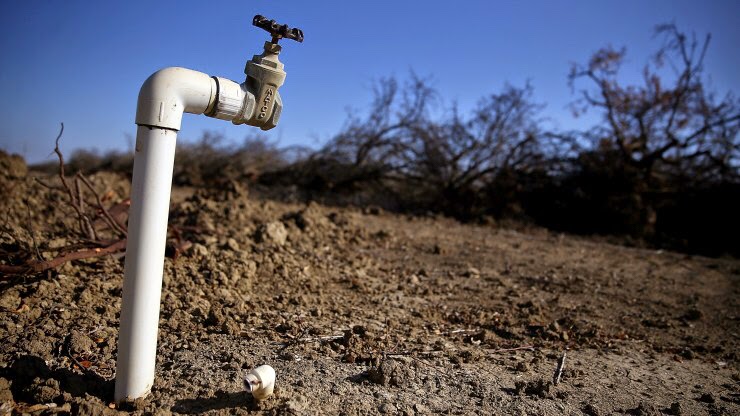
"I just couldn't believe it," she said. "You never imagine anyone would do something like that but there it was, vanishing right before our eyes."

Madden decided to act. She installed security cameras. Then she put locks on the tanks. She even strung a chain across her driveway to keep out unwanted visitors. The theft stopped after the locks went on. But Madden never caught the thief, and she can't stop thinking about who did it.

"This is a really small community, so you sit here and start going through everyone you know and wondering if it was them," she said.

Madden is not alone. Water theft has become increasingly common in California as the state suffers through its worst drought on record. There's no reliable tracking of just how much water has gone missing. But reports of theft rose dramatically in the past year. Officials say a black market set up to peddle water is thriving as wells run dry. And law enforcement is scrambling to respond.

Mendocino County has made catching water thieves a top priority. The sheriff's office set up a water-theft hotline and investigates every tip. It also puts out patrols to sniff out suspicious activity.

In August, a sheriff's deputy there followed a trail of water droplets up a dirt road where he discovered a truck outfitted with a water tank. A confession came quickly. The driver had siphoned water from a nearby canal and planned to sell it to the highest bidder.

The Public Works Department in Lemoore, in Kings County, hired someone to scan city streets for thieves after officials found evidence that someone has been stealing water from fire hydrants.

For now, a statewide effort to curb water theft has yet to materialize. So cities and counties have been left to devise their own methods of retribution.

Officials complain that the penalty for getting caught may not be sufficiently strict: Mendocino County counts water theft as a misdemeanor. County Supervisor Carre Brown considers that a slap on the wrist. "To me this is like looting during a disaster. It should be a felony," Brown said.

Contra Costa County fines anyone caught stealing water $25. Amid worsening theft, the county may soon increase the penalty to $250 and up the amount to $500 for repeat offenders.

But even with all the attention from law enforcement, officials say that much of the theft has gone unpunished.

"This is something that's very hard to pin down. If you don't catch someone in the act, how do you prove they did it?" Mendocino County Sheriff Tom Allman said.

As a result, some California residents have taken matters into their own hands. Online forums and community message boards serve as informal channels where people can post a warning. Word-of-mouth has also proven effective at spreading information.

After Madden told people what had happened, neighbors started to keep an eye on her property. "People will tell me if they see a truck lingering nearby when I'm not there," she said. "We all look out for each other."

Rural communities where residents rely on well water and areas of the state that play host to agricultural operations and illegal marijuana cultivation have been particularly hard hit.

Thousands of gallons of water were stolen from a fire station in North San Juan, a town nestled in the foothills of the Sierra Nevada Mountains, at the height of wildfire season this summer. The theft was discovered after an engineer hit the station's water tank and heard a hollow ringing sound rather than the usual thud.

"We were just absolutely stunned," said Boyd Johnson, a battalion chief with the North San Juan fire department. "Fires are on everyone's mind during the summer so to see this happen, I think it really scared people."

Residents of North San Juan depend on wells for water. The area is also known for growing marijuana and located just a few hours north of California's Central Valley, an area of the state where farmers rely on massive amounts of water to ensure the success of their crops.

This past summer thieves also made off with water from an elementary school and a public health clinic on the San Juan Ridge.

James Berardi, the principal of the school that was hit, says security cameras have been installed in an effort to catch thieves. The fire department is also taking precautions. After the theft, lockboxes with a combination padlock were put on each of the station's water tanks.

"It slows us down a bit getting to the water, but at least we know it's safe," Johnson said.

A growing number of wells have run dry on the ridge as the drought drags on. And that, according to Caleb Dardick, a resident of nearby Nevada City, means the theft is unlikely to end anytime soon.

"People are becoming desperate," Dardick said. "The situation has become really severe in the last few years."

All this has made water a chief concern for residents of the state who say they never used to give water a second thought.

"I think about water constantly, obsessively," Madden said. "I wake up every day dreading what might happen if we run out." More


Saturday, November 8, 2014

Ground water depletion driving global conflicts - NASA scientist

ROME, Nov 7 (Thomson Reuters Foundation) - Global ground water supplies, crucial for sustaining agriculture, are being depleted at an alarming rate with dangerous security implications, a leading scientist said.

Cracked ground of the Atibainha dam Brazil

"It's a major cause for concern because most of the places where it (ground water depletion) is happening are major food producing regions," James Famiglietti, a University of California professor who conducts research for the National Aeronautics and Space Administration (NASA), said in an interview with the Thomson Reuters Foundation.

"India is the worst off, followed by the Middle East, and the U.S. is probably number three ... the Chinese, particularly on the north China plain, are more water limited than people believe."

Famiglietti's conclusions are based on his latest research paper "The global ground water crisis" published in the journal Nature Climate Change last month.

The study uses analysis of satellite images to warn that ground water in many of the world's largest aquifers is being exploited at a far faster rate than it can be naturally replenished.

Farming accounts for more than 80 percent of the United States' water use, according to the U.S. Department of Agriculture, and the figures are similar globally.

Famiglietti has been called to the Pentagon a number of times to discuss the potential impact of groundwater scarcity with leading military planners.

Water-related conflicts are already happening, he said, and security experts are bracing for more.

"In 90 percent of the world where there are violent conflicts, there are water scarcity issues," he said.

Water scarcity has been one component driving Syria's civil war, he said. The agricultural sector lacks sufficient water to farm, and a "young generation of unhappy farmers moved to the city and conflict ensued".

Oil-rich, water scarce countries in the Gulf currently rely on desalinated sea water for much of their water consumption.

Some analysts suggest that more countries will embrace energy-intensive desalination, particularly using nuclear technology, if current trends continue.

Famiglietti said this would not be a good option, as it requires too much energy, and won't be able to efficiently provide the volumes of water needed for large-scale agriculture.

Governments first need to acknowledge there is a problem, he said, and then factor scarcity into pricing, while investing in conservation and new technologies to promote efficiency. More


Monday, August 19, 2013

San Luis Reservoir 17 percent full, causing Silicon Valley water problems

LOS BANOS -- In 1805 Spanish soldiers camped here in the oak-studded valleys. California's Robin Hood, Joaquin Murrieta, hid out here during the Gold Rush. President John F. Kennedy made a visit in 1962.

San Luis Reservoir

There's no question the history around San Luis Reservoir is colorful. But these days, the star attraction isn't much to look at.

This vast inland sea along Highway 152 between Gilroy and Los Banos -- the largest off-stream reservoir in the world -- sits just 17 percent full.

The shoreline is a vast expanse of dried, cracked mud. Boat ramps end above the water's edge. Hills show erosion lines where the lake's surface once lapped in wetter years 168 feet higher than today.

This year, the reservoir

was at it lowest level of any Aug. 1 since 1989. And back then, California was knee-deep in its last major drought, which lasted from 1987 to 1992. A record-dry spring this year and pumping restrictions at the Delta are to blame now.

The low level is making water officials nervous in Silicon Valley, which draws billions of gallons from the reservoir.

"It's a concern for us every year, but more of a concern for us this year," said Joan Maher, deputy operating officer for the Santa Clara Valley Water District, based in San Jose.

When the lake level drops, the water warms, which causes algae to grow.

And when the water is pumped out every day from the reservoir, through a 10-foot-wide pipe 42 miles to the Coyote Pumping Station in Morgan Hill near Anderson Reservoir, it requires lots of treatment. Even after that, it doesn't seem quite right when it comes out of Silicon Valley taps.

"People have been calling, saying, 'What's happening with the water?'" Maher said. "The water is safe to drink, but this makes it taste and smell a little musty."

The people most affected live in Saratoga, Cupertino, Campbell, Los Altos and other communities that receive drinking water from the district's Rinconada treatment plant in Los Gatos. That's the only one of the district's three drinking water treatment plants that doesn't have high-tech ozone treatment -- it won't for another three years or so. For now, the plant is having to clean its filters more regularly, and crews have increased the amount of granulated carbon they use to absorb odors by tenfold from normal years.

When full, San Luis holds 2 million acre-feet of water, enough to supply the needs of 10 million people for a year.

There are two reasons San Luis is so low now.

First is the dry spring. After a wet November and December, California experienced record-dry conditions starting in January.

The amount of snow and rain that fell in the northern Sierra between January and the beginning of April was the least since records were first kept in 1920. Most Bay Area cities had the driest spring in their history.

Less snow and rain meant less runoff. Still, other large reservoirs in Northern California have much more water now than San Luis. Lake Shasta, Oroville, Trinity and New Melones are all between 46 and 61 percent full.

Another reason San Luis has not filled as much, Maher noted, is because its water is pumped from the Delta, 75 miles to the north. And in recent years, federal court decisions have limited the time and scale of how much water could be pumped out of the Delta through the giant federal and state water projects that store water in San Luis for later use, not only by Silicon Valley, but by farmers and cities throughout the Central Valley and Southern California.

As Maher and many other water officials see it, one solution is Gov. Jerry Brown's $24 billion plan to build two massive tunnels under the Delta to more easily ship water south.

Environmentalists say the tunnels will wreck the Delta's fragile ecosystem and make it easier to ship water to subsidized corporate farmers. They argue the problem is that agriculture -- which uses 80 percent of the water that people consume in California -- simply takes too much from the Delta and has planted crops that rely on more water than the Delta can deliver consistently without killing salmon, smelt and other species that live there.

"If we weren't using our precious water to grow almonds to ship to China, we'd have more for urban use," said Barbara Barrigan-Parrilla, executive director of Restore the Delta, a Stockton group.

In the past week, water levels at San Luis Reservoir have crept up 3 feet. That's because demand from farmers is waning in the later part of the growing season and some Delta pumping is occurring, said Tracy Pettit with the state Department of Water Resources. More