Water Security is National Security

Water resources and how they are managed impact almost all aspects of society and the economy, in particular health, food production and security, domestic water supply and sanitation, energy, industry, and the functioning of ecosystems. Under present climate variability, water stress is already high, particularly in many developing countries, and climate change adds even more urgency for action. Without improved water resources management, the progress towards poverty reduction targets, the Millennium Development Goals, and sustainable development in all its economic, social and environ- mental dimensions, will be jeopardized. UN Water.Org

Showing posts with label monsoon. Show all posts

Friday, February 9, 2018

Pakistan's Water Crisis Is a Ticking Time Bomb


Only a few other countries, most of them war-torn places like Syria and Gaza, have experienced similar reversals in providing clean water to cities. And while the causes of Pakistan’s water crisis are complex, the country’s political instability has played a key part. Pakistan is urbanizing at a rapid rate of over 3 percent annually—the highest rate in South Asia. The causes of this fast-moving urbanization are deeply troubling, with climate change and the fight against Muslim extremists acting as key drivers. Given this ever-quickening tide, Pakistan’s cities have had trouble providing basic services, including housing and water, to new urban residents.

But the problem is worse in the water sector because rampant corruption and mismanagement keeps prices high and coverage rates low. Because Pakistan’s cities can’t keep up with growing water demand from new residents, many urban-dwellers are forced to buy water from private tanker trucks. Read More

Tuesday, September 16, 2014

Wastewater recycling, part of the solution to water shortage?

After the report on mountaineering and my experiences on the ascent to Mount Aconcagua, I return to the subject of water, and the opportunities and challenges in recycling it.

In earlier posts here I wrote about a very sophisticated system of wastewater recycling in Singapore, which turns it back into drinking water.

And at this year’s Singapore International Water Week, the Californian Orange County received the highest recognition, for a scheme where perfectly treated wastewater is pumped back into underground aquifers, to be later pumped up again as drinking water. It also serves as a barrier to seawater intrusion.

These two examples, especially Singapore, are probably the most far-reaching examples I know of achievement in water recycling.

Places like San Diego, hit by a drought, are now re-considering again the idea to follow the Singapore example, despite some opposition from civil society. So, to what extent is it possible to scale up these kinds of activities globally; is there potential for wastewater to contribute in a substantial way to closing the gap of some 300 cubic kilometres between the level of water withdrawals and sustainable supply?

Estimates show close to 300 cubic kilometres of wastewater is generated by municipalities per year (average 2003-12). This is the equivalent of some 50% of global average annual withdrawals for household use.

Part of the other 50% of withdrawals not counted as ‘wastewater’ may well be lost in leakage in pipes (in some countries this accounts for up to 70% of the water withdrawn by the municipal water supply schemes). Another part could be ‘used’ through evapotranspiration in lawns and gardens, etc.

As the table below shows, only about half of this wastewater is actually collected and treated, but less than 10% of the treated wastewater is directly reused.

Table 1: Municipal wastewater generation and treatment data 2003-2012, country groups by income per capita

Source: FAO aquastat


To get an idea of how municipal water could contribute to closing the gap between withdrawals and sustainable supply, let me go through the water supply chain.

The first step would require a better understanding of what happens with the 50% of municipal water apparently ‘disappearing’. Where this is down to leakage, governments have to set the right incentives so municipal water authorities address the issue.

One way proposed by the 2030 Water Resources Group (2030 WRG) in South Africa, which has been implemented by the government there, is to measure both water delivery and water intake, and to pay a premium to the schemes where the difference (i.e., water unaccounted for) gets smaller.

According to 2030 WRG cost-curve estimates, the cost savings would by far exceed the necessary spending to reduce the leakage.

As part of my proposals for targets within the water goal for post-2015 sustainable development, I suggest primary treatment of all wastewater by 2030 - an idea I will come back to in a later post.

So, what happens with 285 km³ of estimated wastewater generated, and what needs to be done? We will first have to increase collection, particularly in economically deprived areas, to make sure wastewater is collected and available for proper treatment.

Actually, only 36% of the world’s population has a sewage connection; this leaves 4.6 billion people unconnected. According to a WHO study, initial investment to set up a sewer connection is about USD 170 per capita; so the investment cost to connect them would be somewhere close to USD 800 billion. The annual cost of capital, repayment and operating cost is estimated at USD 1 per m³.

Next: treatment of both the up-to-now untreated collected – and the newly collected – wastewater. Estimates amount to USD 0.35 per m³. A big part of this cost is energy, an often forgotten link in the water-food-energy nexus framework.

And last but not least: less than 10% of treated wastewater is used directly. This can and must be increased. Direct use is, for instance, the Singapore approach, bringing treated water back to consumers as so-called ‘NEWater’.

Another example is Australia: around 1.4 cubic kilometers of municipal wastewater are treated, of which 0.4 cubic kilometers are used directly, mostly in agriculture.

At Nestlé we have a similar approach. All our factories treat wastewater (in fact the first wastewater treatment plant in the group was built in the 1930s, so we understood the need for this very early) and as much of this treated wastewater as possible is used directly.

At the same time, we should keep in mind indirect use, even though it’s often difficult to measure. Treated wastewater is returned to rivers and then often withdrawn again and treated further for human consumption.

One might, for instance, assume that a significant part of the water in the River Thames, once it reaches London, is treated wastewater from communities further up the river. Increasing the share of direct use of wastewater should clearly be encouraged – in a form accepted by local communities.

So, all in all there are some significant opportunities to use treated wastewater as a resource, helping to close the gap between freshwater withdrawals and sustainable supply. But these opportunities need to be carefully evaluated, to make sure they are fully accepted, but also cost and energy effective when compared to other solutions. Via Peter Brabeck-Letmathe - Linkedin More


Thursday, June 26, 2014

Rains Failing Over India:

Feeble 2014 Monsoon Heightens Concerns That Climate Change is Turning A Once-Green Land into Desert

El Nino has yet to be declared. Though signs of the Pacific Ocean warming event abound, they are still in the early stages. But for all the impact on the current Indian Monsoon — the rains this vast sub-continent depends on each year for a majority of its crops — the current pre-El Nino may as well be a monster event comparable to 1998.

For the rains that have come so far have been feeble. By June 18, precipitation totals were more than 50% below the typical amount by this time of year for northern and central India and 45% below average for the country as a whole. A stunted Monsoon that many are saying is about as weak as the devastatingly feeble 2009 summer rains. And with Pacific Ocean conditions continuing to trend toward El Nino, there is concern that this year’s already diminished rains will snuff out entirely by mid-to-late summer, leaving an already drought-wracked India with even less water than before.

Through June 25th, the trend of abnormally frail monsoonal rains continued unabated:

India cloud cover on June 25, 2013 [Left Lower image] compared to India cloud cover on June 25 of 2014 [right upper image].

Note the almost complete lack of storms over India for this year compared to 2013 when almost the entire country was blanketed by rains. Image source: LANCE-MODIS.)

India’s Rain Pattern Has Changed

It’s not just that 2014 is a bad year for India. It’s that the current weakened monsoon comes at the tail end of a long period in which the rains have increasingly failed. Where in the past it took a strong El Nino to stall the rains, ever-increasing human atmospheric and ocean warming have pushed the threshold for Monsoonal failure ever lower. Now even the hint of El Nino is enough to set off a dry spell. A growing trend of moisture loss that is bound to have more and more severe consequences.

A new study by Stanford University bears out these observations in stark detail. For the yearly monsoon that delivers fully 80 percent of India’s rains has fallen in intensity by more than 10% since 1951. And though a 10% loss may seem relatively minor, year on year, the effects are cumulative. Overall, the prevalence of dry years increased from 1981 to 2011 by 27% and the number of years experiencing 3 or more dry spells doubled.

Meanwhile, though a general drying trend has taken hold, rain that does occur happens in more intense bursts, with more rain falling over shorter periods. These newly intensified storms are more damaging to lands and homes, resulting in both increasing destruction of property while also greatly degrading the land through more intense erosion.

25 Percent of India’s Land is Turning to Desert

Loss of annual monsoonal rains is coming along with a dwindling of water flows from the melting Himalayan glaciers. These two climate change induced drying effects are already having stark impacts.

For according to the Indian Government’s Fifth National Report on Desertification, Land Degradation and Drought, a quarter of India’s land mass is now experiencing desertification even as 32 percent is suffering significant degradation due to heightening dryness and erosion. This amounts to more than 80 million hectares of land facing desertification while more than 100 million hectares are steadily degrading. The report also noted that areas vulnerable to drought had expanded to cover 68% of the Indian subcontinent.

From the report: (India Monsoon.)

Desertification and loss of biological potential will restrict the transformation of dry lands into productive ecosystems. Climate change will further challenge the livelihood of those living in these sensitive ecosystems and may result in higher levels of resource scarcity.

Monsoonal Delay, Weakening Continues

By today, June 26, the long disrupted and weakened monsoon continues to sputter. Moisture flow remains delayed by 1-2 weeks even as the overall volume of rainfall is greatly reduced.

Though storms have exploded over some provinces, resulting in flash flooding, much of the country remained abnormally dry.

Overall, preliminary negative rainfall departures remained at greater than 40% below average for most of the nation with only five provinces receiving normal rainfall and the remaining 31 receiving either deficient or scant totals. More


Saturday, May 31, 2014

Monsoon Disrupted By El Nino + Climate Change as India Suffers Deaths, Crop Losses from Extreme Heat.

May is the month when the massive rainstorm that is the Asian Monsoon begins to gather and advance. This year, as in many other years, the monsoon gradually formed along the coast of Myanmar early in the month. It sprang forward with gusto reaching the Bay of Bengal by last week.

And there it has stalled ever since.

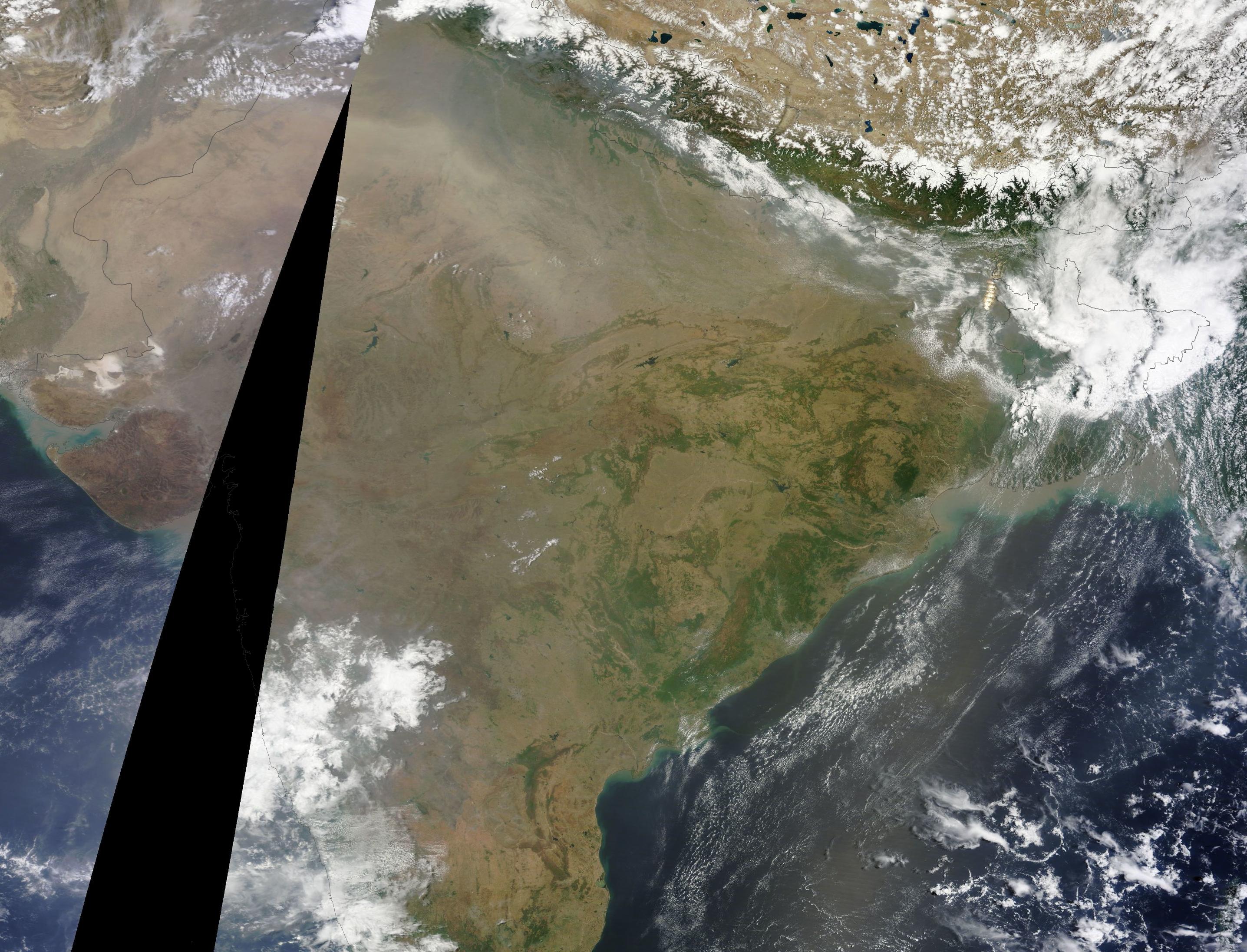
On May 25-27, an outburst of moisture from this stalled monsoonal flow splashed over the coasts of India. But by the 29th and 30th, these coastal storms and even the ones gathering over the Bengali waters had all been snuffed out. The most prominent feature in the MODIS shot of India today isn’t the rainfall that should be now arriving along the southeast coast, but the thick and steely-gray pallor of coal-ash smog trapped under a persistent and oppressive dome of intense heat.

(MODIS shot of India on May 30th. See the open stretch of blue water in the lower right frame? That’s the Bay of Bengal which borders coastal India. During a normal year at this time, that entire ocean zone should be filled with the storm clouds of a building monsoon that is already encroaching on coastal India. Today, there is nothing but a smattering of small and dispersed cloud through a mostly clear sky. Image source: LANCE-MODIS.)

Monsoon Described as Feeble

Official forecasts had already announced as of May 27th that the annual monsoon was likely to be delayed by at least a week for southeast regions of India. Meanwhile, expected monsoonal rainfall for western and northern sections of India for 2014 fell increasingly into doubt.

From The Times of India:

The monsoon is likely to be delayed by 10 days, according to scientists at the Indian Institute of Tropical Meteorology (IITM) here. The IITM’s third experimental real-time forecast says that a feeble monsoon will reach central India after June 20 as against the usual June 15. Last year, the monsoon had covered the entire country by June 15.

The annual monsoon is key to India’s agriculture. The substantial rains nurture crops even as they tamp down a powerful heating that typically builds throughout the sub-continent into early summer. Without these rains, both heat and drought tend to run rampant, bringing down crop yields and resulting in severe human losses due to excessive heat.

But, this year, heat and drought are already at extreme levels.

Major Heatwave Already Results in Loss of Life for 2014

As early as late March, the heatwave began to build over the Indian subcontinent. The heat surged throughout the state, setting off fires, resulting in a growing list of heat casualties, shutting down the power grid and spurring unrest. Meanwhile, impacts to India’s agriculture were already growing as the Lychee fruit crop was reported to have suffered a 40% loss.

By late May, temperatures across a broad region had surged above 105 degrees shattering records as the oppressive and deadly heat continued to tighten its grip.

In a country surrounded on three sides by oceans, it is a combination of heat, humidity and persistently high night-time temperatures that can be a killer. Wet bulb temperatures surge into a high-risk range for human mortality during the day even as night-time provides little respite for already stressed human bodies. Such extreme and long-duration heat doesn’t come without a sad toll. As of today, early reports indicated a loss of more than 56 lives due to heat stroke (In 2012 and 2013, total Indian heat deaths were near 1,000 each year). That said, final figures on heat losses are still pending awaiting complete reports from all of India’s provinces.

"Climatologically, we know that heatwaves are increasing in frequency and the number of days exceeding 45ºC temperatures is increasing. The frequency will increase further with global warming, hence this is a good example of a situation where science and disaster management can come together and avert damage," a spokesman for India’s National Disaster Management Authority noted on Friday.

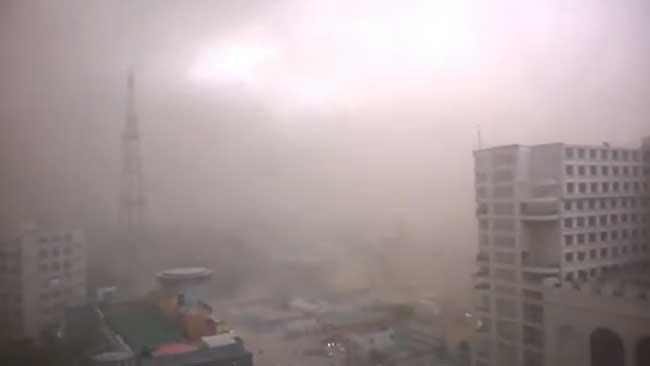
(Hot Dust. A dust storm rolls through New Delhi on Friday amidst furnace-like 113 degree heat snarling traffic and resulting in the tragic loss of 9 more lives. Image source: Gaurav Karoliwal/YouTube Screenshot.)

Today the heatwave continued to gain ground, with Kota and Rajasthan reaching an all-time record of 116 degree F (46.5 C) as New Delhi’s mercury hit 113 degrees F in the midst of a drought-induced dust storm. Dust shrouding the city spurred traffic chaos and in the heat, darkness, and confusion nine more souls were lost.

After two months of growing disruption due to heat and drought, the lands and peoples of India cry out for a Monsoon that is running later and later with each new weather report.

Climate Change + El Nino: Adding Heat and Beating Back the Monsoon

As systems approach tipping points, they are more likely to tilt toward the extremes.

For India this year, its seasonally warmest period from April to May found severe heat amplification from a number of global factors. First, climate change seeded the ground for the current Indian heatwave by adding general heat and evaporation to already hot conditions. With global average heating of +0.8 C above 1880s levels amplifying in the hot zones, early moisture loss due to higher-than-normal temperatures produces a kind of snowball effect for still more warming. Essentially, the cooling effect of water evaporation is baked out early allowing for heat to hit harder just as typical seasonal maximums are reached. More

Originally published by robertscribbler.wordpress.com/


Wednesday, April 16, 2014

The Future Is Evaporating: Climate Change Could Dry Out 30 Percent of the Earth

Scientists expect the changing climate to bring on more drought; there's going to be less rainfall in the already arid regions.

That alone would be bad news for denizens of the planet's dry zones—in some places in North Africa, the American Southwest, India, and the Middle East, water shortages could well become an existential threat to societies built there. But new research shows that in addition to less rain, the rate of evaporation is likely to rise, too. Combined, the two forces could dry out up to a third of the planet.

The study, published in the journal Climate Dynamics last month, estimates that climate change will cause reduced rainfall alone to dry out 12 percent of the Earth's land by 2100. But if evaporation is factored in, the study's authors say that it will "increase the percentage of global land area projected to experience at least moderate drying by the end of the 21st century from 12 to 30 percent."

“We know from basic physics that warmer temperatures will help to dry things out,” the study’s lead author, Benjamin Cook, a climate scientist with Columbia University and NASA's Goddard Institute for Space Studies, said in a statement. “Even if precipitation changes in the future are uncertain, there are good reasons to be concerned about water resources.”

Writing in a 2011 literature review in the science journal Nature, the physicist Joe Romm elaborates on how increased heat and evaporation can lead to a vicious cycle: "Precipitation patterns are expected to shift, expanding the dry subtropics. What precipitation there is will probably come in extreme deluges, resulting in runoff rather than drought alleviation. Warming causes greater evaporation and, once the ground is dry, the Sun’s energy goes into baking the soil, leading to a further increase in air temperature."

Disappearing soil moisture is likely to be a greater problem than previously thought, and the occasional downpour won't sate year-round crops. As Columbia University notes, "An increase in evaporative drying means that even regions expected to get more rain, including important wheat, corn, and rice belts in the western United States and southeastern China, will be at risk of drought."

If it becomes too dry to cultivate crops on one-third of the planet's surface, there's little doubt that crisis will follow. For millions of people who depend on food grown in vulnerable regions, the future is literally evaporating. More


Wednesday, April 9, 2014

Pakistan has only 30 days of water reserves - researchers

ISLAMABAD, Pakistan (Thomson Reuters Foundation) – Inadequate planning is exposing Pakistan to water-related threats from climate change and putting the country’s agriculture, industry and hydropower at risk, water experts say.

Speaking at a water summit in Pakistan recently, they said the country desperately needs more reservoirs to increase its water storage capacity, and they called for conservation awareness campaigns, the introduction of drought-tolerant crop varieties and more economical irrigation.

“The country is gravely vulnerable to water-related (effects) of the changing weather patterns,” said Pakistan’s minister for planning, development and reform, Ahsan Iqbal, in a keynote address at the summit in the nation’s capital.

In December, the World Resources Institute ranked Pakistan among the 36 most water-stressed countries in the world.

Iqbal said that Pakistan needs a minimum storage capacity of 40 percent of the around 115 million acre-feet of water available in the Indus river system throughout the year. But the country’s storage capacity is only 7 percent and is decreasing due to sediment build-up in reservoirs.

This gives Pakistan a stored water supply, adequate to meet its needs, of just 30 days. By contrast, “carryover capacity” in other countries ranges from 200 days in India to 1,000 days in Egypt, he said.

“In Pakistan, planners and policy makers across different sectors, including agriculture and industry, energy and health now have ... a daunting challenge before them of increasing the country’s water storage capacity,” Iqbal said.

The minister urged the finance ministry to explore funding avenues for new water storage projects to boost storage capacity. Many of these are hydroelectric dams, which would also produce power.

THREATS TO HYDROPOWER, AGRICULTURE

But Pakistan Water Partnership’s country director, Pervaiz Amir, warned that if climate change leads to lower water flows in the northwest of the country, it would cut the amount of hydroelectricity that can be produced.

More variable rainfall and glacier melt in the face of climate change also means that agriculture, which he said accounts for over 96 percent of the country’s water consumption, will be affected, Amir said.

Without more facilities to divert and store water, heavy rainfall and flooding in some parts of the country will continue to damage crops, increase soil erosion and delay planting and harvesting, he said.

Pakistan ranks ninth among countries most affected by floods, according to UN-Water’s World Water Development Report.

Arun Shrestha, a senior climate change specialist at the International Centre for Integrated Mountain Development (ICIMOD), said that many South Asian countries lack preparedness for water-related hazards, including flood, droughts and glacial lake outburst floods, and instead focus mainly on post-disaster relief.

What is “more appalling,” he said, is that climate change is dealt with as a separate problem rather than integrated into planning for water-related areas of the government and economy including agriculture, industry, health and energy.

Shrestha urged South Asian countries to include disasters attributable to climate change in their respective water-related planning and policies.

He called for them to analyse their vulnerabilities to increasingly frequent flooding, droughts and glacial lake outburst floods, and to share the findings with each other to develop a regional action plan for dealing with climate-related disasters.

Shrestha underlined the need for regional coordination between government agencies so that river basins can be managed more efficiently, for example by sharing data about river flows.

Stephen Davies, a senior research fellow at the International Food Policy Research Institute, said that water, food and energy are closely interconnected, yet energy models do not properly address water constraints in South Asia and other regions.

Industrial growth and accelerating urbanisation are creating greater demand for energy, he said, but efforts to expand hydropower generation are being hampered by the shrinking availability of water.

Limitations on water availability also are impacting food production to meet the country’s galloping population growth, he added.

Chief executive of LEAD Pakistan and climate policy expert Tauqeer Ali Sheikh urged policymakers to incorporate the interdependence of water, food and energy into their planning.

In South Asia, “energy planning is often made without taking into account possible changes in water availability due to climate change or other water competing uses,” he pointed out. More

Saleem Shaikh and Sughra Tunio are climate change and development reporters based in Islamabad, Pakistan.


Tuesday, September 24, 2013

Pakistan tackles water crisis with rainwater harvesting

MORRY-JE-WANDH, Pakistan (AlertNet) – Wearing colourful traditional dresses with silver jewellery and bangles on their arms, the women of Tharparkar district look festive. But the empty earthen pots they carry tell a different story.

Women of Tharparkar district

“Walking for three miles and (hoisting) a ... bucket filled with water through a wooden pulley from a 130-feet-deep well twice a day is toilsome work,” says Marvi Bheel, who lives in isolated Morry-je-Wandh village in this arid district of Sindh province, some 450 km (280 miles) south-east of Karachi.

Increasing temperatures and lower rainfalls, believed to be associated with climate change, are creating intense water shortages in much of Pakistan, a situation which is likely to worsen if the country’s 170 million population doubles as projected in the next 25 years.

In response, non-governmental organizations are trying to improve water harvesting in rural areas. A pilot project in Morry-je-Wandh has seen the construction of a large covered pond with the capacity to supply the domestic and drinking water needs of 20 families (135 villagers) for more than eight months.

“The new rainwater harvesting facilities have transformed the lives of people, as we have now a safe source of clean water,” said Sobho Bheel, a farmer unrelated to Marvi Bheel.

The effects of having a good supply of drinking water at hand are far-reaching, he added: diseases have diminished, children can go to school and women have more time to spend on other economic activities.

IMPROVING LIFE FOR WOMEN

Women in Tharparker district, as in many places around the world, are charged with the task of gathering water. But as water becomes scarcer, travelling long distances to collect it can be arduous.

“Women fall unconscious on their way to these dug wells, while others develop pregnancy related complications due to being malnourished,” Marvi Bheel said. On summer days temperatures hover around 48 to 50 degrees Celsius (118 to 122 degrees Fahrenheit), and the falling water table means that water sometimes has to be hauled from a depth of 200 to 250 feet (62 to 77 metres).

Dug wells are the major source of water for over 90 percent of the approximately 1.4 million people living in Tharparkar, Pakistan’s largest arid district, which spreads over nearly 20,000 square kilometres (7,600 square miles) and comprises some 2,350 villages.

Water is taken from the wells for domestic, agriculture and livestock needs. But because of the inadequate number of wells in the district and demand for water exceeding supply, wells often produce too little water or dry up within several months of being recharged by rain.

Bharumal Armani of Chelhar village recalls that during August 2010, rains in the Thar Desert recharged parched shallow wells, raised the water table in deep wells and filled household cisterns.

But after four months, local people were without sufficient water even for drinking. Many villagers had to walk miles to fetch supplies, while herdsmen were forced to take their livestock to reservoirs to water them.

According to a study by the Pakistan Council for Research on Water Resources (PCRWR), a government body, the entire Thar Desert receives between 260 and 280 mm (1.0-1.1 inches) of rainfall annually. The scanty precipitation, however, could suffice to meet the domestic water needs of the locals and their livestock for three years, according to the PCRWR.

95 PERCENT OF RAINFALL LOST

But because of inadequate storage and rainwater harvesting facilities, more than 95 percent of the water is lost under sand dunes or evaporates in the summer heat.

“Hardly 0.06 percent of the total annual rainwater is harvested by the locals in their household cisterns or in other indigenous ways,” said A.D. Khan, director for groundwater management at the water council. Khan believes the water shortage problem can be addressed by scaling up rainwater harvesting to at least 0.25 percent of the annual rainfall.

In Morry-je-Wandh, a water storage pond with a cover to curb evaporation is part of that effort. The pond, constructed by the Sukkar Foundation, a non-governmental organisation, cost Rs. 125,000 (about $1,400) and relied on financial and technical support from WaterAid-UK’s Pakistan chapter.

“We lay a geo-membrane sheet under the floor of these (ponds) to check seepage, and cover them with roofs that help check evaporation of stored rainwater during the sizzling summer days,” said Abdul Hafeez, WaterAid’s national programme manager.

Using hand pumps connected to the storage ponds through pipes, women can fill their pitchers with water without any difficulty.

According to Qamar uz Zaman Chaudhry, Pakistan’s advisor on climate change affairs, the country is one of the world’s most arid. Most areas have little or no access to surface water. By international standards, Pakistan was already considered a water-scarce country in 1992 with an annual per capita availability of 1,700 cubic metres. This has now declined to fewer than 1,100 cubic metres, according to the government.

“The situation will grow tenser as rains are becoming more erratic and scarce due to climate change,” said Chaudhry, who is author of Pakistan’s national climate change policy.

Climate change and overuse of limited water is expected to create severe problems for the country in coming years, according to Simi Kamal, chairperson of the Hisar Foundation for Water, Food and Livelihood Security, promotes water conservation and management practices in Pakistan.

Annual per capita availability of water may fall to half its current level by 2020 if the depletion of water resources goes unchecked, she said. She believes much of the solution to growing water stress lies in planning and implementing workable rainwater harvesting programmes at medium and small levels.

Chaudhry agrees.

“More than adequate water can be made available for domestic, agriculture, industrial, livestock and other miscellaneous needs, provided that viable strategic plans are drawn up and implemented for rainwater harvesting at all levels,” he said. More

Saleem Shaikh and Sughra Tunio are development reporters based in Karachi, Pakistan.


Monday, August 19, 2013

San Luis Reservoir 17 percent full, causing Silicon Valley water problems

LOS BANOS -- In 1805 Spanish soldiers camped here in the oak-studded valleys. California's Robin Hood, Joaquin Murrieta, hid out here during the Gold Rush. President John F. Kennedy made a visit in 1962.

San Luis Reservoir

There's no question the history around San Luis Reservoir is colorful. But these days, the star attraction isn't much to look at.

This vast inland sea along Highway 152 between Gilroy and Los Banos -- the largest off-stream reservoir in the world -- sits just 17 percent full.

The shoreline is a vast expanse of dried, cracked mud. Boat ramps end above the water's edge. Hills show erosion lines where the lake's surface once lapped in wetter years 168 feet higher than today.

This year, the reservoir

was at it lowest level of any Aug. 1 since 1989. And back then, California was knee-deep in its last major drought, which lasted from 1987 to 1992. A record-dry spring this year and pumping restrictions at the Delta are to blame now.

The low level is making water officials nervous in Silicon Valley, which draws billions of gallons from the reservoir.

"It's a concern for us every year, but more of a concern for us this year," said Joan Maher, deputy operating officer for the Santa Clara Valley Water District, based in San Jose.

When the lake level drops, the water warms, which causes algae to grow.

And when the water is pumped out every day from the reservoir, through a 10-foot-wide pipe 42 miles to the Coyote Pumping Station in Morgan Hill near Anderson Reservoir, it requires lots of treatment. Even after that, it doesn't seem quite right when it comes out of Silicon Valley taps.

"People have been calling, saying, 'What's happening with the water?'" Maher said. "The water is safe to drink, but this makes it taste and smell a little musty."

The people most affected live in Saratoga, Cupertino, Campbell, Los Altos and other communities that receive drinking water from the district's Rinconada treatment plant in Los Gatos. That's the only one of the district's three drinking water treatment plants that doesn't have high-tech ozone treatment -- it won't for another three years or so. For now, the plant is having to clean its filters more regularly, and crews have increased the amount of granulated carbon they use to absorb odors by tenfold from normal years.

When full, San Luis holds 2 million acre-feet of water, enough to supply the needs of 10 million people for a year.

There are two reasons San Luis is so low now.

First is the dry spring. After a wet November and December, California experienced record-dry conditions starting in January.

The amount of snow and rain that fell in the northern Sierra between January and the beginning of April was the least since records were first kept in 1920. Most Bay Area cities had the driest spring in their history.

Less snow and rain meant less runoff. Still, other large reservoirs in Northern California have much more water now than San Luis. Lake Shasta, Oroville, Trinity and New Melones are all between 46 and 61 percent full.

Another reason San Luis has not filled as much, Maher noted, is because its water is pumped from the Delta, 75 miles to the north. And in recent years, federal court decisions have limited the time and scale of how much water could be pumped out of the Delta through the giant federal and state water projects that store water in San Luis for later use, not only by Silicon Valley, but by farmers and cities throughout the Central Valley and Southern California.

As Maher and many other water officials see it, one solution is Gov. Jerry Brown's $24 billion plan to build two massive tunnels under the Delta to more easily ship water south.

Environmentalists say the tunnels will wreck the Delta's fragile ecosystem and make it easier to ship water to subsidized corporate farmers. They argue the problem is that agriculture -- which uses 80 percent of the water that people consume in California -- simply takes too much from the Delta and has planted crops that rely on more water than the Delta can deliver consistently without killing salmon, smelt and other species that live there.

"If we weren't using our precious water to grow almonds to ship to China, we'd have more for urban use," said Barbara Barrigan-Parrilla, executive director of Restore the Delta, a Stockton group.

In the past week, water levels at San Luis Reservoir have crept up 3 feet. That's because demand from farmers is waning in the later part of the growing season and some Delta pumping is occurring, said Tracy Pettit with the state Department of Water Resources. More


Friday, March 22, 2013

America's Water: The World's Water

We live in a bountiful land that extends from sea to shining sea. We are home to the world's largest freshwater reserve, the Great Lakes.

The waterfalls and serene lakes from Yellowstone to Niagara to Yosemite to Havasu inspire us as to the wonders of nature. Our inland waterways from the mighty Mississippi to the sinuous Colorado have been the backbone of a nation's exploration, freight and development. Our unseen groundwater reserves, much larger in volume than the fresh water in rivers and lakes, have nurtured our cities and our fields, providing the resource that makes us the most productive agricultural nation on the planet. We live an enviable lifestyle. For most of us, inexpensive, safe drinking water flows from the tap and we use it luxuriously for drinking, bathing, maintaining beautiful yards, golf courses, swimming pools and water theme parks. This access to nature's largess is in clear contrast to the global water crisis that many talk about -- the billion people in diverse countries who lack access to safe drinking water. But so is our wealth.

Today, America's water is at a crossroads. The last decade has been marked by a series of widespread droughts in the West, Southwest, and Southeast that stressed water systems and led to interstate conflict. The large aquifers in the Midwest, in Central California and in Florida are depleting. Recent floods have also stressed our infrastructure, response and recovery systems. These events bring into question our resilience to climate variability. Surely, it is better than in the 12th and the 13th century when the industrious and proud Anasazi vanished following major droughts. But, today we have a larger population with much higher consumption rates, and much of the world depends on our agricultural production that is fueled in part by vanishing aquifers. We have an ever-growing hunger for energy. The availability of water constrains where we can put thermal power plants and the amount of water that can be used for unearthing energy (e.g., hydrofracking), leaving renewable energy development at the forefront.

Regulatory efforts at controlling water pollution from industry and other "point" sources have been by and large successful and have contributed to a dramatic improvement in river and groundwater quality in many places. But, non-point source pollution from farms and cities is largely unabated. Nearly 2.5 million people in Central California are affected by high nitrate concentrations in the groundwater they drink. Nearly 2/3rd of the people who responded to a Value of Water Survey indicated that they had to boil their water at least once in the last year due to a disruption in supply.

Over the last decade, water rates have risen at a rate much faster than inflation, partly because they were too low given past government subsidies, and in part to cover capital expenses associated with renewal or expansion of water and wastewater infrastructure. In many places, the rate increases have stimulated lower consumption. This translated into revenues lower than those before the rate increase, leading to many utilities unable to cover operating costs. The ASCE estimates that nearly $1.5 trillion needs to be invested in the next 20 years to renew aging water and wastewater infrastructure, dams and levees. Federal investment in water declined significantly since the 1980s, and the infrastructure has aged since to the point that major renewal may be needed. The financial burden for providing water services has shifted increasingly to local communities. The ability of these communities to raise funds for capital improvements is under question.

The challenges related to climate-induced risks, to energy and agricultural productivity, to pollution and the quality of water supplied, and to the financing and governance of water systems that we face are universal. Every nation, every community in the world, is increasingly facing these challenges. The challenge is extreme in places like India where the highly variable climate, the pressures of the population and the stasis of the bureaucracy combine to create a living disaster. The same is true in places like Haiti where all aspects of development need attention. Solutions for the world are likely to be easier if places where there is technical and intellectual capacity, which if not constrained by an immediate challenge can innovate systems and principles that lead us to appropriate, sustainable solutions in all our environments so that the world is a healthy place for 9 billion people living in harmony with nature. It is a time for leadership in and from America.

Over time, much of the world adapted the U.S. paradigms for scientific and economic water management and development that were formalized and articulated through public and educational institutions over the last century. Principles of public benefit cost analysis for water systems were articulated. The application of these principles was stimulated by Federal government investment in water research, water storage, distribution and treatment infrastructure projects, and in the monitoring and regulation of water quantity and quality. The idea of the human right to water was made explicit by the U.S. government only recently, but was effectively practiced through its policies and investments. The legacy of these investments includes the vast civil engineering projects that brought us dams, canals, levees, sewers, drinking water and waste water treatment, the Clean Water Act that led to the assurance of water quality, and the Superfund program aimed at hazardous waste sites that severely contaminated water sources. Similar programs have emerged worldwide. More


Wednesday, February 6, 2013

Sun-Powered Desal: A Gateway to Meeting MENA’s Water Needs

Extreme variability in rainfall and temperature are the new norm in the Middle East and North Africa and its consequences are especially severe for the Arab world.

A new publication, Renewable Energy Desalination, provides one solution for adapting to the changing climate while meeting growing water demands. The work, supported by the Water Partnership Program (WPP), proposes closing the region’s water gap through desalination run on renewable energy rather than conventional fossil fuels. The strategy seeks to promote both energy and water security by capitalizing on two of the region’s abundant resources: solar energy and seawater.

Renewable Energy Desalination is a timely source offering new ideas for integrating adaptation into policy making. The book’s recommendations will help ensure inclusive and sustainable climate mitigation actions throughout the MENA region, as promoted by a new World Bank special report on Adaptation to a Changing Climate in the Arab Countries launched in November 2012 at the UN Climate Change Conference (COP-18) in Doha, Qatar. The book builds on an improved understanding of water issues in the MENA region provided by earlier groundwork studies on future climate change implications for the region’s water gap and on options for desalination. It uses the “marginal cost of water” approach for prioritizing options for reducing the water gap, considering the associated economic costs, energy requirements, and environmental considerations of using fossil fuels and renewable energy sources, and Concentrated Solar Power (CSP) in particular. It also highlights the benefits of coupling desalination with CSP to generate a competitive energy supply that could ensure sustainable water supply for the region over time. More


Saturday, February 2, 2013

5 Sobering Realities About Global Water Security

Some people say that water is the oil of the 21st Century. If only water were that simple.

Water is very complicated. It’s affected by large-scale issues like climate change and globalization. International commerce moves virtual water (the water it takes to grow or produce a product) from farms in Brazil to grocery stores in China and Egypt.

But water is also inherently local, impacted by site-specific weather, geography, and other environmental and land use conditions. Managing and using water, then, requires understanding it in its full geographic context.

Today, WRI is launching its new Aqueduct mapping tool to do just that. Aqueduct provides businesses, governments, and other decision makers with the highest-resolution, most up-to-date data on water risk across the globe. Armed with this information, these decision-makers can better understand how water risk impacts them—and hopefully, take actions to improve water security.

5 Findings about Water

So, what are these global maps telling us? Here are five immediate conclusions:

  • Water risk has many dimensions. WRI’s Aqueduct tool offers a new way of combining and mapping multiple indicators of water stress. Factors like inter-annual variability, floods, droughts, and groundwater depletion are added to baseline water stress, revealing a richer picture of water stress across the globe. Other important factors related to water quality and reputational risk are also included to help companies and governments understand the full breadth of water risks associated with a particular region or water basin. Not only do these layers enrich the overall picture, they can help inform strategies for improving water security.

  • Water stress is growing worldwide. Our new global Aqueduct maps use the most recent 2010 data (previous maps used data from 2000). The picture that emerges shows that water stress is both more prevalent and more severe than estimated in 2000. The new maps reveal areas of higher water stress on every continent, particularlyin China, South and Central Asia, and Africa.

  • Water stress isn’t just in arid regions anymore. One of the striking things about Aqueduct’s new maps is that many parts of Europe and the U.S. East Coast and upper Midwest now show medium to high levels of water risk. These regions are not arid, yet they still face significant water stress as demand increases and supply is affected by climate change and other factors.

  • High competition and annual variability make for a bad combination. In some areas with elevated water stress—including the U.S. West, Australia, northern China, northwest India, and parts of Pakistan—there is also high variability in available water supply from year to year. In places where demand for water is high relative to the available supply, a greater likelihood of low-water years makes the situation even riskier.

  • Increasing risks to food security. Most of the world’s water is used for agriculture, which accounts for approximately 70 percent of all freshwater withdrawals. Overlaying the world’s major irrigated crop regions on Aqueduct maps reveals that many of these areas already face significant water stress. The situation may become more severe in the future—water stress is likely to grow due to climate change and increased demand for food and water. More


Monday, January 21, 2013

Step by step water security

Ratlam is perhaps the only city endowed with as many step-wells or bawdis,almost one step-well at each step inthe town of little over 200,000 inhabitants.

According to municipal records, some 52 bawdis exist in various stages of neglect. Even the police station and the government hospital have bawdis in their premises. However, indications are that many more may have subsequently been filled-up to pave way for municipal or private usage.

Located on the Delhi-Mumbai railway route, Ratlam has been an important junction which is better known for its range of salt confectioneries. Situated in the north-west part of Madhya Pradesh, better known as malwa, Ratlam was once one of the first commercial towns in central India known for its extensive trade in opium, tobacco and salt.

But the irony is that most of the step-wells in the town -- though heritage structures -- have been taken for granted as waste dumps, earning the municipality flak from the media and the public at large. A preliminary survey revealed that while the Sai Bawdi in Shastri Nagar and the Do Mukhi Bawdi on the main street have been turned into garbage bins by the surrounding habitation, theKashi Viswanath Bawdi, a few yards away, has retained its glory under a samiti headed by a local priest.

Why have bawdis come to endow this town? The town must have had a rich history at the centre of its legacy. It is evident that the bawdis have existed much before the town of Ratlam was founded by Captain Borthwick in 1829, with broadened roads and well-built houses. The town was not only the capital of the princely state of Ratlam, it was an important town on the trade between western and central princely states.

Given the fact that the town is located in a region that receives an average 90 cm rainfall during two months of the year, it might have forced the inhabitants to build the bawdis. Due its proximity to Rajasthan, the traditional knowledge of water storage and conservation may have percolated from the adjoining dry districts. The need for step-wells may have been necessitated due to the large presence of outside traders in the city as well.

Needless to say, the bawdis were in use well after Independence for household water consumption as well as for critical irrigation needs. These were in use till drinking water was sourced first from Gunavad pond and later from a large storage structure called Dolawad. Some 40-45 lakh gallons of water get supplied for daily domestic consumption in the city. More