Water Security is National Security

Water resources and how they are managed impact almost all aspects of society and the economy, in particular health, food production and security, domestic water supply and sanitation, energy, industry, and the functioning of ecosystems. Under present climate variability, water stress is already high, particularly in many developing countries, and climate change adds even more urgency for action. Without improved water resources management, the progress towards poverty reduction targets, the Millennium Development Goals, and sustainable development in all its economic, social and environ- mental dimensions, will be jeopardized. UN Water.Org

Showing posts with label treaty. Show all posts

Saturday, July 26, 2014

Distributed Water Balance of the Nile Basin [HD]

Water is the new oil. This means that it will become, if it has not already done so, become a trigger for conflict.

See More


This visualization shows how satellite data and NASA models are being applied to study the hydrology of the Nile basin. The Tropical Rainfall Measurement Mission (TRMM) Multisensor Precipitation Analysis fTMPA) provides three-hourly estimates of rainfall rate across much of the globe.


Here we see the seasonal cycle of monthly precipitation derived from TMPA for Africa, including the Nile Basin. The annual migration of the Intertropical Convergence Zone (ITCZ) from the Nile Equatorial Lakes region around Lake Victoria, source of the White Nile, northward into Sudan and the highlands of Ethiopia, headwaters of the Blue Nile, and back is evident in the seasonal cycle in precipitation. This precipitation cycle drives flow through the Nile River system. The Nile basin, however, is intensely evaporative, and the majority of the water that falls as rain leaves the basin as evaporation rather than river flow—either from the humid headwaters regions or from large resen/oirs and irrigation developments in Egypt and Sudan.


The Atmosphere Land Exchange Inverse (ALEXI) evapotranspiration product, developed by USDA scientists, uses satellite data to map daily evapotranspiration across the entire Nile basin, providing unprecedented information on water consumption. The balance of rainfall and evapotranspi ration can be seen in seasonal patterns of soil moisture, as simulated by the NASA Nile Land Data Assimilation System (LDAS), which merges satellite information with a physically-based land surface model to simulate variability in soil moisture—a critical variable for rainfed agriculture and natural ecosystems. Finally, the twin satellites of the Gravity Recovery and Climate Experiment (GRACE) can be used to monitor variability in total water storage, including surface water, soil moisture, and groundwater. The annual cycle in GRACE estimates of water storage anomalies clearly shows the seasonal movement of water storage due to precipitation patterns and the movement of surface waters from headwaters regions into the wetlands of South Sudan and the resen/oirs of the lower Nile basin.


The Nile is the longest river in the world and its basin is shared by 11 countries. Reliable, spatially distributed estimates of hydrologic storage and fluxes can provide critical information for water managers contending with multiple resource demands, a variable and changing climate, and the risk of damaging floods and droughts. NASA observations and modeling systems offer unique capabilities to meet these information needs.

Completed: 7 May 2013

Animator: Trent L. Schindler (USRA) (Lead)

Producer: Jefferson Beck (USRA)

Scientists: David Toll (NASA/GSFC)

Ben Zaitchik (Johns Hopkins University)


Wednesday, April 9, 2014

Pakistan has only 30 days of water reserves - researchers

ISLAMABAD, Pakistan (Thomson Reuters Foundation) – Inadequate planning is exposing Pakistan to water-related threats from climate change and putting the country’s agriculture, industry and hydropower at risk, water experts say.

Speaking at a water summit in Pakistan recently, they said the country desperately needs more reservoirs to increase its water storage capacity, and they called for conservation awareness campaigns, the introduction of drought-tolerant crop varieties and more economical irrigation.

“The country is gravely vulnerable to water-related (effects) of the changing weather patterns,” said Pakistan’s minister for planning, development and reform, Ahsan Iqbal, in a keynote address at the summit in the nation’s capital.

In December, the World Resources Institute ranked Pakistan among the 36 most water-stressed countries in the world.

Iqbal said that Pakistan needs a minimum storage capacity of 40 percent of the around 115 million acre-feet of water available in the Indus river system throughout the year. But the country’s storage capacity is only 7 percent and is decreasing due to sediment build-up in reservoirs.

This gives Pakistan a stored water supply, adequate to meet its needs, of just 30 days. By contrast, “carryover capacity” in other countries ranges from 200 days in India to 1,000 days in Egypt, he said.

“In Pakistan, planners and policy makers across different sectors, including agriculture and industry, energy and health now have ... a daunting challenge before them of increasing the country’s water storage capacity,” Iqbal said.

The minister urged the finance ministry to explore funding avenues for new water storage projects to boost storage capacity. Many of these are hydroelectric dams, which would also produce power.

THREATS TO HYDROPOWER, AGRICULTURE

But Pakistan Water Partnership’s country director, Pervaiz Amir, warned that if climate change leads to lower water flows in the northwest of the country, it would cut the amount of hydroelectricity that can be produced.

More variable rainfall and glacier melt in the face of climate change also means that agriculture, which he said accounts for over 96 percent of the country’s water consumption, will be affected, Amir said.

Without more facilities to divert and store water, heavy rainfall and flooding in some parts of the country will continue to damage crops, increase soil erosion and delay planting and harvesting, he said.

Pakistan ranks ninth among countries most affected by floods, according to UN-Water’s World Water Development Report.

Arun Shrestha, a senior climate change specialist at the International Centre for Integrated Mountain Development (ICIMOD), said that many South Asian countries lack preparedness for water-related hazards, including flood, droughts and glacial lake outburst floods, and instead focus mainly on post-disaster relief.

What is “more appalling,” he said, is that climate change is dealt with as a separate problem rather than integrated into planning for water-related areas of the government and economy including agriculture, industry, health and energy.

Shrestha urged South Asian countries to include disasters attributable to climate change in their respective water-related planning and policies.

He called for them to analyse their vulnerabilities to increasingly frequent flooding, droughts and glacial lake outburst floods, and to share the findings with each other to develop a regional action plan for dealing with climate-related disasters.

Shrestha underlined the need for regional coordination between government agencies so that river basins can be managed more efficiently, for example by sharing data about river flows.

Stephen Davies, a senior research fellow at the International Food Policy Research Institute, said that water, food and energy are closely interconnected, yet energy models do not properly address water constraints in South Asia and other regions.

Industrial growth and accelerating urbanisation are creating greater demand for energy, he said, but efforts to expand hydropower generation are being hampered by the shrinking availability of water.

Limitations on water availability also are impacting food production to meet the country’s galloping population growth, he added.

Chief executive of LEAD Pakistan and climate policy expert Tauqeer Ali Sheikh urged policymakers to incorporate the interdependence of water, food and energy into their planning.

In South Asia, “energy planning is often made without taking into account possible changes in water availability due to climate change or other water competing uses,” he pointed out. More

Saleem Shaikh and Sughra Tunio are climate change and development reporters based in Islamabad, Pakistan.


Friday, March 21, 2014

Egypt gets muscular over Nile dam

When Egypt’s then-president Mohamed Morsi said in June 2013 that “all options” including military intervention, were on the table if Ethiopia continued to develop dams on the Nile River, many dismissed it as posturing. But experts claim Cairo is deadly serious about defending its historic water allotment, and if Ethiopia proceeds with construction of what is set to become Africa’s largest hydroelectric dam, a military strike is not out of the question.

Relations between Egypt and Ethiopia have soured since Ethiopia began construction on the 4.2 billion dollar Grand Renaissance Dam in 2011.

Egypt fears the new dam, slated to begin operation in 2017, will reduce the downstream flow of the Nile, which 85 million Egyptians rely on for almost all of their water needs. Officials in the Ministry of Irrigation claim Egypt will lose 20 to 30 percent of its share of Nile water and nearly a third of the electricity generated by its Aswan High Dam.

Ethiopia insists the Grand Renaissance Dam and its 74 billion cubic metre reservoir at the headwaters of the Blue Nile will have no adverse effect on Egypt’s water share. It hopes the 6,000 megawatt hydroelectric project will lead to energy self-sufficiency and catapult the country out of grinding poverty.

“Egypt sees its Nile water share as a matter of national security,” strategic analyst Ahmed Abdel Halim tells IPS. “To Ethiopia, the new dam is a source of national pride, and essential to its economic future.”

The dispute has heated up since Ethiopia began diverting a stretch of the Nile last May, with some Egyptian parliamentarians calling for sending commandos or arming local insurgents to sabotage the dam project unless Ethiopia halts construction.

Ethiopia’s state-run television responded last month with a report on a visit to the site by army commanders, who voiced their readiness to “pay the price” to defend the partially-built hydro project.

Citing a pair of colonial-era treaties, Egypt argues that it is entitled to no less than two-thirds of the Nile’s water and has veto power over any upstream water projects such as dams or irrigation networks.

Accords drawn up by the British in 1929 and amended in 1959 divvied up the Nile’s waters between Egypt and Sudan without ever consulting the upstream states that were the source of those waters.

The 1959 agreement awarded Egypt 55.5 billion cubic metres of the Nile’s 84 billion cubic metre average annual flow, while Sudan received 18.5 billion cubic metres. Another 10 billion cubic metres is lost to evaporation in Lake Nasser, which was created by Egypt’s Aswan High Dam in the 1970s, leaving barely a drop for the nine other states that share the Nile’s waters.

While the treaty’s water allocations appear gravely unfair to upstream Nile states, analysts point out that unlike the mountainous equatorial nations, which have alternative sources of water, the desert countries of Egypt and Sudan rely almost entirely on the Nile for their water needs.

“One reason for the high level of anxiety is that nobody really knows how this dam is going to affect Egypt’s water share,” Richard Tutwiler, a specialist in water resource management at the American University in Cairo (AUC), tells IPS. “Egypt is totally dependent on the Nile. Without it, there is no Egypt.”

Egypt’s concerns appear warranted as its per capita water share is just 660 cubic metres, among the world’s lowest. The country’s population is forecast to double in the next 50 years, putting even further strain on scarce water resources.

But upstream African nations have their own growing populations to feed, and the thought of tapping the Nile for their agriculture or drinking water needs is all too tempting.

The desire for a more equitable distribution of Nile water rights resulted in the 2010 Entebbe Agreement, which replaces water quotas with a clause that permits all activities provided they do not “significantly” impact the water security of other Nile Basin states. Five upstream countries – Ethiopia, Kenya, Uganda, Tanzania and Rwanda – signed the accord. Burundi signed a year later.

Egypt rejected the new treaty outright. But after decades of wielding its political clout to quash the water projects of its impoverished upstream neighbours, Cairo now finds itself in the uncomfortable position of watching its mastery over the Nile’s waters slip through its fingers.

“Ethiopia’s move was unprecedented. Never before has an upstream state unilaterally built a dam without downstream approval,” Ayman Shabaana of the Cairo-based Institute for Africa Studies had told IPS last June. “If other upstream countries follow suit, Egypt will have a serious water emergency on its hands.”

Ethiopia has sought to assure its downstream neighbours that the Grand Renaissance Dam is a hydroelectric project, not an irrigation scheme. But the dam is part of a broader scheme that would see at least three more dams on the Nile.

Cairo has dubbed the proposal “provocative”.

Egypt has appealed to international bodies to force Ethiopia to halt construction of the dam until its downstream impact can be determined. And while officials here hope for a diplomatic solution to diffuse the crisis, security sources say Egypt’s military leadership is prepared to use force to protect its stake in the river.

Former president Hosni Mubarak floated plans for an air strike on any dam that Ethiopia built on the Nile, and in 2010 established an airbase in southeastern Sudan as a staging point for just such an operation, according to leaked emails from the global intelligence company Stratfor posted on Wikileaks.

Egypt’s position was weakened in 2012 when Sudan, its traditional ally on Nile water issues, rescinded its opposition to the Grand Renaissance Dam and instead threw its weight behind the project. Analysts attribute Khartoum’s change of heart to the country’s revised domestic priorities following the secession of South Sudan a year earlier.

According to AUC’s Tutwiler, once Sudan felt assured that the dam would have minimal impact on its water allotment, the mega-project’s other benefits became clear. The dam is expected to improve flood control, expand downstream irrigation capacity and, crucially, allow Ethiopia to export surplus electricity to power-hungry Sudan via a cross-border link.

Some studies indicate that properly managed hydroelectric dams in Ethiopia could mitigate damaging floods and increase Egypt’s overall water share. Storing water in the cooler climes of Ethiopia would ensure far less water is lost to evaporation than in the desert behind the Aswan High Dam.

Egypt, however, is particularly concerned about the loss of water share during the five to ten years it will take to fill the dam’s reservoir. Tutwiler says it is unlikely that Ethiopia will severely choke or stop the flow of water.

“Ethiopia needs the electricity…and hydroelectric dams don’t work unless you let the water through.” More


Sunday, January 19, 2014

Egypt-Ethiopia Nile dam talks hit dead end

Technical negotiations among water ministers from Egypt, Sudan and Ethiopia have reached a dead end after all parties refused the proposals set forth to solve the crisis that revolves around the repercussions Ethiopia’s Renaissance Dam have on Egypt’s water security. These repercussions were discussed during three rounds of negotiations in the Sudanese capital Khartoum.

Security guards at Ethiopia's Great Renaissance Dam

The third round of negotiations held in Khartoum on Jan. 4 — and attended by technical delegations represented by water ministers from Egypt, Sudan and Ethiopia — did not yield any clear results. Egypt withdrew from the meeting, describing the Ethiopian stance as “intransigent,” as Ethiopia refused the Egyptian proposal that ensures Egyptian water security, as noted in a statement issued by the Egyptian Ministry of Water Resources and Irrigation.

Al-Monitor secured a copy of the statement, which stated: “The dispute between Egypt and Ethiopia during the negotiations is related to two points. First, Ethiopia refused the participation of international experts in the new mechanism put in place to follow up on Ethiopian studies about the consequences of the Renaissance Dam. These studies will be conducted in accordance with the report of the international committee. Second, Ethiopia refused to discuss the document on 'principles of confidence-building' between the countries of the eastern Nile basin — namely Egypt, Sudan and Ethiopia. Egypt proposed this document to provide guarantees for the downstream countries against any negative effects that may be generated from the construction of the dam.”

In a phone interview with Al-Monitor, Egypt’s Water Minister Mohammed Abdel Moteleb said: “We tried to set forth more than one initiative to build the trust Ethiopia always talks about when promising not to cause Egypt any harm. However, we will not attend or participate in any technical negotiations concerning theRenaissance Dam until we make sure Ethiopia is proposing genuine initiatives that are in line with the Egyptian view, so that these meetings will be meaningful.

“Egypt has concerns and reservations over the Renaissance Dam. It is not logical to build a dam that big without completing the technical and environmental studies required by the international committee. Ethiopia agreed to these studies and signed [the committee’s] final report.”

He went on: “Egypt agreed on attending the three rounds of negotiations, so that it could not be accused of rejecting cooperation. We are always striving [to hold] a dialogue that is based on the principles of not causing harm and creating benefits for all parties. Currently, we do not have the luxury of giving up any drop of water from Egypt’s share of Nile water.”

An informed Egyptian security source concerned with the issue of the Nile basin told Al-Monitor: “Egypt will follow new courses to solve its crisis with Ethiopia in regard to the Renaissance Dam. It will adopt measures to push the issue forward on the international level. Egypt will not accept for its historical share of the Nile water, which is preserved by agreements and provisions of international law, to be diminished.”

“We do not rule out [the possibility of adopting] any technical, political or security measures to solve this crisis. We are waiting for the referendum on the constitutionto be over. After that, we will launch a series of official and nonofficial movements,” the source affirmed. He pointed out the “possibility of referring to international courts and filing a claim with international institutions, such as the UN, to preserve Egypt’s rights.”

A diplomatic source, closely tied to the Egyptian Cabinet, told Al-Monitor, “Egypt has already launched diplomatic movements to convince donor countries to stop the financial aids serving the construction of the dam until it is assured that it will not harm Egypt.” The source affirmed, “This campaign will be put in focus after the completion of parliamentary and presidential elections, and once relative stability has been achieved.”

Interim President Adly Mansour held a closed meeting with the National Defense Council on Jan. 8. The meeting was attended by Defense Minister Abdel Fattah al-Sisi and Prime Minister Hazem el-Biblawi, who discussed the crisis of the Renaissance Dam and the deadlock surrounding the technical negotiations. The council reiterated the importance of “not wasting the water rights of Egypt and not accepting any violation against Egyptian national security.”

Former Water Minister and Nile Basin Studies Unit head Mohammad Nasreddin Allam, told Al-Monitor, “We are currently drafting an international claim comprising five parts, which will be filed to donor countries, international institutions and organizations entitled to settle this dispute. Such a dispute can threaten peace and security in the East African region.”

“The memorandum will comprise a legal part documenting the historical rights of Egypt to the Nile water, and another part stating the Ethiopian violations of the law and international agreements, after it constructed a large dam without taking into consideration the safety of downstream countries. It will also include a call to form a fact-finding committee to prove the dangerous impact of the dam on Egyptian water security, as stipulated by the regional dispute settlement mechanisms, the UN pact and the African Union Peace and Security Council,” Allam added.

Allam also affirmed, “The memorandum will call for the immediate halt of all construction works at the site until the fact-finding committee fulfills its task.”

Despite the warning messages Egypt is conveying to affirm it will not give up on protecting its share of Nile water, the Egyptian prime minister was optimistic about the possibility of negotiating again and resolving the crisis. He said during a press conference on Jan. 9, attended by , “Negotiations do not end in one session. Things will continue to progress, and the issue of the dam remains until now open for discussion.”

A technical source who attended the latest negotiations commented on the prime minister’s statement, telling Al-Monitor, “Negotiations reached a deadlock. The Ethiopian water minister publicly refused during an official meeting the request of Egypt to host negotiations in Cairo, claiming that the security situation in Egypt was the reason for his refusal.”

“Egypt is now wasting its chance. Calling for more negotiations is time-consuming because Ethiopia is proceeding with the constructions as a de facto situation,” the source warned.

For his part, Ethiopian Water and Energy Minister Alemayehu Tegenu said in a statement on Jan. 13: “The construction of the Renaissance Dam is taking place without any hassles or difficulties. The project will be finalized according to the decided time frame,” reiterating that “the project is not facing technical or funding problems.” More


Wednesday, January 15, 2014

Speech by Mikhail Gorbachev to World Water Forum 6

Mar 12th 2012

Mr. Prime Minister, Ladies and gentlemen,

I thank the government of France for the invitation to come here and the organization for the great work that went into making this (World Water) Forum possible. I support the view of President Sarkozy when saying that water problems must be in the forefront of international politics.

The presence here of representatives of more than seventy countries and of prominent scientists and experts gives this Forum considerable global importance. Preparations for it proceeded under an apt slogan: Time for Solutions. Indeed, the time has come to move from discussions and declarations to concrete action.

The deficit of fresh water is becoming increasingly severe and large-scale – whereas, unlike other resources, there is no substitute for water. Looking for traces of organic life on other celestial bodies we start by seeking signs of the presence of water. On our planet Earth we do have water, but accessible resources of fresh water are limited, and water use for human needs keeps rising. Continuation of water consumption at 20th century rates is no longer possible.

Thinking about ways of countering the global water crisis, we must first of all recognize its true causes.

• the growth of the world’s population and of agricultural, industrial and energy production, which are the main consumers of water;

• wasteful use of water and other natural resources in an economy driven by hyperprofits and excessive consumption;

• mass poverty and backwardness in countries where authorities are not able, and often have no desire, to organize effective water management;

• and, finally, the arms race and the senseless waste of enormous amounts of wealth and resources in wars and conflicts.

It is therefore clear that the water problem should not be considered in isolation from other global challenges and from the overall international context. Green Cross International, of which I am the founding president and which I have the honor of representing here, has been working for twenty years at the nexus of problems of security, poverty and the environment. Some time ago, GCI launched the Water for Life initiative. We proposed developing an international convention on the right to water. In 2010 the United Nations decided to include the right to water among fundamental human rights. It was not easy for the international community to take such an important step – but it has been taken.

What’s needed now is the practical implementation of this principle. Until now, only a few countries have included the right to water in their national legislation. Among those countries is France, which is also allocating significant resources to ensure access to water in developing countries. Green Cross International is taking active part in the development of measures aimed at preserving and rationally managing water resources.GCI is working to speed the entry into force of the United Nations Convention on non-navigational uses of international waterways; we also implement specific projects to assure the right to water.

Even simple solutions that do not require enormous investments save many human lives. Thanks to just one pilot GCI project in Ghana, 40,000 people living in the basin of the Volta have now been given access to clean drinking water and sanitation.

Another important area in which we deploy our efforts is the prevention of conflicts related to access to water resources or resulting from their use as an instrument of pressure or diktat. As someone who has more than fifty years of experience in politics, I am convinced that the water crisis is closely related to the flaws of contemporary economics and politics. Let me make two points in this regard.We have met at a time when the world is still reeling from the consequences of a severe, global economic crisis.

The emerging signs of recovery in the world economy should not deceive us. The crisis has shown that the currently dominant model of economic growth is unsustainable. This model engenders crises, social injustice and the danger of environmental catastrophe.There is a clear need for an evolutionary but sufficiently rapid transition to a different model. It should be based on a combination of markets and private initiative with the principles of social and environmental responsibility of business and effective government regulation.

We therefore need to rethink the goals of economic development. Consumption must not remain the only or the principal driver of growth. The economy needs to be reoriented to goals that include public goods such as a sustainable environment, people’s health in the broadest sense of the word, education, culture and social cohesion, including absence of glaring gaps between the rich and the poor. Major water projects, both national and international, could become one of the engines in a qualitatively new stage of the development of global economy.

My second point: the world needs a new political architecture, a new architecture of security, global governance and sustainable development.It should be based on the rejection of confrontational thinking or any attempts to dominate international relations and on demilitarization of international politics. It is only on such a basis that we will be able to respond to the main challenges of this century – the challenge of security, the challenge of poverty and backwardness, and the challenge of the global environmental crisis.

During the fifteen years of its existence, the World Water Forum has helped to put water problems on the international political agenda. Unfortunately, however, it has still not gone beyond general discussion between representatives of governments and the business community, nor has it produced breakthrough solutions to the water crisis. That is why, parallel to the forum, alternative discussion platforms are emerging as a result of civil society initiatives. The voice of the public must be heard at this Forum.

Therefore, let me convey to you the position formulated by our civil society partners: “We believe that good governance of water and sanitation will only be brought about through human rights-based approaches and adequate investment in informed and effective civil society participation. We greatly welcomed the 2010 UN recognition of the human right to safe drinking water and sanitation and now urge all actors to support national governments to implement these rights for all people in accordance with human rights law and to recognize and effectively support local knowledge and community management as important to implement this right.”

Let us unite our efforts! Let us think and act on the basis of common principles: Peace for all. Water for all. Dignity and the life worthy of a human being, for all. We should not settle for less. More


Wednesday, January 8, 2014

Conflict over water in cross-border river basins – the need for peaceful cooperation by Peter Brabeck-Letmathe

In January 2005, I organised the first discussion on water at the World Economic Forum in Davos. Avishay Braverman, a leading Israeli politician, and then President of Ben Gurion University of the Negev, was one of the invited panelists. He spoke about the battle over water – some were even seeing the risks of war over water – in the Middle East and elsewhere.

But he made it very clear: “Water is not the reason for war; it is only an excuse for war." Another quote from Malidoma Somé, an initiated Elder into the Dagara Tribe of West Central Africa and holder of a Ph.D. in Political Science from the Sorbonne: “The Dagara tribe of West Central Africa successfully categorize their people into five different categories: fire, water, mineral, earth and nature. The "water" people are usually considered the peacemakers. They are the ones with the ability to reconcile differences, both differences within the self and differences with one another.”

Recently the rivalries between Egypt and Ethiopia have drawn worldwide attention. The two nations’ dispute over the construction of the Ethiopian giant dam is escalating.

Ethiopia announced its Ethiopian Grand Renaissance Dam project in 2011. The project is located in the Benishangul-Gumuz Region of Ethiopia, about 40km east of the border with Sudan. When completed, it will be one of the largest dams in Africa, with a capacity of 63 billion cubic meters, and since it was announced the project has caused a battle between Egypt and Ethiopia over water resources.

Ethiopian officials claim that the project is “win-win”, whereas Egyptians disagree, and some Egyptian politicians were even reported as saying that “it might be better to bomb the dam or to arm Ethiopian guerrillas to pressure the government in Addis Ababa” (Financial Times article, ‘Water: Battle of the Nile’).

The Nile, as one of the longest rivers in the world, passes through 11 countries: Democratic Republic of Congo, Burundi, Rwanda, Tanzania, Kenya, Uganda, Eritrea, Ethiopia, Sudan, South Sudan and Egypt. Two main tributaries, the White Nile and the Blue Nile, meet at Khartoum and flow northwards through the Sahara desert. Between 80-90%of the Nile’s flow comes from the Blue Nile and the other rivers (such as Atbara) which originate in the Ethiopian Highlands, while the White Nile contributes 10-20 % of the annual Nile discharge (State of the Nile Basin 2012).

In the northern part of the Nile basin, where Egypt, Sudan and South Sudan lie, there is virtually no rainfall in the summer. In contrast, the southern portion, which encompasses the Ethiopian Highlands, has heavy rains during the summer months. Evaporation is averagely high in the basin, but also varies from country to country. In the desert area, evaporation is low, as there is little available water despite higher temperatures. In contrast, the Ethiopian Highlands experience lower temperatures. Therefore, less rainfall is evaporated and more appears as run off. This link, to the Food and Agriculture Organization of the United Nations, highlights the natural water balance across each country around the Nile Basin. (See Table 1.)

Up to now, most of the water withdrawal from the Nile River has been used for irrigation in Egypt, Sudan and South Sudan, while upstream countries such as Ethiopia were barely using Nile waters. The latter are increasingly looking into the potential of Nile as a source of water and power supply, in order to develop their domestic economy including agricultural activities.

Fighting for water resources in the shared river basin is not something new. As a typical example, the uneven distribution of water resources in the Nile Basin, due to geological, historical, economic and political reasons, has caused tension between downstream countries (Egypt, Sudan and South Sudan) and those sitting upstream. In recent decades, rivalry between nations and threat for political security in the basin has escalated, with increasing water resource scarcity under the pressure of fast growing populations, economic development, and climate change.

A consensus among all involved stakeholders is key to settling the issue in the long term, and it should be based on a holistic understanding of the challenges and with a focus on sustainable development across the whole basin. This has technical, economic and political aspects. One is the loss of water from the river due to evaporation: for instance, less than half of the water entering the Sudd region, a vast swamp in South Sudan, flows out of it into the White Nile. The rest disappears through evaporation and evapotranspiration. More water is lost between Sudd and Assuan, and then, in particular, in Lake Assuan. Research therefore suggests that from a water economy view it would be better to withdraw water for irrigation upstream than downstream before large parts of it are lost through evaporation (Whittington et al., 2004). Goods with the water embedded in food grown further upstream could then be traded to supply downstream consumers (see my previous post on virtual water trade).

Another aspect to be considered is irrigation efficiencies. Let me illustrate this with FAO data on irrigation water requirement and agricultural water withdrawal between 1993 and 2007 in the countries in the basin. The country with the highest irrigation efficiency among these 11 countries is Egypt, at 76.5%, following by Uganda at 52.2%. The irrigation efficiency in the rest of the countries is only around 20%. Agricultural water withdrawal accounts for 93.6% of total water withdrawal. That makes 3.7 billion cubic meters of water loss from irrigation every year in the nation, accounting for 6% of the capacity of the reservoir under construction. Given the large percentage that agricultural water withdrawal represents of total water withdrawal - 73.4% on average in all of these countries - we know that a total of nearly 42 billion cubic meters of water withdrawn for irrigation every year from the river basin is lost.

Just by looking at this data, it is clear that establishing effective common cross-border water strategies and management schemes, and adopting tools such as the water cost curve strategy proposed by 2030 Water Resource Group to improve the efficiency in local water use (especially irrigation), are essential for relieving water shortage stress in the Basin and ultimately, avoid conflict.

A consensus, involving technical, economic, and political measures, will be the way out of the current situation that threatens peace and development in this region.

No doubt, the issue requires further discussion; I would welcome any thoughts and comments. More

Sunday, January 5, 2014

The Nile River and who’s giving a “dam” over its future

Egypt has been in danger of losing a part of its water lifeline the Nile River. Ethiopia is dead set on constructing a giant dam over their part of the mighty river. And both parties still don’t see eye to eye.

Renaissance Dam

This project, which was planned for the Blue Nile by Ethiopia, is just a part the water problems of population dense Egypt; which also loses a significant part of Nile River water from other sources: evaporation, leaky water pipe infrastructure, and from vegetation growing on the banks of the Nile and on river islands.

Talks between water resource ministers of three of the countries that share the Nile’s water resources, Egypt, Ethiopia and Sudan, ended inconclusively this week in Khartoum, with the participants agreeing to meet meet again next month.

The ‘successful’ Egypt-Ethiopia talks failed to end differences over Nile water. A number of unresolved issues still remain to be solved. They revolve around Ethiopia’s Grand Renaissance Dam project on Ethipia’s upstream portion of the Nile, called the Blue Nile. Many water experts say this project could ”damn Egypt’s development future”. Bur Ethiopia feels that this water is their energy right.

Ethiopia is an energy-poor country that is also plagued by drought and famine. Constructing the massive dam will provide it with both increased water supplies and with hydro-electric power. According to Middle East Online, Ethiopia began diverting the Blue Nile in May to build the 6,000 MW dam, which will be the largest dam built in Africa when completed in 2017.

Although Ethiopian water experts claim that Egypt’s water loss from the project will be “minimal”, Egypt claims that it has ‘historic rights’ to the use of Nile water. These rights stem from two treaties made in 1929 and 1959 that allow it 87 percent of the Nile’s flow and gives it veto power over upstream water projects.

Egypt itself constructed a large dam on the Nile at Aswan (see above photo), which was completed in 1970 during the presidency of Gamal Abdel Nasser.

This ten-year project caused much controversy and resulted in many historic archeological sites having to be relocated due to subsequent flooding by what is now known as Lake Nasser.

A dam on the Blue Nile by Ethiopia would obviously have an affect on both neighboring Sudan and Egypt.

Sudan, which like Egypt has still not signed Nile water use treaties with Ethiopia, has said that it will not be so much affected by the Renaissance Dam project. Sudan, Egypt’s long time ally, has apparently switched sides in favor of Ethiopia in regards to this project.

The unresolved issues dealing with the project will be further discussed when the water ministers meet again on January 4. After being weakened following the political turmoil of the Arab Spring uprisings, Egypt appears to be less able to exert its influence over Ethiopia on this important issue. More


All states need to resolve their riverine / water sharing issues in a equitable manner via treaty as soon as possible. This needs to be acomplished in the near term, before climate change progresses any further. Water is, unfortunatly, the new oil and as we all realise oil has caused conflicts, and water, given its necessity to sustaining life has a much higher potential to trigger conflict. Editor


Tuesday, August 6, 2013

Turning Water Into Gold

For centuries, water has been seen as a free public good, with no price attached.

Shrinking Water Resources

But as droughts, population growth and farming demand deplete aquifers worldwide, water prices and demand for innovative water technology are set to steadily rise, said experts.

“The dry regions such as the American Southwest are getting drier,” said Simon Gottelier, an investment manager at Impax Asset Management in London.

Every place on the global map will need to spend money on water, said Gottelier. He predicts that the water industry will grow 5% to 7% each year on average.

Financial firms are meeting the demand for investable opportunities in some new ways. Texas-based Waterfund LLC, for one, is creating swaps, a derivative where one security is exchanged for another. The risk management firm has also teamed with IBM to craft a water index that finally pins a price on water use in the world’s 100 largest cities. Through these swaps, institutions can then hedge their risks when water prices rise.

The long view

Water stocks are a multi-decade opportunity, Gottelier said, for many reasons. One, and arguably the most urgent, is cleaning polluted water. The mighty Nile, which runs through nine nations and supports 80 million people throughout the region, is polluted, since heavy regulation only allocates water flow. Even though it’s polluted and carries diseases, the river water is used for farming, drinking and bathing.

The Nile River

And in water-starved China, 80% of the rivers and lakes are polluted, by World Bank estimates. Shanghai alone is spending tens of billions of yuan to fix the problem. India has a similar problem: over-polluted rivers such as the Ganges and Indus. The government is investing the equivalent of tens of millions of dollars on treatment facilities.

So, like many problems with a business-oriented solution, investors are seeking ways to profit from the surging demand for technology and systems to clean and filter contaminated water.

Companies are also eager to discover and extract more H2O. Seventy percent of the planet is covered in water, but only 3% of it is fresh. And that supply is mainly stashed in hard-to-reach places such as icecaps and deep underground reservoirs.

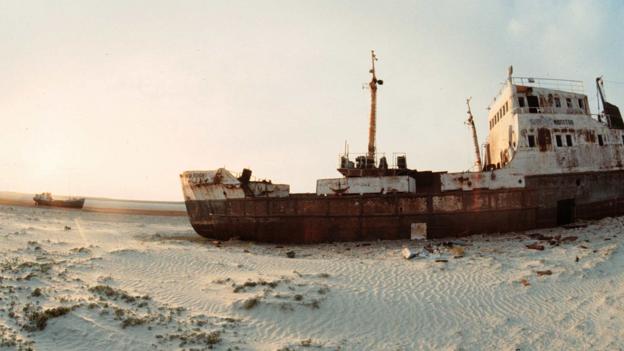
Easily gotten sources — reservoirs, lakes and rivers — are getting quickly depleted. The Aral Sea in Uzbekistan, for example, has shrunk so much that former fishing villages are now surrounded by desert land. Formerly part of the famous Silk Road, the Aral Sea will be completely dry within a decade.

Storied rivers such as the Nile and the Colorado in the US are also losing water as dams and other measures divert water from their flows for agricultural and other uses.

“Too much water is also being taken out of the Nile,” said Dr Jenny Kehl, director of the Center for Water Policy at the University of Wisconsin-Milwaukee. But the Nile isn’t alone, she added, since other great rivers such as the Jordan and the Mekong are also running drier as usage increases.

Deep underground aquifers, which store the freshest water, are also in rough shape as increased demand drains them dry. The problem is particularly acute in North Africa and the southwestern US, Kehl added.

Good news for water companies

Both dwindling supplies and dirtier water are translating into tighter water management. And that’s good news for the 300 global companies plying the water market. Most are in the US, followed by Europe, said Gottelier. Japan is a serious player, too.

Unlike taming carbon, water is a cheerier story.

“There are already lots of solutions in place,” said Cate Lamb, head of Carbon Disclosure Project’s water program. “So water management can shift much more rapidly than carbon.”

Repairing and monitoring crumbling, leaky pipes, pumps and valves is a key part of the water market. There are about 50 to 100 years of underinvestment in water supply upgrades in parts of Europe, said Gottelier, which leads to lots of leakage. In the US, the EPA estimates that upgrades to its aged water infrastructure will cost as much as $400 billion.

Water needs will translate into recurring business for infrastructure manufacturers such as Swiss-based Pentair Ltd, Texas based Flowserve Corp, and New York-based Xylem, said Matthew Sheldon, a portfolio manager for the Calvert Global Water Fund. “They all have very strong business models,” he said.

No surprise, then, that the $197 million Calvert fund’s largest holding is infrastructure stocks, along with technology plays for leak detection. Canada-based Pure Technologies Ltd which inspects and monitors pipelines, is a player in the water efficiency niche. The company is growing 20% to 30% per year, added Sheldon. UK-based Halma PLC also makes leak detection equipment.

Reusing water is the fastest growing niche though, said Sheldon. So water treatment and filtration companies such as Kurita Water Industries Ltd in Japan and China Everbright International in Hong Kong are set to prosper, said Sheldon.

“Much of the world is catching up with purification,” added Neil Berlant, a partner at Crowell, Weedon & Co, a brokerage and money management firm in Los Angeles. “Water treatment transcends all borders.”

Desalination, which removes salt from water, is being heavily used in Israel, Spain and Australia. The main reason: its price is decreasing.

“Up until now, desalination has been a small part of the water industry,” said Sheldon. “But it should begin accelerating next year.” Desalination players include big water utility companies such as VeoliaEnvironnement and Suez Environnement in France and the smaller pure-play company Energy Recovery in the US.

Oddly, few innovative emerging water companies are making waves. The initial public offering market, like the broader market, is still suffering. And new biological treatments for recovering energy and nutrients from waste water are still in their infancy, said Sheldon. More


Wednesday, May 22, 2013

Water, the Great Regional Threat

For decades, long-range forecasters have been predicting that water – and a lack of it – loomed as the biggest threat to regional security. Booming populations, food security, the occasional drought and competition among neighboring countries for dwindling resources made for a pessimistic outlook.

Much of this was pushed down the policy totem pole over the last decade as religion and long standing territorial disputes remerged to challenge Asian diplomats. However, the 2nd Asia-Pacific Water Summit in Chiang Mai in northern Thailand attempted to put water firmly back on the agenda.

The usually calm Sultan of Brunei Hassanal Bolkiah was unusually frank in warning the summit that Asian nations needed to spend about US$380 billion on water and sanitation systems by 2020 if full water security was to be realized.

He described the undertaking as vital and warned water and competing interests "… could lead to international disputes." His comments were echoed by Thai Prime Minister Yingluck Shinawatra who warned “there could be a fight over resources.”

More than 1,300 delegates from 40 countries across the Asia-Pacific met amid tight security and threats of protests by civil society groups arguing governments were doing too little, too late. Thailand’s Deputy Prime Minister Plodprasop Suraswadi was anything but conciliatory, describing protestors as “garbage” and warning they would be arrested.

Protestors argued that water-related projects ignored public needs and were too focused on the construction of infrastructure, where billions of dollars spent on dams had enriched politicians, businessmen and contractors but done little for ordinary citizens.

The Asian Development Bank has warned that almost two-thirds of the region’s population has no access to piped clean drinking water in the home, despite the record economic growth of the past 20 years. Bad management was largely to blame.

Delegates said the answers were in resource sharing and Bangladeshi Prime Minister Sheikh Hasina noted that the water-sharing treaty between her country and neighboring India over access to the Ganges, the most sacred of rivers for Hindus, was a prime example that has worked.

She also warned that conflict could only be prevented by the “… judicious management of access to water resources.”

Nine leaders attending the conference set aside their differences and signed the Chiang Mai Declaration, which essentially reiterated a previous standing commitment to prevent water-related disasters that cause loss of life, economic and social damage.

The nine were Thailand, Brunei, South Korea, Laos, Myanmar, Vietnam, Georgia, Tajikistan and Vanuatu.

The Chiang Mai Declaration is not legally binding. “It is an expression of intention to place importance on water management and in inter-country collaboration for the managing of water resources for mutual benefit, as well as for environmental and economic integrity.”

This fell far short of the concerted and united effort needed to resolve water issues. The public conviviality among leaders – as expected on such occasions – meant long-standing diplomatic rows over control of inland river systems were never addressed.

Heated arguments between Uzbekistan and its neighbors Tajikistan and Kyrgyzstan, which want to build two of the world's biggest hydro-electric power stations, have dominated their relationship over recent years. Tajik President Emomali Rakhmon used the conference to defend his country's right to exploit its own natural resources, including the completion of the Rogun Hydro Power Plant on the Vakhsh River, which has infuriated Uzbeks who fear their downstream agricultural industries, cotton in particular, will be ruined.

Other delegations were silent. Vietnam and Cambodia had bitterly opposed construction of the Xayaburi Dam across the mainstream of the Mekong River by a Thai construction company, which has gone ahead despite independent analysis warning of depleted fish catches.

Thai companies – Ch Karnchang Public Company, which will construct the US$3.5 billion dam and the Electricity Generating Authority of Thailand, which will buy and sell electricity from the dam – intend to profit handsomely. And another ten dams are planned for Laos alone.

Cambodia has also released its own plans for dam construction, including the Lower Sesan Two across major tributaries of the Mekong River. Mainstream dams are also planned and observers say it was for this reason the Cambodian government had ceased its criticism of Xayaburi.

Other issues were left untouched. Singapore relies on Malaysia for much of its fresh water and has sought to resolve its long-standing differences in recent years. For others like the Philippines and Indonesia, excessive rain and flooding have a long and deadly history.

Yingluck said water was essential for economic growth and lives, however, she chose her words carefully, adding the eco system remained off-balance, causing frequent and damaging natural disasters.

As such, the Thai prime minister came across as a vocal supporter for dam construction, saying that restoring the environment and having an effective water management system in place, as a means of controlling water levels, was required.

"We have experience that the cost of investment and planning to prevent natural disasters will be lower than the cost of addressing problems and recovery again and again," she said. "Therefore, we should work together to promote water security by addressing the problems at its roots."

Thailand was initially slated to host water summit two years ago, but it was postponed amid record flooding that left more than 800 dead, shut down the country and prompted Bangkok to find some answers to its long-clogged waterways.

This included a US$12 billion water management plan, a series of floodways, dikes and water-retention areas designed to avert a repeat of the disastrous 2011 floods.

The Chiang Mai water summit did help put water and its potential to cause friction among neighbors back on the agenda – the first summit was held way back in Japan in 2007 — particularly among the 10 members of the Association of South East Asian Nations (ASEAN).

ASEAN is perhaps the fastest growing trading bloc in the world, with plans to establish a single ASEAN Economic Community (AEC) by the end of 2015.

“With all this talk about the ASEAN community, and regional development, you can’t forget about water. No water, no development — it’s as simple as that,” said regional political analyst Ray Leos from Pannasastra University in Phnom Penh.

“You’ve got a burgeoning population, rapid urbanization, climate change, and increased agricultural demand — all these things are putting severe pressure on water supplies.”

But he also added for least developing countries, whether it’s Cambodia, Bangladesh or East Timor, agriculture and access to water remained the key for development and “a water crisis could put a monkey wrench into their plans to accelerate economic growth.” More