Water Security is National Security

Water resources and how they are managed impact almost all aspects of society and the economy, in particular health, food production and security, domestic water supply and sanitation, energy, industry, and the functioning of ecosystems. Under present climate variability, water stress is already high, particularly in many developing countries, and climate change adds even more urgency for action. Without improved water resources management, the progress towards poverty reduction targets, the Millennium Development Goals, and sustainable development in all its economic, social and environ- mental dimensions, will be jeopardized. UN Water.Org

Showing posts with label riverine. Show all posts

Sunday, January 11, 2015

Egypt refuses Renaissance Dam storage capacity

Egypt rejected the current the Grand Ethiopian Renaissance Dam’s (GERD) high storage capacity, as studies showed it will affect its national water security

Grand Ethiopian Renaissance Dam’

Egypt rejected the current the Grand Ethiopian Renaissance Dam’s (GERD) high storage capacity, as studies showed it will affect its national water security, reported state-owned Middle East News Agency (MENA) Sunday.

The dam’s storage capacity reaches 74bn cubic meters. Calling such capacity “unjustified and technically unacceptable”, Egypt asked Ethiopia to reduce it to what was agreed before the start of negotiations over the years-of-filling and operation of the dam.

Egypt, Ethiopia, and Sudan, the three countries involved, are facing difficulties in technical negotiations, said Alaa Yassin, Advisor to the Egyptian Minister of Water Resources and Irrigation and spokesman for the GERD file, according to state news agency MENA.

Yassin hopes that all parties adhere to the August agreements that took place in Sudan“without procrastination and time-wasting”, while the three countries are trying to overcome these difficulties.

“Egypt’s share in the historic Nile River water red line cannot be crossed,” Yassin told MENA.

Ethiopia began constructing the dam in 2011, and since then Egypt and Ethiopia have been locked in a diplomatic dispute, which reached a peak in 2013. Egypt, which utilises more Nile water than any other country, fears the dispute will have a detrimental effect on its share of Nile water.

As per agreements signed in 1929 and 1959, Egypt annually receives 55.5bn cubic metres of the estimated total 84bn cubic metres of Nile water produced each year, with Sudan receiving 18.5bn cubic metres. More


Thursday, January 8, 2015

LA Imports Nearly 85 Percent of Its Water—Can It Change That by Gathering Rain?

The urban drainage-ways of Los Angeles can never quite look like wild creeks, but restoring some of their capacity to store, slow, and filter water fixes many problems at once.

Walk the glaring streets of Los Angeles’ San Fernando Valley on a sun-soaked afternoon in a drought year, the dry, brush-covered mountains rising behind you, and it can be easy to feel that you’re in arid country. “Beneath this building, beneath every street, there’s a desert,” said the fictional mayor in the Oscar-winning 1974 movie Chinatown. “Without water the dust will rise up and cover us as though we’d never existed!”

It’s an apocryphal idea. L.A. is not the Mojave but, climatically, more like Athens. Artesian springs, fed by rain in the mountains and hills, used to bubble up around Los Angeles, and farmers and Spanish missionaries grew fruit and olives in the Valley starting in the 18th and 19th centuries.

But the city has a history of treating its own raindrops and rivers as if they were more problematic than valuable. The L.A. River was prone to catastrophic floods in heavy rains, and, in the 20th century, engineers buried, straightened, and paved sections of the riverbed, flushing the water through concrete drainage channels to the Pacific Ocean. Then, to quench the thirst of its growing population, Los Angeles undertook a series of engineering feats that pumped water from the eastern Sierra Nevada Mountains, Northern California, and the Colorado River via hundreds of miles of pipes and reservoirs. Now the city typically imports more than 85 percent of its water from afar. And it’s as if the waters of Los Angeles disappeared from the consciousness of locals: Many Angelenos will tell you, mistakenly, that they live in a desert.

Now that story is changing again.

In the past decade and a half, a few local environmentalists have been collaborating with city and county officials to rewrite the plan for water here, driven by more and more urgent necessity. As winter temperatures rise in an era of climate change, the city’s distant water sources, fed by mountain snowmelt, are becoming less reliable. And drought years and battles over water allocation are adding to the difficulties. The State Water Project, which transfers water from the north to southern California, announced this year it would supply only five percent of the amount of water requested by agencies around the state (including the Metropolitan Water District of Southern California, which supplies parts of Los Angeles), because of the drought. Court rulings to protect endangered species have limited the amount of water L.A. and other cities can take from the Sacramento-San Joaquin Delta.

There’s no easy way for L.A. to get more water from distant sources, but new research from UCLA suggests that rainfall in the Los Angeles region is likely to stay the same on average in decades ahead.

Urban drainage in L.A. can never look like wild creeks, but restoring some capacity to store, slow, and filter water fixes many problems.

The city will need to become more water self-reliant to survive the rest of this century, and capturing local rain looks much more desirable than in the past. “There’s been a refocus on the value of local stormwater as a resource, not as a nuisance,” says Kerjon Lee, public affairs manager for the Los Angeles County Department of Public Works.

During the 1990s, in the flat landscape of Sun Valley, a San Fernando Valley neighborhood at the foot of the Verdugo Mountains, Los Angeles engineers and bureaucrats began re-imagining what one could do with raindrops.

Sun Valley never stopped acting as a tributary of the Los Angeles River, even as many of its lots filled, over the past several decades, with sand and gravel pits, auto body shops, junkyards, metals recycling plants, and miscellaneous blue-collar industries. Now two-thirds of the land here is covered with what engineers call an “impervious surface,” like concrete or asphalt, which water cannot penetrate. The more such surfaces there are in a neighborhood, the more rainwater tends to puddle up and flood. Heavy rain can make many of Sun Valley’s streets impassable. In one of the worst storms, about a decade ago, a sinkhole swallowed up part of a major street that used to be a riverbed, and a city engineer tumbled in and died.

Sun Valley is one of a few areas of L.A. not served by the massive drainage system that sends stormwater either to San Pedro or Santa Monica Bay. In the 1990s, the county planned to build a series of storm drains throughout the neighborhood—until a local environmentalist and gadfly named Andy Lipkis stepped in and asked them to reconsider.

Lipkis founded an organization called TreePeople in the mid-1970s, when he was just a teenager. The organization eventually made its headquarters on the site of an old fire station in Coldwater Canyon Park, on the high ridgeline along Mulholland Drive, named after the famous engineer who designed the first system to import water to the city on a large scale. There, among the breezy, fragrant slopes of oak and bay trees, you can see what Lipkis has been trying to tell locals his whole life: Much of Los Angeles is part forest and part river.

In 1998, Lipkis rigged a south L.A. house with water cisterns and rain gardens, gathered a group of local officials, and staged a deluge, aiming fire hoses at the roof. The group watched with amazement as the lot soaked up thousands of gallons of water.

He convinced them to consider what, at the time, was a more experimental and costly approach to managing water in Sun Valley, which overlies the San Fernando Valley Groundwater Basin, an aquifer that supplies about 13 percent of L.A.’s water. Lipkis argued that the county and city could begin to revive some of the features of a natural watershed. The urban drainage-ways of Los Angeles can never quite look like wild creeks, but restoring some of their capacity to store, slow, and filter water fixes many problems at once. When stormwater gushes across pavement, it picks up debris and contamination; when it soaks into soil and enters an aquifer, it is cleaner. Conventional storm drains would have only cost about $40 million, while TreePeople says its recommendations were nearly five times as expensive. But the organization’s own analysis suggested that the latter would return at least $300 million in benefits to the city.

“There’s been a refocus on the value of local stormwater as a resource, not as a nuisance.”

Water managers brought the options to stakeholders and residents in the mostly Latino, working-class neighborhood. They chose Lipkis’ approach. “The community didn’t want more concrete,” says Lee.

Alicia Gonzales moved to Sun Valley in 1985, as a nine-year-old, after her parents “fell in love with the house” on Elmer Avenue. Then she and her family watched as the rains poured through her yard, turning it from grass to mud. She remembers how the rain would form a torrent in the alley near her family’s house. “Trash and shopping carts would get stuck there,” she says.

She moved out as a young adult, then returned several years ago to help her father, who was struggling with severe diabetes and kidney disease and needed regular dialysis.

When the streets flooded, many kids in the neighborhood stayed home. Gonzales often wouldn’t drive her daughters to school on rainy days. “My car would get stuck,” she said.

Though Lipkis had sowed the ideas for a new way to manage water here, years passed before anyone found the funding and wherewithal to solve Elmer Avenue’s flooding problems. In 2004, L.A. County finalized a new stormwater plan for Sun Valley. Two years later, the county finished its first project. Under a baseball and soccer field in Sun Valley Park, a tree-lined oasis in the middle of an industrial district, engineers installed a retention tank that collects runoff from the surrounding streets. In 2007, the county Flood Control District spent nearly $4 million to build drains, catch basins, and a tiny corner park at an intersection that used to turn into a deep lagoon in heavy rain—and was a favorite location for news crews to shoot dramatic footage of local storms.

About eight years ago, employees of TreePeople appeared on Gonzales’ block. They said that her street was part of a watershed, and stormwater from the mountains was pouring into her backyard. (When Gonzales first met Andy Lipkis, she says he rhapsodized about her parents’ olive tree, nearly the only landscaping that had survived the flood damage.) An organization called the Council for Watershed Health had partnered with TreePeople to renovate her street.

“There’s been a refocus on the value of local stormwater as a resource, not as a nuisance.”

The Council for Watershed Health led the effort to pull apart the street and put in rain barrels, rain gardens, underground water tanks, and water-permeable walkways and driveways. Gonzales got one of a few special grants to replant her muddy yard, and volunteers showed up at her house to help with the landscaping. The alley became a pedestrian walkway that the project organizers dubbed The Paseo, a meandering sidewalk lined with native plants between concrete-block walls, painted with the words, “Water is the driving force of life.” In rainstorms now, the water runs through the landscaping, and kids walk the path to school. Neighbors water their drought-tolerant plants with rain barrels, but most of the rain soaks in under the street.

As small as these three projects were—a single city block, a corner park, and a soccer field—they have gotten the attention of the entire region: two Southern California regional water districts, several Los Angeles city and county agencies, the federal Bureau of Reclamation, and a number of state agencies got involved and provided funding for Elmer Avenue. These projects have become test cases for a much larger strategy to boost the water supply every time it rains across the entire region.

In Sun Valley, the county plans ultimately to capture nearly all of the rainwater that pours through the neighborhood. Next to Sun Valley Park, the city and county are planning to convert what is now a gravel pit and concrete plant into a 46-acre park that will collect in an average year about enough water to supply 4,000 Angelenos.

Their findings come at a crucial time. Crumbling infrastructure and a new court ruling are forcing the hands of local officials: A federal court has ordered the county to clean up the Los Angeles and San Gabriel Rivers, currently fouled by the dirt, grime, and toxins that wash from streets into storm drains. Meanwhile, billions of dollars worth of city water infrastructure is falling apart and has to be replaced before it breaks down.

The city of Santa Monica has set a goal to use only local water by 2020.

The city needs to both clean up its stormwater problem and find more water to drink. TreePeople says it could do both at once and is working with the City of Los Angeles to rewrite its entire stormwater management plan by next year. The county has undertaken a study, in partnership with the Bureau of Reclamation, to predict how climate change will affect local hydrology and what it can do to better capture stormwater. Water districts throughout the region are following suit: The Water Replenishment District of Southern California, which manages groundwater for parts of the region, has set a goal to wean itself off imported water altogether by treating and recycling wastewater and collecting more stormwater. The Council for Watershed Health released a study in 2012 estimating that the district could capture 5.5 billion gallons of water per year through more projects like Elmer Avenue.

The city of Santa Monica has set a goal to use only local water by 2020. The Los Angeles Department of Water and Power estimates that by 2035, it will import just over half of its water (down from 85 percent), meet 9 percent of its water needs by conserving more, and supply 28 percent by using local groundwater, capturing stormwater, and recycling water from sewage. Water recycling and stormwater projects aren’t cheap, but they’re typically less costly than building high-energy desalination plants that distill water from the ocean. A new desalination plant is going up in Carlsbad, south of Los Angeles. But if groups like TreePeople and the Council succeed, southern California may not need to build many more facilities like this.

“We’re looking at how we could shift the amount of water we currently squander.” says Edith de Guzman, a researcher at TreePeople. More

Madeline Ostrander wrote this article for Cities Are Now, the Winter 2015 issue of YES! Magazine. Ostrander is a contributing editor to YES! and a 2014 National Health Journalism Fellow. She lives in Seattle and writes about the environment and climate change.


Sunday, January 4, 2015

Abu Dhabi summit to discuss water security challenges

More than 32,000 global leaders from 170 countries representing government, industry, investment and research to Abu Dhabi, will provide an upfront look at affordable technologies to enable sustainable water resource management to help meet the Middle East’s rising demand for water.

Hosted by Masdar, Abu Dhabi’s renewable energy company, ADSW is a yearly platform that addresses the interconnected challenges of energy and water security, climate risk and sustainable development.

Running from January 17 to 24, ADSW includes the World Future Energy Summit (WFES), the world’s foremost event dedicated to the advancement of renewable energy, energy efficiency and clean technology; and the International Water Summit (IWS), which provides a business approach to addressing water scarcity, sustainable growth and economic development in arid regions.

“The Mena region is in a truly unique position to solve the challenge of water security,” remarked Raed Bkayrat, vice president of development for Saudi Arabia at First Solar, which is participating in WFES.

“While the region is quite arid, it also has one of the highest solar irradiances of any region in the world, and much of the population has ready access to seawater. Accordingly, solar photovoltaic projects are proving to be sustainable means of powering water desalination in the region, ensuring that the supply of clean water will keep up with the region’s increasing demand for it,” he noted.

Masdar took a major step by launching a pilot project to test energy-efficient desalination technologies – such as reverse osmosis and forward osmosis – powered by renewable energy.

The company awarded contracts to Abengoa, Degremont, Sidem/Veolia and Trevi Systems to build the desalination plants, which are expected to enable the implementation of cost-competitive desalination plants powered by renewable energy in the UAE and abroad.

“Engaging different sectors of the industry is really crucial to bring forward innovative solutions, as well as pilot projects that demonstrate to governments the value of new integrated systems,” Bkayrat added.

Both WFES and IWS will offer numerous keynote addresses, panel discussions and workshops as well as exhibitors introducing affordable technologies to enable sustainable water resource management.

Along with WFES and IWS, ADSW will include the second EcoWaste and the seventh Zayed Future Energy Prize Award Ceremony; it also coincides with the Fifth General Assembly of the International Renewable Energy Agency.-TradeArabia News Service More


Thursday, December 11, 2014

Water woes in Lima: A glimpse of our future?

As UN negotiators meet in Lima to work out a plan for dealing with rising temperatures, Matt McGrath visited a community paying a high price for water supplies threatened by climate change and increasing demand. Is Peru's experience a sign of things to come?

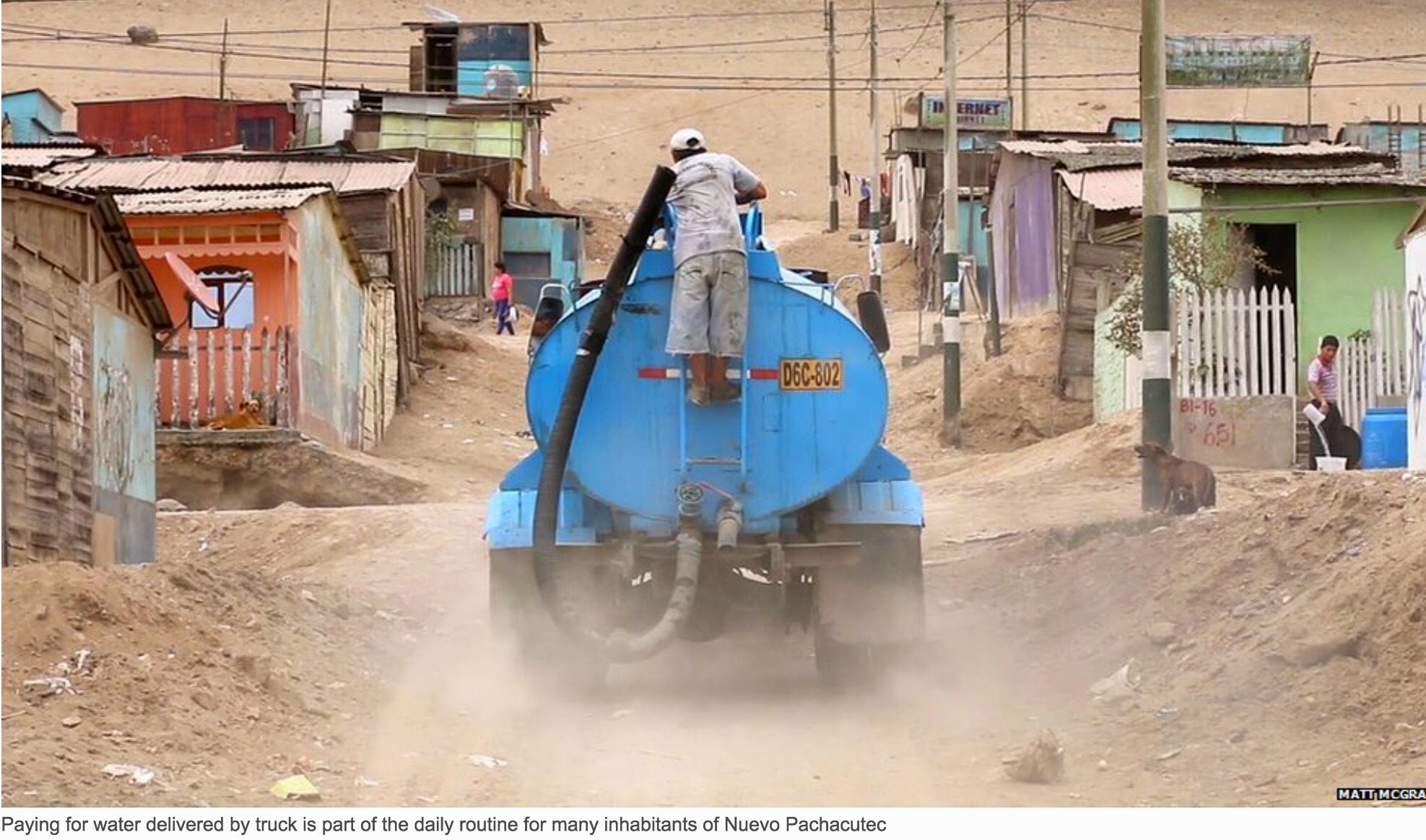
Snarling and screeching, the bouncing water truck speeds backwards down the steep hill, in a cloud of coarse dust.

It halts with a judder and a wild eyed, sweaty man jumps from the cab, grabs a large plastic pipe on the back and starts to fill a series of plastic containers on the ground, with little care.

Dressed in bright pink, a woman looks on nonchalantly.

The man runs up to her and holds out his hand. She drops some coins and away he goes, jumping onto the running board of his vehicle, already snorting its way to the next stop.

This is daily routine for tens of thousands of people who live in this sprawling hillside settlement that looks down on the Pacific Ocean, less than an hour north of Lima, Peru.

Water in Nuevo Pachacutec is not just the vital substance for life, it is a measure of social status and progress.

People first came to these hazy hills in the 1980s, in response to politicians who promised them land in return for votes.

When they first arrived the women said their feet would just sink in the sand. That's all that was here.

The politicians allowed them to take the ground - but most of the 160,000 people here do not have legal title. They are "possessors of the land" but not the owners.

And land is too grand a word. This is really a desert. After Cairo, Lima is said to be the world's second biggest city built in one. Rainfall here amounts to just 50mm of water per year.

A river runs through it

A few kilometres south of Nuevo Pachacutec, a miserable, dirty stream meanders under a motorway.

Bags of rubbish sit alongside the ubiquitous tractor tyres.

This is the Chillon river, the sole water source for around two million people in northern Lima.

The waters of the Chillon are fed by glaciers in the Andes. And this is a source of concern.

"We are worried here in Peru because climate change is already having a huge impact on our access to water," says Armando Mendoza a research officer with Oxfam in the country.

"In the last 40 years, the glacial coverage has retreated by 40% more or less, because of the increase in global warming.

"The predictions are that in the future access to water will become even more difficult and the ones who are most vulnerable to this are the poor."

These longer term water issues with glaciers are not the immediate priority in Nuevo Pachacutec.

As well as the speeding tuktuks, the sandy roads are festooned with signs for car washes, even private schools.

Despite the fact that 80% of the homes are made of wood, incomes and aspirations are rising here.

Access to water is critical in this development, as it is in developing nations all over the world.

With funding from the German government, a green group called Alternativa has helped build networks of white water tanks, connected by underground tubes that bring water directly to the houses.

They have also installed 900 outside water points in this sprawling settlement.

Their efforts to date have brought the vital liquid to 9,000 households.

In this community, water is more than just a key ingredient for life, it is a reflection of harsh social divisions.

The blue barrels

Despite the fact that 80% of the homes are made of wood, incomes and aspirations are rising here.

Access to water is critical in this development, as it is in developing nations all over the world.

With funding from the German government, a green group called Alternativa has helped build networks of white water tanks, connected by underground tubes that bring water directly to the houses.

They have also installed 900 outside water points in this sprawling settlement.

Their efforts to date have brought the vital liquid to 9,000 households.

In this community, water is more than just a key ingredient for life, it is a reflection of harsh social divisions.

Radios and children play loudly on the street where Daniza Cruz Navarro lives.

The homes on this stretch are known as the "casas azules" - the blue houses.

Outside many sit blue plastic barrels, some with lids, some without, that hold the water residents get from the trucks that constantly career about the local roads.

Dogs lap from the open containers. Mosquitoes lay their eggs in the water.

"You can see the effects of the way the water is being stored in the kids' health," says Daniza.

"They often get sick, there is often misuse and mismanagement of the water here."

She has moved on from the blue barrel and is now the owner of a more effective and efficient water tank that she has bought through the efforts of Alternativa.

However, as she still gets water directly from the delivery trucks, she has to pay significantly more than her neighbours.

Daniza says she pays 120 Nuevo Soles (£26; $40) per month for the precious water. This is about 10% of her household income.

Those who are connected to the main water grid pay just 6-12 Soles per month.

These are big sums of money and the differences can be a source of friction between neighbours.

Despite these problems, those who work with the people in Nuevo Pachacutec say progress is being made. It's really a story of local self-empowerment.

"Even if they are not perfect, they have bettered considerably," says engineer Osvaldo Caceres who works with Alternativa.

"This infrastructure is managed by them, for them. The local population know what they want, but they know and understand they have to participate to get it.

Plug and pay


"When we first got here it was all desert - there were no roads, it was pure sand," says Ycella Bonilla a resident of Nuevo Pachacutec.

She stands proudly in the doorway of her recently built bathroom cum laundry room, completed with the help of microfinance.

Ycella calls it her "unit of dignity".

Despite this advance, Ycella and her family are still paying heavily for water. She has a hose and a key that allows her family to plug into a water point. For this she pays 80 Nuevo Soles a month (£18; $27) a month.

Despite the gripes over cost, Ycella recognises that water is the bedrock of development for the community.

"We have roads, we have schools, we have a lot of the basic necessities now, including water."

The struggle for development and the need to have resources like water to empower that development is not just on the minds of those in Nuevo Pachacutec.

An hour down the road in Lima itself, UN climate negotiators are struggling with that same dilemma. How to balance the burgeoning needs of a growing population, with the need to limit those same enriching activities because they threaten the future of the planet.

Osvaldo Caceres says that as in solving the water stresses of Nuevo Pachacutec, the climate battle can be won, by everyone playing their part now. It's no use passing the buck down the generations.

"Every actor in this chain must take responsibility for what they have to do," he says.

"The governments, the authorities, and obviously the people, they all need to act." "There is no other way." More


Friday, November 21, 2014

IWMI Launches Book on Developing Water-Related SDGs


IWMI logo20 October 2014: The International Water Management Institute (IWMI) has released a book, titled ‘On Target for People and Planet: Setting and Achieving Water-Related Sustainable Development Goals (SDGs),' which highlights that framing water-related SDGs in a water security context provides a more comprehensive framework than the human-needs approach of the Millennium Development Goals (MDGs).


The book calls for: recognizing economic water scarcity; balancing development and conservation needs; and exploring pragmatic solutions. The book also identifies four key challenges: development of broad partnerships within the water sector and beyond; accommodation of growth requirements particularly in Asia and Africa; large-scale investments in water resources and agriculture need to complement, rather than undermine small-scale producers; and integration of policies for coherent water management across sectors. Next steps are also identified in the book: supporting governments to set national targets; achieving water and food security-related SDGs; and measuring and tracking progress.


The book includes chapters on: water-food-energy nexus; water governance; water metrics; social inclusion; sustainable development and ecosystem services; managing water variability; water quality; and accessing and putting water to productive use in Sub-Saharan Africa. [Publication: On Target for People and Planet: Setting and Achieving Water-Related SDGs] More


Thursday, November 20, 2014

Wells Dry, Fertile Plains Turn to Dust

HASKELL COUNTY, Kan. — Forty-nine years ago, Ashley Yost’s grandfather sank a well deep into a half-mile square of rich Kansas farmland. He struck an artery of water so prodigious that he could pump 1,600 gallons to the surface every minute.

Last year, Mr. Yost was coaxing just 300 gallons from the earth, and pumping up sand in order to do it. By harvest time, the grit had robbed him of $20,000 worth of pumps and any hope of returning to the bumper harvests of years past.

“That’s prime land,” he said not long ago, gesturing from his pickup at the stubby remains of last year’s crop. “I’ve raised 294 bushels of corn an acre there before, with water and the Lord’s help.” Now, he said, “it’s over.”

The land, known as Section 35, sits atop the High Plains Aquifer, a waterlogged jumble of sand, clay and gravel that begins beneath Wyoming and South Dakota and stretches clear to the Texas Panhandle. The aquifer’s northern reaches still hold enough water in many places to last hundreds of years. But as one heads south, it is increasingly tapped out, drained by ever more intensive farming and, lately, by drought.

Vast stretches of Texas farmland lying over the aquifer no longer support irrigation. In west-central Kansas, up to a fifth of the irrigated farmland along a 100-mile swath of the aquifer has already gone dry. In many other places, there no longer is enough water to supply farmers’ peak needs during Kansas’ scorching summers.

And when the groundwater runs out, it is gone for good. Refilling the aquifer would require hundreds, if not thousands, of years of rains.

This is in many ways a slow-motion crisis — decades in the making, imminent for some, years or decades away for others, hitting one farm but leaving an adjacent one untouched. But across the rolling plains and tarmac-flat farmland near the Kansas-Colorado border, the effects of depletion are evident everywhere. Highway bridges span arid stream beds. Most of the creeks and rivers that once veined the land have dried up as 60 years of pumping have pulled groundwater levels down by scores and even hundreds of feet.

On some farms, big center-pivot irrigators — the spindly rigs that create the emerald circles of cropland familiar to anyone flying over the region — now are watering only a half-circle. On others, they sit idle altogether.

Two years of extreme drought, during which farmers relied almost completely on groundwater, have brought the seriousness of the problem home. In 2011 and 2012, the Kansas Geological Survey reports, the average water level in the state’s portion of the aquifer dropped 4.25 feet — nearly a third of the total decline since 1996.

And that is merely the average. “I know my staff went out and re-measured a couple of wells because they couldn’t believe it,” said Lane Letourneau, a manager at the State Agriculture Department’s water resources division. “There was a 30-foot decline.”

Kansas agriculture will survive the slow draining of the aquifer — even now, less than a fifth of the state’s farmland is irrigated in any given year — but the economic impact nevertheless will be outsized. In the last federal agriculture census of Kansas, in 2007, an average acre of irrigated land produced nearly twice as many bushels of corn, two-thirds more soybeans and three-fifths more wheat than did dry land.

Farmers will take a hit as well. Raising crops without irrigation is far cheaper, but yields are far lower. Drought is a constant threat: the last two dry-land harvests were all but wiped out by poor rains.

In the end, most farmers will adapt to farming without water, said Bill Golden, an agriculture economist at Kansas State University. “The revenue losses are there,” he said. “But they’re not as tremendously significant as one might think.”

Some already are. A few miles west of Mr. Yost’s farm, Nathan Kells cut back on irrigation when his wells began faltering in the last decade, and shifted his focus to raising dairy heifers — 9,000 on that farm, and thousands more elsewhere. At about 12 gallons a day for a single cow, Mr. Kells can sustain his herd with less water than it takes to grow a single circle of corn.

“The water’s going to flow to where it’s most valuable, whether it be industry or cities or feed yards,” he said. “We said, ‘What’s the higher use of the water?’ and decided that it was the heifer operation.”

The problem, others say, is that when irrigation ends, so do the jobs and added income that sustain rural communities.

“Looking at areas of Texas where the groundwater has really dropped, those towns are just a shell of what they once were,” said Jim Butler, a hydrogeologist and senior scientist at the Kansas Geological Survey.

The villain in this story is in fact the farmers’ savior: the center-pivot irrigator, a quarter- or half-mile of pipe that traces a watery circle around a point in the middle of a field. The center pivots helped start a revolution that raised farming from hardscrabble work to a profitable business.

Since the pivots’ debut some six decades ago, the amount of irrigated cropland in Kansas has grown to nearly three million acres, from a mere 250,000 in 1950. But the pivot irrigators’ thirst for water — hundreds and sometimes thousands of gallons a minute — has sent much of the aquifer on a relentless decline. And while the big pivots have become much more efficient, a University of California study earlier this year concluded that Kansas farmers were using some of their water savings to expand irrigation or grow thirstier crops, not to reduce consumption.

A shift to growing corn, a much thirstier crop than most, has only worsened matters. Driven by demand, speculation and a government mandate to produce biofuels, the price of corn has tripled since 2002, and Kansas farmers have responded by increasing the acreage of irrigated cornfields by nearly a fifth.

At an average 14 inches per acre in a growing season, a corn crop soaks up groundwater like a sponge — in 2010, the State Agriculture Department said, enough to fill a space a mile square and nearly 2,100 feet high.

Sorghum, or milo, gets by on a third less water, Kansas State University researchers say — and it, too, is in demand by biofuel makers. As Kansas’ wells peter out, more farmers are switching to growing milo on dry land or with a comparative sprinkle of irrigation water.

But as long as there is enough water, most farmers will favor corn. “The issue that often drives this is economics,” said David W. Hyndman, who heads Michigan State University’s geological sciences department. “And as long as you’ve got corn that’s $7, then a lot of choices get made on that.”

Of the 800 acres that Ashley Yost farmed last year in Haskell County, about 70 percent was planted in corn, including roughly 125 acres in Section 35. Haskell County’s feedlots — the county is home to 415,000 head of cattle — and ethanol plants in nearby Liberal and Garden City have driven up the price of corn handsomely, he said.

But this year he will grow milo in that section, and hope that by ratcheting down the speed of his pump, he will draw less sand, even if that means less water, too. The economics of irrigation, he said, almost dictate it.

“You’ve got $20,000 of underground pipe,” he said. “You’ve got a $10,000 gas line. You’ve got a $10,000 irrigation motor. You’ve got an $89,000 pivot. And you’re going to let it sit there and rot?

“If you can pump 150 gallons, that’s 150 gallons Mother Nature is not giving us. And if you can keep a milo crop alive, you’re going to do it.”

Mr. Yost’s neighbors have met the prospect of dwindling water in starkly different ways. A brother is farming on pivot half-circles. A brother-in-law moved most of his operations to Iowa. Another farmer is suing his neighbors, accusing them of poaching water from his slice of the aquifer.

A fourth grows corn with an underground irrigation system that does not match the yields of water-wasting center-pivot rigs, but is far thriftier in terms of water use and operating costs.

For his part, Mr. Yost continues to pump. But he also allowed that the day may come when sustaining what is left of the aquifer is preferable to pumping as much as possible.

Sitting in his Ford pickup next to Section 35, he unfolded a sheet of white paper that tracked the decline of his grandfather’s well: from 1,600 gallons a minute in 1964, to 1,200 in 1975, to 750 in 1976.

When the well slumped to 500 gallons in 1991, the Yosts capped it and drilled another nearby. Its output sank, too, from 1,352 gallons to 300 today.

This year, Mr. Yost spent more than $15,000 to drill four test wells in Section 35. The best of them produced 195 gallons a minute — a warning, he said, that looking further for an isolated pocket of water would be costly and probably futile.

“We’re on the last kick,” he said. “The bulk water is gone.” More


Tuesday, November 18, 2014

Water Resource Management- New Publication 2014

Department of Organic Food Quality and Food Culture, University of Kassel and Department of Archaeology and Heritage Management, Rajarata University, Sri Lanka are pleased to announce about the publication of their new research paper, titled "Water Resource Management in Dry Zonal Paddy Cultivation in Mahaweli River Basin, Sri Lanka: An Analysis of Spatial and Temporal Climate Change Impacts and Traditional Knowledge" in the Special Issue "Changes in precipitation and impacts on regional water resources", Climate Journal International.

The paper may be accessed at http://www.mdpi.com/2225-1154/2/4/329

Abstract: Lack of attention to spatial and temporal cross-scale dynamics and effects could be understood as one of the lacunas in scholarship on river basin management. Within the water-climate-food-energy nexus, an integrated and inclusive approach that recognizes traditional knowledge about and experiences of climate change and water resource management can provide crucial assistance in confronting problems in megaprojects and multipurpose river basin management projects.

The Mahaweli Development Program (MDP), a megaproject and multipurpose river basin management project, is demonstrating substantial failures with regards to the spatial and temporal impacts of climate change and socioeconomic demands for water allocation and distribution for paddy cultivation in the dry zone area, which was one of the driving goals of the project at the initial stage. This interdisciplinary study explores how spatial and temporal climatic changes and uncertainty n weather conditions impact paddy cultivation in dry zonal areas with competing stakeholders' interest in the Mahaweli River Basin.

In the framework of embedded design in the mixed methods research approach, qualitative data is the primary source while quantitative analyses are used as supportive data. The key findings from the research analysis are as follows: close and in-depth consideration of spatial and temporal changes in climate systems and paddy farmers' socioeconomic demands altered by seasonal changes are important factors. These factors should be considered in the future modification of water allocation, application of distribution technologies, and decision-making with regards to water resource management in the dry zonal paddy cultivation of Sri Lanka. More


Thursday, November 13, 2014

Drought Is Taking California Back to the Wild, Wild West

Mary Madden feels paranoid. Last fall Madden noticed something suspicious. The water filling the tanks outside her veterinary clinic in Los Gatos, Calif., was disappearing at an alarming rate. Madden checked for leaks but found none. Then she realized: Someone was stealing her water.

"I just couldn't believe it," she said. "You never imagine anyone would do something like that but there it was, vanishing right before our eyes."

Madden decided to act. She installed security cameras. Then she put locks on the tanks. She even strung a chain across her driveway to keep out unwanted visitors. The theft stopped after the locks went on. But Madden never caught the thief, and she can't stop thinking about who did it.

"This is a really small community, so you sit here and start going through everyone you know and wondering if it was them," she said.

Madden is not alone. Water theft has become increasingly common in California as the state suffers through its worst drought on record. There's no reliable tracking of just how much water has gone missing. But reports of theft rose dramatically in the past year. Officials say a black market set up to peddle water is thriving as wells run dry. And law enforcement is scrambling to respond.

Mendocino County has made catching water thieves a top priority. The sheriff's office set up a water-theft hotline and investigates every tip. It also puts out patrols to sniff out suspicious activity.

In August, a sheriff's deputy there followed a trail of water droplets up a dirt road where he discovered a truck outfitted with a water tank. A confession came quickly. The driver had siphoned water from a nearby canal and planned to sell it to the highest bidder.

The Public Works Department in Lemoore, in Kings County, hired someone to scan city streets for thieves after officials found evidence that someone has been stealing water from fire hydrants.

For now, a statewide effort to curb water theft has yet to materialize. So cities and counties have been left to devise their own methods of retribution.

Officials complain that the penalty for getting caught may not be sufficiently strict: Mendocino County counts water theft as a misdemeanor. County Supervisor Carre Brown considers that a slap on the wrist. "To me this is like looting during a disaster. It should be a felony," Brown said.

Contra Costa County fines anyone caught stealing water $25. Amid worsening theft, the county may soon increase the penalty to $250 and up the amount to $500 for repeat offenders.

But even with all the attention from law enforcement, officials say that much of the theft has gone unpunished.

"This is something that's very hard to pin down. If you don't catch someone in the act, how do you prove they did it?" Mendocino County Sheriff Tom Allman said.

As a result, some California residents have taken matters into their own hands. Online forums and community message boards serve as informal channels where people can post a warning. Word-of-mouth has also proven effective at spreading information.

After Madden told people what had happened, neighbors started to keep an eye on her property. "People will tell me if they see a truck lingering nearby when I'm not there," she said. "We all look out for each other."

Rural communities where residents rely on well water and areas of the state that play host to agricultural operations and illegal marijuana cultivation have been particularly hard hit.

Thousands of gallons of water were stolen from a fire station in North San Juan, a town nestled in the foothills of the Sierra Nevada Mountains, at the height of wildfire season this summer. The theft was discovered after an engineer hit the station's water tank and heard a hollow ringing sound rather than the usual thud.

"We were just absolutely stunned," said Boyd Johnson, a battalion chief with the North San Juan fire department. "Fires are on everyone's mind during the summer so to see this happen, I think it really scared people."

Residents of North San Juan depend on wells for water. The area is also known for growing marijuana and located just a few hours north of California's Central Valley, an area of the state where farmers rely on massive amounts of water to ensure the success of their crops.

This past summer thieves also made off with water from an elementary school and a public health clinic on the San Juan Ridge.

James Berardi, the principal of the school that was hit, says security cameras have been installed in an effort to catch thieves. The fire department is also taking precautions. After the theft, lockboxes with a combination padlock were put on each of the station's water tanks.

"It slows us down a bit getting to the water, but at least we know it's safe," Johnson said.

A growing number of wells have run dry on the ridge as the drought drags on. And that, according to Caleb Dardick, a resident of nearby Nevada City, means the theft is unlikely to end anytime soon.

"People are becoming desperate," Dardick said. "The situation has become really severe in the last few years."

All this has made water a chief concern for residents of the state who say they never used to give water a second thought.

"I think about water constantly, obsessively," Madden said. "I wake up every day dreading what might happen if we run out." More


Thursday, November 6, 2014

AGWA Launches Toolkit for Climate Change Adaptation in Water Resources Management


4 September 2014: The Alliance for Global Water Adaptation (AGWA) and partners have launched a manual for dealing with uncertainty under climate change by applying climate-informed decision-making to water resource management, project design and risk evaluation.


The manual was launched in a seminar held during World Water Week, on 4 September.


‘Beyond Downscaling: A Bottom-Up Approach to Climate Adaptation for Water Resources Management' is the result of two years' work by AGWA, the World Bank, the Inter-American Development Bank (IDB), US Army Corps of Engineers, University of Massachusetts and RTI International, among others.


It provides practical guidelines for practitioners and project coordinators for risk-based decision making and adaptation of water systems by using a bottom-up approach. The book aims to “provide an alternative approach contributing to improvement in the quality and effectiveness of water resources management planning and project design under climate variability and change uncertainty.”


The manual covers: AGWA's approach to sustainable water management; climate change impacts on water resources; mainstreaming adaptation into water resources management; key tools for supporting climate risk assessment; and approaches to identifying adaptation strategies for water projects. It also makes the case for moving beyond down-scaling global climate models, to a bottom-up approach to climate adaptation in the water sector, and presents a framework for an AGWA-supported adaptation approach.


The approach supported by AGWA, inter alia: recognizes the need to integrate climate adaptation into existing decision-making processes; advocates for bottom-up approaches to vulnerability assessment; supports the use of “systematic decision trees based on existing water resources management approaches”; stresses the importance of creating flexible decision pathways; and emphasizes the integration of flexible governance mechanisms into water resources management.


Speaking at the launch, Marcus Wijnen, Senior Water Resources Management Specialist, World Bank, noted that the book is “work in progress,” and invited stakeholders to provide feedback. More


The 2014 World Water Week took place from 31 August-5 September, in Stockholm, Sweden. [AGWA Publication Webpage] [Publication: Beyond Downscaling: A Bottom-up Approach to Climate Adaptation for Water Resources Management] [Video of Launch]


Friday, October 17, 2014

Water as a single post-2015 UN Sustainable Development Goal

We need a single post-2015 Sustainable Economic and Social Development Goal for Water with four concrete targets responding to the major challenges: access to truly safe water for basic needs, access to decent sanitation, primary treatment of all wastewater (see my previous post), and, last but not least, rebalancing overdraft of freshwater.

I made my proposals already on several occasions and would like to use this platform to bring them to the attention of an even wider group of people. They are based on a broad consultationearlier this year and then further developed in many discussions with persons from civil society, private sector and government. A single goal for water with four concrete targets as part of the Post-2015 UN Sustainable Development GoalsThe discussion on the post-2015 Goals is ongoing both in New York and in capitals of UN member countries.

The proposals of a single water goals with the four targets as specified below need, if you agree with them, your support whenever and wherever possible

1) Water as a human right – implement the universal accesses to safe drinking water bringing ‘improved’ water to all people by 2025 at the latest, with a parallel focus and longer-term perspective (i.e., beyond 2025) on quality, i.e., moving from an ‘improved’ water perspective to ‘truly safe drinking water’, and on bringing this water actually to the homes of individual citizens. While it is essential for achieving this target that infrastructure costs (including capital costs) are fully covered, water to cover the very basic needs must be free for those who are unable to pay

2) Accelerate the provision of access to improved sanitation to at least 120 million additional people per year, aiming for universal access before 2050. Data on actual improvements achieved show that this is realistically possible; with further strengthened efforts political leaders might aim for even more ambitious targets.

3) Adequate treatment of all municipal and industrial wastewater prior to discharge by 2030. Best practice initiatives and learning to reduce groundwater pollution by agricultural production (traditional, organic, etc.). According to FAO only about half of the 285 cubic-kilometres of wastewater are treated, and only some 10% of treated municipal wastewater is directly re-used. This means there is potential here to close the gap – as outlined in my previous post here on LinkedIn

4) Finally, yet fundamentally, we must address the water overdraft, i.e., bringing freshwater use/waste (initially measured as withdrawals) back into line with sustainable supply (natural renewal minus environmental flows). Without change in the way we are using water today, we risk shortfalls of up to 30% of global cereal production due to water scarcity by 2030. First priority must be on this target 4, if we can’t overcome water overuse, water shortage will impact all other targets above. Cost effective and comprehensive actions are needed, combining the supply side and demand side by increasing the efficiency of water use and managing wastewater as a reusable resource. The 2030 Water Resources Group that I am chairing, a disruptive public-private partnership, is participating in these efforts. But it is an initiative that still needs more support – we are looking for more companies and other stakeholders to join.

Need for reality checks of goals, need for good management, and need for a broader policy context.

All of these targets need to be checked against reality: we did it with data of improvements of the past. But then it is also about good management of their local implementation, rather than solemn declarations, that is what is most needed in the coming years.

And they need to be put in the context of other policies and urgent policy changes:

  • more efforts to reduce loss and waste of food, again a management task, also with the necessary investment in infrastructure, and more responsibility of consumers in advanced economies;
  • we must further liberalise international trade (of virtual water) so, water intensive staple food, for instance, can be grown in regions where water is abundant;
  • land and other property, but also usage rights, for instance private rights to use water particularly of small farmers must be better protected;
  • and governments must no longer wait and stop mandates and subsidies for biofuels.

Water plays a complex role in society and human life, which makes its management quite challenging. This means further discussion on all the points I’ve made over the past few posts remains necessary. More


Friday, September 19, 2014

Jamaican's Cautioned Against False Sense Of Water Security

THE RAINS have returned, bringing with them relief from drought conditions that plagued the island during the summer, but Jamaicans must guard against a false sense of water security.

Hope River in dry season

So says Director of the Climate Studies Group Mona Dr Michael Taylor, who is supported in his caution by Herbert Thomas, deputy managing director of the Water Resources Authority.

Taylor, a physicist, urges Jamaicans to be mindful not only of the El Niño phenomenon that promises a return to the dry spell towards the end of this year and into next year. They need, too, he warned, to be cognisant of climate change, which will see the island experiencing longer and more severe dry spells over the long term, as well as flooding incidents.

"As El Niño peaks, we might revert to dry conditions somewhere between the end of the year and early next year, but as it declines, we are susceptible to the reverse, which is flooding, when the early rainfall season kicks in," he said.

"So the point is, we have to figure out how to be resilient to these swings in extremes from drought to flood within the course of a year, and these kinds of swings will become more and more the norm under climate change," the scientist posited.

This is borne out by research done over the last two to three years by the Climate Studies Group for the Planning Institute of Jamaica.

That research, Taylor said, looks at climate scenarios up to 2040, with a focus on projections for temperature and rainfall.

"The temperature will continue increasing about one degree up to 2040, and that is further from where we are now. We have warmed by about one degree over the last 50 years. What that really translates into is, the number of really hot days is increasing every year and the number of really hot nights is also increasing and will continue to increase," he said.

"Rainfall will continue with this form of variability, which is a yearly swing between drought and flood conditions, but by 2040 will show the beginning of an overall long-term drying trend. This means that, from 2040 onward, even though we will get rain, we will get less overall rain," added Taylor.

The solution, he said, is a comprehensive look at water security, something Government is attempting to tackle, with work ongoing on a new water policy that takes account of climate impacts.

"We need to be concerned about water capture, water storage, water access, conservation, efficiency, and using science to help us to better plan for these kinds of extreme variations," the head of the physics department at the University of the West Indies said.

Thomas agreed, noting that the island's long-term water security will depend on a comprehensive plan, informed by the new water policy now nearing completion, and with both private citizens and Government working in concert.

"Some people like to stand under the shower and sing. Cutting out things like those [is important]; you would be surprised to know the amount of water you waste that way," he told The Gleaner recently.

Retrofitting for conservation

In addition, Thomas said Jamaicans might have to look at retrofitting their homes and offices to include features such as low-flush toilets and faucets that use less water for showers. This, while the island looks at alternative energy sources in order to reduce the overall cost of getting water to the areas where it is needed.

Checks with communications manager at the National Water Commission, Charles Buchanan, revealed that current electricity cost for water stands at some of $500 million monthly.

Beyond that, Thomas said there is the need to look at rainwater harvesting and the comprehensive use of wastewater, to which the water policy also gives attention.

"For example, the treated sewage out at Soapberry, there is the thinking that some of the water could be used in St Catherine areas for agriculture and, therefore, the water normally used for agriculture could be freed up for domestic use in Kingston," he noted.

"And there are other things ... . You might have to consider a double-plumbing system so you separate grey water (water from bathroom sinks, tubs and washing machines, etc) from black water. Grey water you can use to flush toilets and water lawns," Thomas added. More