Water Security is National Security

Water resources and how they are managed impact almost all aspects of society and the economy, in particular health, food production and security, domestic water supply and sanitation, energy, industry, and the functioning of ecosystems. Under present climate variability, water stress is already high, particularly in many developing countries, and climate change adds even more urgency for action. Without improved water resources management, the progress towards poverty reduction targets, the Millennium Development Goals, and sustainable development in all its economic, social and environ- mental dimensions, will be jeopardized. UN Water.Org

Showing posts with label desert. Show all posts

Sunday, November 26, 2017

In Peru's deserts melting glaciers are a godsend - until they are gone

Using some of the glacial water to ‘Green’ the Peruvian the desert, as is being done in China and North Africa would be a smart move. See LOESS PLATEAU WATERSHED REHABILITATION PROJECT


Yet climate change now threatens some of these ambitious undertakings, reducing lakes, diminishing aquifers and shrinking glaciers that feed crops. Here in Peru, the government irrigated the desert and turned it into farmland through an $825 million project that, in a few decades, could be under serious threat.

“We’re talking about the disappearance of frozen water towers that have supported vast populations,” said Jeffrey Bury, a professor at the University of California at Santa Cruz who has spent years studying the effects of glacier melt on Peruvian agriculture. “That is the big picture question related to climate change right now.”

A changing climate has long haunted Peru. One past civilization, the Moche people, built cities in the same deserts, only to collapse more than a millennium ago after the Pacific Ocean warmed, killing fish and causing flash floods, many archaeologists contend.

Now dwindling water is the threat. While more than half of Peru sits in the wet Amazon basin, few of its people ever settled there. Most inhabit the dry northern coast, cut off from most rain by the Andes range. While the region includes the capital, Lima, and 60 percent of Peruvians, it holds only 2 percent of the country’s water supply.

The glaciers are the source of water for much of the coast during Peru’s dry season, which extends from May to September. But the icecap of the Cordillera Blanca, long a supply of water for the Chavimochic irrigation project, has shrunk by 40 percent since 1970 and is retreating at an ever-faster rate. It is currently receding by about 30 feet a year, scientists say. https://goo.gl/Wa1JyK

Thursday, December 11, 2014

Water woes in Lima: A glimpse of our future?

As UN negotiators meet in Lima to work out a plan for dealing with rising temperatures, Matt McGrath visited a community paying a high price for water supplies threatened by climate change and increasing demand. Is Peru's experience a sign of things to come?

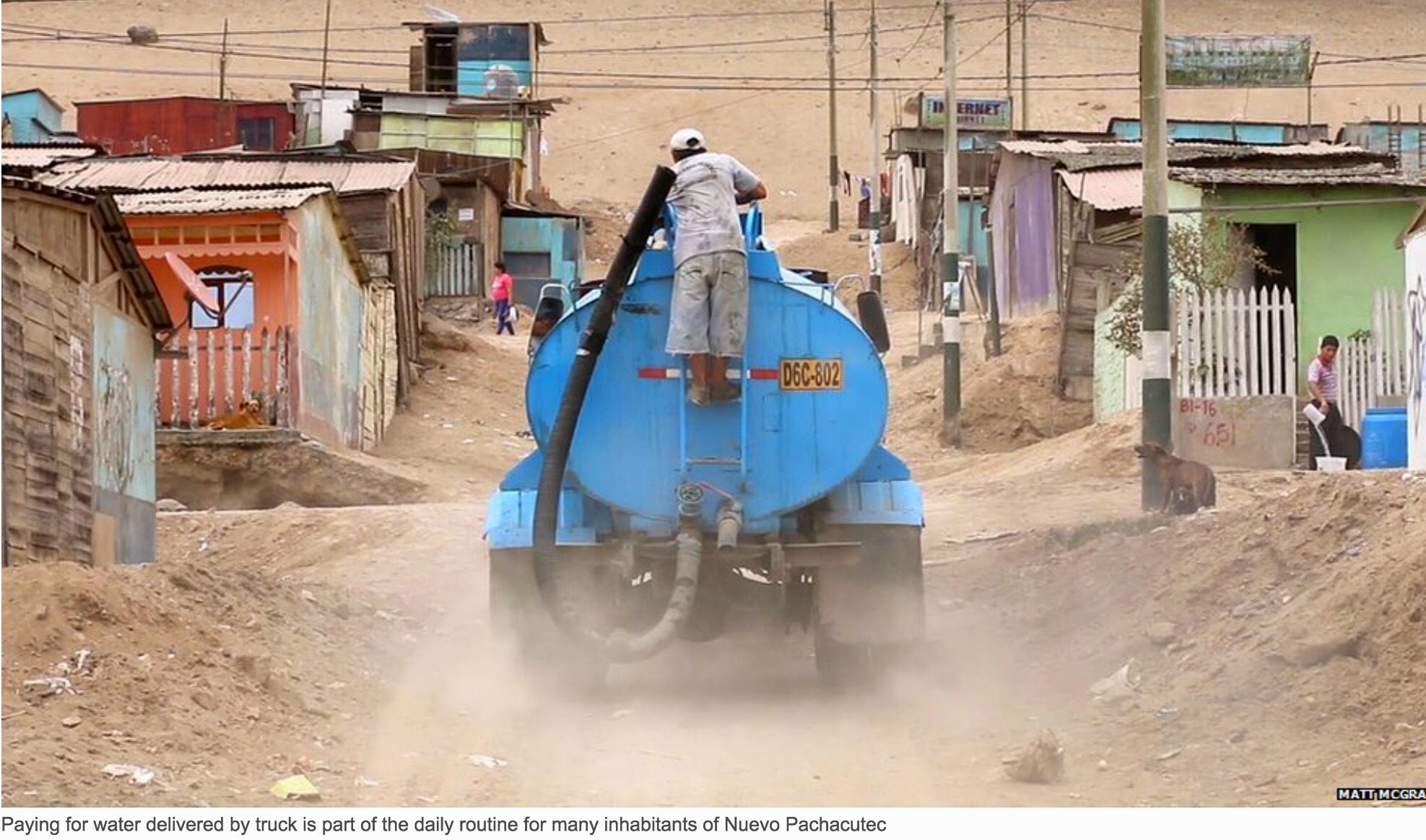
Snarling and screeching, the bouncing water truck speeds backwards down the steep hill, in a cloud of coarse dust.

It halts with a judder and a wild eyed, sweaty man jumps from the cab, grabs a large plastic pipe on the back and starts to fill a series of plastic containers on the ground, with little care.

Dressed in bright pink, a woman looks on nonchalantly.

The man runs up to her and holds out his hand. She drops some coins and away he goes, jumping onto the running board of his vehicle, already snorting its way to the next stop.

This is daily routine for tens of thousands of people who live in this sprawling hillside settlement that looks down on the Pacific Ocean, less than an hour north of Lima, Peru.

Water in Nuevo Pachacutec is not just the vital substance for life, it is a measure of social status and progress.

People first came to these hazy hills in the 1980s, in response to politicians who promised them land in return for votes.

When they first arrived the women said their feet would just sink in the sand. That's all that was here.

The politicians allowed them to take the ground - but most of the 160,000 people here do not have legal title. They are "possessors of the land" but not the owners.

And land is too grand a word. This is really a desert. After Cairo, Lima is said to be the world's second biggest city built in one. Rainfall here amounts to just 50mm of water per year.

A river runs through it

A few kilometres south of Nuevo Pachacutec, a miserable, dirty stream meanders under a motorway.

Bags of rubbish sit alongside the ubiquitous tractor tyres.

This is the Chillon river, the sole water source for around two million people in northern Lima.

The waters of the Chillon are fed by glaciers in the Andes. And this is a source of concern.

"We are worried here in Peru because climate change is already having a huge impact on our access to water," says Armando Mendoza a research officer with Oxfam in the country.

"In the last 40 years, the glacial coverage has retreated by 40% more or less, because of the increase in global warming.

"The predictions are that in the future access to water will become even more difficult and the ones who are most vulnerable to this are the poor."

These longer term water issues with glaciers are not the immediate priority in Nuevo Pachacutec.

As well as the speeding tuktuks, the sandy roads are festooned with signs for car washes, even private schools.

Despite the fact that 80% of the homes are made of wood, incomes and aspirations are rising here.

Access to water is critical in this development, as it is in developing nations all over the world.

With funding from the German government, a green group called Alternativa has helped build networks of white water tanks, connected by underground tubes that bring water directly to the houses.

They have also installed 900 outside water points in this sprawling settlement.

Their efforts to date have brought the vital liquid to 9,000 households.

In this community, water is more than just a key ingredient for life, it is a reflection of harsh social divisions.

The blue barrels

Despite the fact that 80% of the homes are made of wood, incomes and aspirations are rising here.

Access to water is critical in this development, as it is in developing nations all over the world.

With funding from the German government, a green group called Alternativa has helped build networks of white water tanks, connected by underground tubes that bring water directly to the houses.

They have also installed 900 outside water points in this sprawling settlement.

Their efforts to date have brought the vital liquid to 9,000 households.

In this community, water is more than just a key ingredient for life, it is a reflection of harsh social divisions.

Radios and children play loudly on the street where Daniza Cruz Navarro lives.

The homes on this stretch are known as the "casas azules" - the blue houses.

Outside many sit blue plastic barrels, some with lids, some without, that hold the water residents get from the trucks that constantly career about the local roads.

Dogs lap from the open containers. Mosquitoes lay their eggs in the water.

"You can see the effects of the way the water is being stored in the kids' health," says Daniza.

"They often get sick, there is often misuse and mismanagement of the water here."

She has moved on from the blue barrel and is now the owner of a more effective and efficient water tank that she has bought through the efforts of Alternativa.

However, as she still gets water directly from the delivery trucks, she has to pay significantly more than her neighbours.

Daniza says she pays 120 Nuevo Soles (£26; $40) per month for the precious water. This is about 10% of her household income.

Those who are connected to the main water grid pay just 6-12 Soles per month.

These are big sums of money and the differences can be a source of friction between neighbours.

Despite these problems, those who work with the people in Nuevo Pachacutec say progress is being made. It's really a story of local self-empowerment.

"Even if they are not perfect, they have bettered considerably," says engineer Osvaldo Caceres who works with Alternativa.

"This infrastructure is managed by them, for them. The local population know what they want, but they know and understand they have to participate to get it.

Plug and pay


"When we first got here it was all desert - there were no roads, it was pure sand," says Ycella Bonilla a resident of Nuevo Pachacutec.

She stands proudly in the doorway of her recently built bathroom cum laundry room, completed with the help of microfinance.

Ycella calls it her "unit of dignity".

Despite this advance, Ycella and her family are still paying heavily for water. She has a hose and a key that allows her family to plug into a water point. For this she pays 80 Nuevo Soles a month (£18; $27) a month.

Despite the gripes over cost, Ycella recognises that water is the bedrock of development for the community.

"We have roads, we have schools, we have a lot of the basic necessities now, including water."

The struggle for development and the need to have resources like water to empower that development is not just on the minds of those in Nuevo Pachacutec.

An hour down the road in Lima itself, UN climate negotiators are struggling with that same dilemma. How to balance the burgeoning needs of a growing population, with the need to limit those same enriching activities because they threaten the future of the planet.

Osvaldo Caceres says that as in solving the water stresses of Nuevo Pachacutec, the climate battle can be won, by everyone playing their part now. It's no use passing the buck down the generations.

"Every actor in this chain must take responsibility for what they have to do," he says.

"The governments, the authorities, and obviously the people, they all need to act." "There is no other way." More


Saturday, January 18, 2014

Water security in the Kingdom of Saudi Arabia … a far-fetched dream?

DAMMAM – Environmental and water experts have warned that water security might be a far-reaching dream for the Kingdom.
Limited water resources such as groundwater are being depleted by greedy farmers who care about nothing but profits, they said. The claimed nuclear energy can help desalinate seawater and save the country from a looming disaster that future generations will experience. Al-Riyadh daily asked the experts about the challenges the state faces in ensuring water security.

Precious resource

Dr. Asad Abu Ruzaizah, president of the Saudi Society for Environment Sciences, said the country is running out of groundwater at an alarming rate. He stressed the important role citizens can play to mitigate the enormity of the problem and conserve this valuable resource. “Some people are not really aware that we have a water security problem,” Ruzaizah said. “The government spends a huge amount of money on the desalination process but this causes a tremendous negative effect on the environment.
“Moreover, strategic water reserves are poor in the Kingdom and other GCC countries and this fact makes the water problem a huge challenge for these countries.
“We have a poor water authority and low awareness levels regarding the importance of saving water. “More funding should go into developing and managing water resources and searching constantly for new sources.
“The water authority and other water agencies should be developed to deal better with this issue and achieve sustainable development for the next generation.”

New regulations to manage current reserve

Dr. Muhammad Al-Ghamdi, professor of King Faisal University’s School of Agricultural Sciences, disagrees with Ruzaizah. “Everyone is saying let’s find new water resources instead of searching for regulations that can lead to the wise management of current resources,” Al-Ghamdi said. “Unfortunately, there are no clear plans, programs, or strategies to help us achieve water security.” He said he wondered how this problem would be solved while farmers, led by greed, continue to waste groundwater and mismanage limited water resources. “The sad thing is facts and statistics indicate that our groundwater problem is getting worse every year. “I’m worried the next generations will encounter insurmountable problems solving this issue.”
Dr. Ali Ishqi, ecology professor at King Abdulaziz University, said the Arabian Peninsula has a severe water shortage. Ninety percent of its area is barren desert land while green areas account for 2 percent of the total area. Ishqi believed that mismanagement of water resources has largely exacerbated groundwater shortages.
He said the only strategy that can end this looming crisis is to make use of nuclear energy.
“The use of nuclear reactors is the best choice for seawater desalination.
“Solar energy is not. “To meet the water needs of a small city population, you will need to have so many solar cells on a very large area.”

Rainwater harvesting is the solution

Abdullah Al-Rasheed, economist, said the only option available to solve this crisis is to set up a national authority for rainwater harvesting, where rainwater is collected and used for irrigation, drinking, and other purposes. The next upcoming war will be for water, Al-Rasheed claimed.
He quoted a feature that National Geographic carried a while ago on the water issue.
The Kingdom’s groundwater resources used to stand at 500 cubic kilometers 40 years ago, according to the feature. So far the country has used 400 cubic kilometers, which means that one generation has consumed 80 percent of the country’s resources. The feature said the Kingdom now has no choice but to use seawater because the remaining groundwater will probably be consumed in a few years. Al-Rasheed said he hoped that the statistics mentioned in the feature were not true. “One thing remains true: we have squandered our groundwater and used it for farming purposes. “There is no point now of crying over spilled milk. “It’s high time we utilized rainwater.”
Al-Rasheed said every year there is 150 billion to 250 billion cubic meters of rainfall in the Kingdom, while the amount of desalinated water the public consumes annually is 3 billion. “This is a small amount compared to the huge quantity of rainwater available for us.” More


Monday, July 22, 2013

Peak Water: What Happens When the Wells Go Dry?

Peak oil has generated headlines in recent years, but the real threat to our future is peak water. There are substitutes for oil, but not for water. We can produce food without oil, but not without water.

We drink on average four liters of water per day, in one form or another, but the food we eat each day requires 2,000 liters of water to produce, or 500 times as much. Getting enough water to drink is relatively easy, but finding enough to produce the ever-growing quantities of grain the world consumes is another matter.

Grain consumed directly supplies nearly half of our calories. That consumed indirectly as meat, milk, and eggs supplies a large part of the remainder. Today roughly 40 percent of the world grain harvest comes from irrigated land. It thus comes as no surprise that irrigation expansion has played a central role in tripling the world grain harvest over the last six decades.

During the last half of the twentieth century, the world’s irrigated area expanded from close to 250 million acres (100 million hectares) in 1950 to roughly 700 million in 2000. This near tripling of world irrigation within 50 years was historically unique. But since then the growth in irrigation has come to a near standstill, expanding only 10 percent between 2000 and 2010.

In looking at water and our future, we face many questions and few answers. Could the world be facing peak water? Or has it already peaked?

Farmers get their irrigation water either from rivers or from underground aquifers. Historically, beginning with the Sumerians some 6,000 years ago, irrigation water came from building dams across rivers, creating reservoirs that then enabled them to divert the water onto the land through a network of gravity-fed canals. This method of irrigation prevailed until the second half of the twentieth century, where with few sites remaining for building dams, the prospects for expanding surface irrigation faded. Farmers then turned to drilling wells to tap underground water resources.

In doing so, they learned that there are two types of aquifers: those that are replenishable through rainfall, which are in the majority, and those that consist of water laid down eons ago, and thus do not recharge. The latter, known as fossil aquifers, include two strategically important ones, the deep aquifer under the North China Plain and the Ogallala aquifer under the U.S. Great Plains.

Tapping underground water resources helped expand world food production, but as the demand for grain continued climbing, so too did the amount of water pumped. Eventually the extraction of water began to exceed the recharge of aquifers from precipitation, and water tables began to fall. And then wells begin to go dry. In effect, overpumping creates a water-based food bubble, one that will burst when the aquifer is depleted and the rate of pumping is necessarily reduced to the rate of recharge.

Today some 18 countries, containing half the world’s people, are overpumping their aquifers. Among these are the big three grain producers—China, India, and the United States—and several other populous countries, including Iran, Pakistan and Mexico. More


Sunday, July 21, 2013

As drought spreads, firms could be up the creek

Water shortages are already stressing business in China, India, South Africa and parts of South America. Yet most companies aren't moving fast enough to stave off conflicts over the dwindling resource. Over 75 percent of the world's biggest companies see water risks as critical, but most of these companies lack long-term water strategies, a KPMG sustainability report concluded.

Some of the biggest water users among corporations—food and beverage, apparel and technology—are pioneering new ways to reduce their aqua footprint. In addition to Coca-Cola and Pepsi, these include companies like Nike and Anheuser-Busch. They're turning to cooling towers, using gray water—various forms of wastewater—and installing water meters to pinpoint high usage.

AT&T began conserving water in 2010. After doing a water audit, the company found that billions of gallons of water were being used, including water used to cool facilities such as data centers. So the company has implemented energy efficiency measures in water cooling towers and other upgrades to reduce water usage. Overall, AT&T has identified 125 facilities where water management changes can significantly reduce water usage—these facilities account for roughly half of the company's estimated 3.4 billion gallons in annual water usage. AT&T expects to save 150 million gallons of water by 2015. "We will be making water reduction investments for years to come," said John Schulz, director of sustainability operations at AT&T. "It's such an emotional issue when water is running short."

Google has been awarded a patent for a floating data center powered by waves and cooled by sea water.

Far from Texas, corporations with a global footprint are scrambling to address their water risk because shortages can quickly short-circuit business in developing regions. Water reliability is increasing seen as a competitive edge. In the future, businesses will need to factor water availability—and quality—when searching for new manufacturing sites or face possible shortages. The math is simple: One percent of GDP growth translates into 1 percent more water consumption, and water shortages are already dinging China's growth. Worldwide, shortages will be dire in coming years: By 2030, there will be a 40 percent global shortfall between water demand and water supply, according to the World Economic Forum.

Pepsi Bottling and Coca-Cola ran into these shortages early on. Nine years ago, they closed down plants in India after they were believed to be competing for limited water resource. Since then, Coca-Cola has faced protests about depleting water in other dry areas of India.

Those plant closures are still rare, said Giulio Boccaletti, managing director of global fresh water at Nature Conservancy. Instead, regulators in developing countries are putting pressure on companies by questioning licensing agreements. "The licensing process is slowing down," he said. Some companies that have gone into Africa and privatized the water there have had their plants shut down, said Eric Lowitt, managing director at Nexus Global Advisors.

The "water wars" are forcing corporations to conduct natural resource due diligence before expanding. Some big companies end up playing a key role in shoring up water infrastructure in developing countries, working with citizens and local governments, Lowitt said. In drought-stricken countries like Chile, a company has to bring water treatment to the area to win a license, he said.

"All water is local in developing countries, since it's usually a watershed or basin," said Bert Share, a senior global director at Anheuser-Busch InBev. "So our aim is to understand a community's water issues, such as watershed quality and quantity." The beverage company is also partnering with private landowners to offer them incentives for restoring water quality. "Water management has to be collaborative, because the local issues are so complex," Share said.

Ford, which has operations in 70 countries, is plotting future water scenarios, ranging from scarcity to abundance, to determine how the company will be affected. "India and China are the two countries most on everyone's radar," said Thomas Niemann, Ford's reporting manager for sustainability. The car company aims to reduce its global water use per vehicle 30 percent by 2015 through the installation of water meters and using recycled water, among other methods. More


Thursday, August 16, 2012

Rift on the Nile: Challenges lie ahead for Nile water sharing

"Egypt, the gift of the Nile” is a phrase coined by the Greek historian Herodotus 3,000 years ago in his book about Egypt. His description continues to be true today, as Egypt is the only place in the world where a river cuts across a thousand miles of desert, creating a civilization along with it.

The Nile is the lifeline of Egypt, with people crowded on its sides, cities located along its banks, and roads shaped along its bends. But what Egyptians have long taken for granted, the abundant Nile always flowing through their lands, may be facing a dramatic shift.

Although the post-revolutionary atmosphere gave rise to many gestures of goodwill that have eased differences over the distribution of Nile water, Egypt is still facing serious pressure from irritated Nile Basin countries to agree on a new water-sharing package.

The Cooperative Framework Agreement that was signed in 2010, which reduces Egypt’s quota of the Nile water, has become even more pressing since Burundi joined five other Nile Basin states in the agreement last year, giving it the necessary majority to begin implementation.

Although Egypt and Sudan have firmly refused the agreement, it has become obvious that this rigid stance will not resolve the issue. This realization has pushed Egypt to shift its diplomacy regarding the issue, trading a harsh tone for attempts at exercising soft power, calling for more cooperation and joint projects.

"Egypt must first realize that it faces a major threat to its national security; water is vital to a major agricultural country like Egypt, and the Nile provides the country with 86 percent of its water needs and about 92 percent of the water used in agriculture,” explains Mohamed Ibrahim, an assistant professor of agricultural economics at Alexandria University.

Ibrahim adds that in order to resolve this crisis, Egypt has to adopt a multi-dimensional strategy. Diplomatically, Egypt must show more flexibility toward the terms of the new Nile Basin cooperative agreement and more openness to negotiate. Economically, Egypt has to help fund agricultural and development projects in the other Nile Basin countries as well as work on finding better ways to reduce wasted water that results from inefficient, old-fashioned practices of rolling out threats of military actions.” More