Water Security is National Security

Water resources and how they are managed impact almost all aspects of society and the economy, in particular health, food production and security, domestic water supply and sanitation, energy, industry, and the functioning of ecosystems. Under present climate variability, water stress is already high, particularly in many developing countries, and climate change adds even more urgency for action. Without improved water resources management, the progress towards poverty reduction targets, the Millennium Development Goals, and sustainable development in all its economic, social and environ- mental dimensions, will be jeopardized. UN Water.Org

Showing posts with label climate change. Show all posts

Friday, February 9, 2018

Pakistan's Water Crisis Is a Ticking Time Bomb


Only a few other countries, most of them war-torn places like Syria and Gaza, have experienced similar reversals in providing clean water to cities. And while the causes of Pakistan’s water crisis are complex, the country’s political instability has played a key part. Pakistan is urbanizing at a rapid rate of over 3 percent annually—the highest rate in South Asia. The causes of this fast-moving urbanization are deeply troubling, with climate change and the fight against Muslim extremists acting as key drivers. Given this ever-quickening tide, Pakistan’s cities have had trouble providing basic services, including housing and water, to new urban residents.

But the problem is worse in the water sector because rampant corruption and mismanagement keeps prices high and coverage rates low. Because Pakistan’s cities can’t keep up with growing water demand from new residents, many urban-dwellers are forced to buy water from private tanker trucks. Read More

Monday, May 25, 2015

Deciphering clues to prehistoric climate changes locked in cave deposits

It turns out that the steady dripping of water deep underground can reveal a surprising amount of information about the constantly changing cycles of heat and cold, precipitation and drought in the turbulent atmosphere above. The analysis of a stalagmite from a cave in north east India can detect the link between El Nino conditions in the Pacific Ocean and the Indian monsoon, a new study has found.

When the conversation turns to the weather and the climate, most people’s thoughts naturally drift upward toward the clouds, but Jessica Oster’s sink down into the subterranean world of stalactites and stalagmites.

That is because the assistant professor of earth and environmental sciences at Vanderbilt University is a member of a small group of earth scientists who are pioneering in the use of mineral cave deposits, collectively known as speleothems, as proxies for the prehistoric climate.

It turns out that the steady dripping of water deep underground can reveal a surprising amount of information about the constantly changing cycles of heat and cold, precipitation and drought in the turbulent atmosphere above.

As water seeps down through the ground it picks up minerals, most commonly calcium carbonate. When this mineral-rich water drips into caves, it leaves mineral deposits behind that form layers which grow during wet periods and form dusty skins when the water dries up.

Today, scientists can date these layers with extreme precision based on the radioactive decay of uranium into its daughter product thorium. Variations in the thickness of the layers is determined by a combination of the amount of water seeping into the cave and the concentration of carbon dioxide in the cave’s atmosphere so, when conditions are right, they can provide a measure of how the amount of precipitation above the cave varies over time. By analyzing the ratios of heavy to light isotopes of oxygen present in the layers, the researchers can track changes in the temperature at which the water originally condensed into droplets in the atmosphere changes and whether the rainfall’s point of origin was local or if traveled a long way before falling to the ground.

The value of this information is illustrated by the results of a study published May 19 in the journal Geophysical Research Letters by Oster’s group, working with colleagues from the Berkeley Geochronology Center, the Smithsonian Institution National Museum of Natural History and the University of Cambridge titled “Northeast Indian stalagmite records Pacific decadal climate change: Implications for moisture transport and drought in India.”

In the study, Oster and her team made a detailed record of the last 50 years of growth of a stalagmite that formed in Mawmluh Cave in the East Khasi Hills district in the northeastern Indian state of Meghalaya, an area credited as the rainiest place on Earth.

Studies of historical records in India suggest that reduced monsoon rainfall in central India has occurred when the sea surface temperatures in specific regions of the Pacific Ocean were warmer than normal. These naturally recurring sea surface temperature “anomalies” are known as the El Niño Modoki, which occurs in the central Pacific, and the Pacific Decadal Oscillation, which takes place in the northern Pacific. (By contrast, the historical record indicates that the traditional El Niño, which occurs in the eastern Pacific, has little effect on rainfall levels in the subcontinent.)

When the researchers analyzed the Mawmluh stalagmite record, the results were consistent with the historical record. Specifically, they found that during El Niño Modoki events, when drought was occurring in central India, the mineral chemistry suggested more localized storm events occurred above the cave, while during the non-El Niño periods, the water that seeped into the cave had traveled much farther before it fell, which is the typical monsoon pattern.

“Now that we have shown that the Mawmluh cave record agrees with the instrumental record for the last 50 years, we hope to use it to investigate relationships between the Indian monsoon and El Niño during prehistoric times such as the Holocene,” said Oster.

The Holocene Climate Optimum was a period of global climate warming that occurred between six to nine thousand years ago. At that time, the global average temperatures were somewhere between four to six degrees Celsius higher than they are today. That is the range of warming that climatologists are predicting due to the build-up of greenhouse gases in the atmosphere from human activity. So information about the behavior of the monsoon during the Holocene could provide clues to how it is likely to behave in the future. This knowledge could be very important for the 600 million people living on the Indian subcontinent who rely on the monsoon, which provides the area with 75 percent of its annual rainfall.

“The study actually grew out of an accidental discovery,” said Oster. Vanderbilt graduate student Chris Myers visited the cave, which co-author Sebastian Breitenbach from Cambridge has been studying for several years, to see if it contained enough broken speleothems so they could use them to date major prehistoric earthquakes in the area.

Myers found a number of columns that appear to have broken off in the magnitude 8.6 earthquake that hit Assam, Tibet in 1950. But he also discovered a number of new stalagmites that had begun growing on the broken bases. When he examined these in detail he found that they had very thick layers and high concentrates of uranium, which made them perfect for analysis.

Because of the large amount of water running into the cave, the stalagmite they choose to analyze had grown about 2.5 centimeters in 50 years. (If that seems slow, compare it with growth rates of a few millimeters in a thousand years found in caves in arid regions like the Sierra Nevada.) As a result, the annual layers averaged about 0.4 millimeters thick — wide enough for the researchers to get seven to eight samples per layer, which is slightly better than one measurement every two months. The amount of information about the climate that scientists can extract from the stalagmites and stalactites in a cave is amazing. But the value of this approach increases substantially as the number of caves that can act as climate proxies increases.

It is not a simple task. Because each cave is unique, the scientists have to study it for several years before they understand it well enough to use it as a proxy. For example, they must establish how long it takes water to move from the surface down to the cave, a factor that can vary from days to months.

Efforts to use the mineral deposits in caves as climate proxies began in the 1990’s. Currently, there are only a few dozen scientists who are pursuing this line of research and they have analyzed the mineral deposits from 100 to 200 caves in this fashion.

Story Source:

The above story is based on materials provided by Vanderbilt University. The original article was written by David Salisbury. Note: Materials may be edited for content and length.

Journal Reference:

  1. Christopher G. Myers, Jessica L. Oster, Warren D. Sharp, Ralf Bennartz, Neil P. Kelley, Aaron K. Covey, Sebastian F.M. Breitenbach. Northeast Indian stalagmite records Pacific decadal climate change: Implications for moisture transport and drought in India. Geophysical Research Letters, 2015; DOI: 10.1002/2015GL063826


Tuesday, March 3, 2015

Climate change key in Syrian conflict – and it will trigger more war in future

Climate change was a key driver of the Syrian uprising, according to research which warns that global warming is likely to unleash more wars in the coming decades, with Eastern Mediterranean countries such as Jordan and Lebanon particularly at risk.

Experts have long predicted that climate change will be a major source of conflict as drought and rising temperatures hurt agriculture, putting a further strain on resources in already unstable regimes.

But the Syria conflict is the first war that scientists have explicitly linked to climate change. Researchers say that global warming intensified the region’s worst-ever drought, pushing the country into civil war by destroying agriculture and forcing an exodus to cities already straining from poverty, an influx of refugees from war-torn Iraq next door and poor government, the report finds.

“Added to all the other stressors, climate change helped kick things over the threshold into open conflict,” said report co-author Richard Seager, of Columbia University in New York.

“I think this is scary and it’s only just beginning. It’s going to continue through the current century as part of the general drying of the Eastern Mediterranean – I don’t see how things are going to survive there,” Professor Seager added.

Turkey, Lebananon, Israel, Jordan, Iraq and Afghanistan are among those most at risk from drought because of the intensity of the drying and the history of conflict in the region, he says. Israel is much better equipped to withstand climate change than its neighbours because it is wealthy, politically stable and imports much of its food. Drought-ravaged East African countries such as Somalia and Sudan are also vulnerable along with parts of Central America – especially Mexico, which is afflicted by crime, is politically unstable, short of water and reliant on agriculture, Prof Seager said.

The conflict in Syria began in spring 2011 and has evolved into a complex multinational war that has killed at least 200,000 people and displaced millions more, according to the Columbia study, which appears in the journal Proceedings of the National Academy of Sciences. It was preceded by a record drought that ravaged Syria between 2006 and 2010.The paper says the timing is unlikely to be a coincidence, citing a recent interview with a 38-year old farmer in Mohasen, an agricultural village in the north east of Syria.

Asked if the conflict was about the drought, Faten – a female farmer who did not want to give her last name – said: “Of course. The drought and unemployment were important in pushing people towards revolution. When the drought happened, we could handle it for two years, and then we said, ‘It’s enough’,” the report said.

The study combined climate, social and economic data relating to the so-called Fertile Crescent, spanning parts of Turkey and much of Syria and Iraq, where agriculture and herding are thought to have started 12,000 years ago and continue to be crucial.

The region has warmed by between 1 and 1.2C since 1900, reducing rainfall in the wet season by an average of 10 per cent. In addition to the warming – which has found to be caused by human greenhouse gas emissions – Syria has had to contend with rapid population growth, from 4 million in the 1950s to 22 million now.

The ruling al-Assad family encouraged water-intensive export crops such as cotton, while illegal drilling of irrigation wells dramatically depleted groundwater that might have provided valuable reserves, the report said. The drought’s effects were immediate. Agriculture production, which typically makes up a quarter of Syria’s economy, plummeted by a third.

In the hard-hit northeast, livestock herds were practically obliterated, cereal prices doubled and nutrition-related diseases among children increased dramatically. As many as 1.5m people fled from the country to the city.

“Whether it was a primary or substantial factor is impossible to know, but drought can lead to devastating consequences when coupled with pre-existing acute vulnerability,” said lead author Colin Kelley, who did the work at Columbia but is now the University of California, Santa Barbara.

The pressure exerted by climate change is even more dangerous because it comes against a backdrop of rising populations and growing scarcity of resources, experts say.

With demand for basic commodities such as wheat and copper set to soar over the next two decades, relatively small shocks to supply risk causing sudden price rises and triggering “overreactions or even militarised responses”, the Chatham House think-tank has warned.

Furthermore, while the effects of rising population and global warming may be felt hardest among the poorer countries most affected by climate change, the impact will be felt worldwide.

Global trade is so interconnected that no importer of resources is insulated from the problems of key exporters – a fact of concern to the UK, which imports 40 per cent of its food and a high proportion of fossil fuels and metals, the think-tank warns. More


Thursday, January 1, 2015

Behind the veil of the Islamic State is a war for water

A little known fact of the war in Syria is that it started at the end of the worst drought in Syrian history, a biblical drought which forced over 1 million farmers into the cities.

Pulitzer Prize-winner Thomas L. Friedman interviewed Syrian refugees and farmers in Syria about the link between this drought and the start of the civil war. He comes to the conclusion that the drought certainly played some role and was probably a key tipping point for a bad situation to turn into a full scale war. In the documentary “Years of living dangerously” we see how wiki-leaked diplomatic cables and high level US officials such as Condoleezza Rice acknowledge this link.

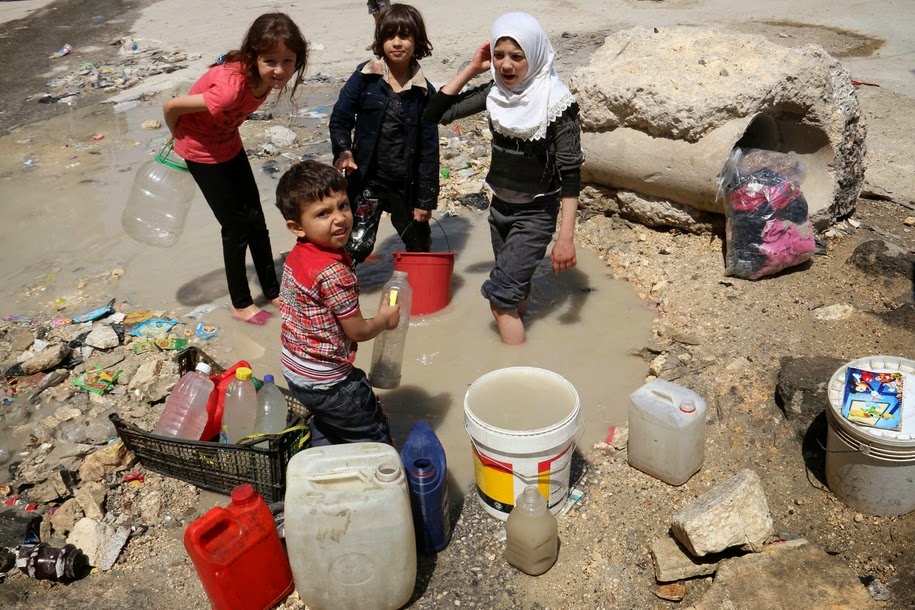
But there’s a lot more happening to explain why behind the veil of a quest for an Islamic State (IS), there’s also a war for water in Syria and Iraq. Making the plight of citizens worse is the continued targeting of water supply networks by both regime and opposition forces, which have attacked strategic lifelines, such as water channels, to gain control of territory and to punish and put pressure on their opponents.

Opening the flood gates …

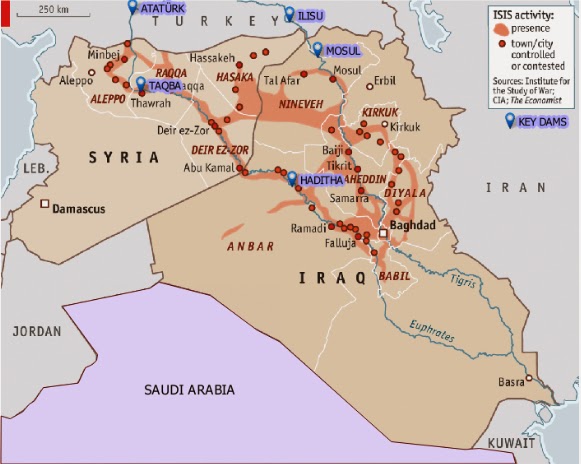
The Islamic State’s quest for hydrological control began in Syria, when it captured the Tabqa Dam in 2013. Rebel-held areas had been systematically denied electricity by President Bashar al-Assad’s forces in their effort to turn the population against the insurgency. The Tabqa Dam was built more than 40 years ago with Russian help and aimed to make Syria self-sufficient in energy production. Behind the dam is Lake Assad, which provides millions of Syrians with drinking water and is a vital irrigation source for farms. After the capture of the dam, IS opened the flood-gates to get maximum electricity supply for the areas they control and win favour with the local population. As a result, the lake dropped six metres, to a record low in May, which worsened the plight of millions of already destitute Syrians as severe water cuts began to hit Aleppo province.

Conflict over the water flowing though the Euphrates and Tigris is of course nothing new and predates religious wars. They were the first rivers to be used for large scale irrigation, in the region once known as the Fertile Crescent. Somewhere between 1720 and 1684 BC, a grandson of Hammurabi dammed the Tigris to prevent the retreat of rebels led by Iluma-Ilum, who declared the independence of Babylon. The Euphrates was already used as a weapon somewhere around 2500 BC, in another fight for Babylon, when the king of Umma cut the banks of irrigation canals alongside the Euphrates dug by his neighbor, the king of Girsu.

The Euphrates and Tigris are the two major and longest rivers in the Middle East. They both originate in Turkey. The Euphrates flows through Syria and Iraq to reach the Persian Gulf while the Tigris flows through Kurdish territory, meeting up with the Euphrates in the Southern Mesopotamian Marshes of Iraq. There are currently at least 46 dams in the Tigris-Euphrates basin, with at least 8 more planned or under construction. These dams have become key pieces of geo-political control in the region.

… and shutting down the flows

While one act of war is opening the flood gates, another is closing them. In 1974, Iraq threatened to bomb the same Tabqa Dam in Syria, alleging that the dam had reduced the flow of Euphrates River water to Iraq. But between then and now, Turkey, through its position upstream, has taken over as the most powerful regional commander of water, by completing the giant Ataturk Dam. In 1990 Syria and Iraq protested that Turkey now has a weapon of war: by closing the gates they could leave them dry. They had good reason to protest. In mid-1990 Turkish president Turgut Özal threatened to restrict water flow to Syria to force it to withdraw support for Kurdish rebels operating in southern Turkey.

In April 2014, the Islamic State blamed the low water levels in Lake Assad to Turkey’s closure of the Ataturk Dam. Sources found by Al Jazeera said that these claims are disputed. But even if the allegations are only partly true: they were used by the Islamic State to issue threats to ‘liberate Istanbul’, if that was necessary. So while Turkey, IS and Assad fight over water, millions of ordinary Syrians and Iraqi’s see their water levels drop dramatically. Not just by a new drought, with rainfall down by 50-85 percent since October 2013, but mostly due to a power struggle.

Tensions over water control in the region are set to heat up further if Turkey completes the Ilisu Dam on the Tigris River near the border of Syria. The Ilisu Dam will generate 1,200 MW and is part of the vast and ambitious Southeastern Anatolia Project, known as GAP after its Turkish title (Guneydogu Anadolu Projesi): a network comprising 22 dams and 19 power plants. The Ilisu reservoir will flood 52 villages and 15 towns, including Hasankeyf, a Kurdish town of 5,500 people, which is the only town in Anatolia that has survived since the Middle Ages and is under archaeological protection. It will displace approximately 16,000 people in the troubled Kurdish region.

The World Bank (WB), the British construction company Balfour Beatty and the Italian company Impreglio have all withdrawn from the problematic project. So have international funds and export credit from Austria, Germany and Switzerland. However, the project is currently funded by Turkish banks. Iraq and also Syria will be the most heavily impacted if the dam and others go through, with the most extreme projections holding that, owing to a combination of climate change and upstream dam activity, the Tigris and Euphrates rivers won’t have sufficient flow to reach the sea by as early as 2040.

If you live in Syria or Iraq and the water irrigating your field stops coming you might join the ranks of any army promising to attack those who kept the water for themselves – no matter if they tell you the truth or not. As is often the case in conflicts or epidemics it is not the facts themselves that count most but what people believe to be the facts. Those who can convince it’s the enemies fault that there’s not enough water will have the key to where the hearts and minds of the people will go to – no matter what the facts are.

The US finally finds a Weapon of Mass Destruction in Iraq

The Tabqa Dam is not the only dam attacked by IS. They are also trying to take the Haditha Dam, the second-largest in Iraq, raising the possibility of catastrophic damage and flooding. On Sunday, the US was bombing IS positions close to the dam. The IS militants are also fighting for control of the Euphrates River Dam, about 120 miles northwest of Baghdad and government forces were fighting to halt their advance. Insurgents from IS seized the Falluja Dam in Iraq in February and closed the floodgates to cause upstream flooding and to cut downstream water supply. Some 40.000 people were displaced just to flood the area around the city of Falluja to force government troops to retreat and lift a siege, while cutting water supplies and hydroelectricity generation for other parts of the country. All that was peanuts compared to what IS did next.

On August 7 IS captured the 1GW Mosul Dam on the Tigris – sending shock waves through Bagdad, Kuwait and the US. Whoever controls the Mosul Dam, the largest in Iraq, controls most of the country’s water and power resources. Located on the Tigris River upstream of Mosul, the dam, 3.6 km long and with 320 MW of capacity daily, formerly known as the Saddam dam, was built beginning in 1980 at a cost of 1.5$ billion USD, to bolster the regime during the Iran-Iraq war by a German-Italian consortium that was led by Hochtief Aktiengesellschaft. Its construction submerged many archaeological sites in the region yet more troubling is that because the dam was constructed on a foundation of soluble gypsum, it requires continuous grouting of the dam’s foundation to promote stability. Due to the engineering problems it presents it has been described recently by US engineers as “the most dangerous dam in the world.” And that was before the “most dangerous terror group ever” captured it.

A senior U.S. administration official said that “The failure of the Mosul Dam could threaten the lives of large numbers of civilians, threaten U.S. personnel and facilities – including the U.S. Embassy in Baghdad – and prevent the Iraqi government from providing critical services to the Iraqi populace,” (Source: Reuters). A 2006 U.S. Army Corps of Engineers report obtained by the Washington Post said the dam, which blocks the Tigris and holds 12 billion cubic meters of water, could flood two cities killing over a half a million people if it were destroyed or collapsed. The tsunami going to Mosul, a city of 1.7 million people, can be 20m high if the dam breaks with a full reservoir.

But even without a catastrophic failure, the dam is already at the epicenter of the war. Soon after the Islamic State captured the Mosul Dam they cut supplies to some villages in the north of the country that have not joined their cause. Recapturing this instrument of war was a sufficient reason for US forced to deploy air power to support Kurdish forces to recapture the dam. Saving the Yazidis from their mountain captured most media attention, but a key reason for the US to bomb Iraqi soil for the first time since 2011 was the fact that IS took the Mosul Dam. After bombing IS positions for several days, freshly re-equipped Kurdish fighters recently regained control of the dam.

Mega Dams & Water Management Practices

The importance of hydro-infrastructure in these battles and how it can be wielded firstly underlines the need for a serious re-appraisal of water management practices. Big dams (with funding from Multilateral agencies such as the WB, national and regional development banks, private equity and pension funds as well as from the Clean Development Mechanism, etc.) cause large scale displacement of populations, are ecologically destructive, wash away any other source of livelihood, and often saddle countries with debt while performing well below planned outputs as regards electricity generation. Moreover, compounded by climate change, contemporary ecological crises are leading to ever more conflict over trans-boundary water rights, such as for example between Ethiopia and Egypt, which are also on the verge of war over the construction of the Grand Renaissance and Gibe 3 dams, which would become Africa’s tallest. The world’s Big Dam Fan Club should take note of what has just happened in Syria and Iraq and realise that once disaster hits, hatred will not go to any God but to those who constructed the weapon of mass destruction. Water, rather than oil, is shaping up to be the key strategic resource in the region. More


Thursday, December 11, 2014

Water woes in Lima: A glimpse of our future?

As UN negotiators meet in Lima to work out a plan for dealing with rising temperatures, Matt McGrath visited a community paying a high price for water supplies threatened by climate change and increasing demand. Is Peru's experience a sign of things to come?

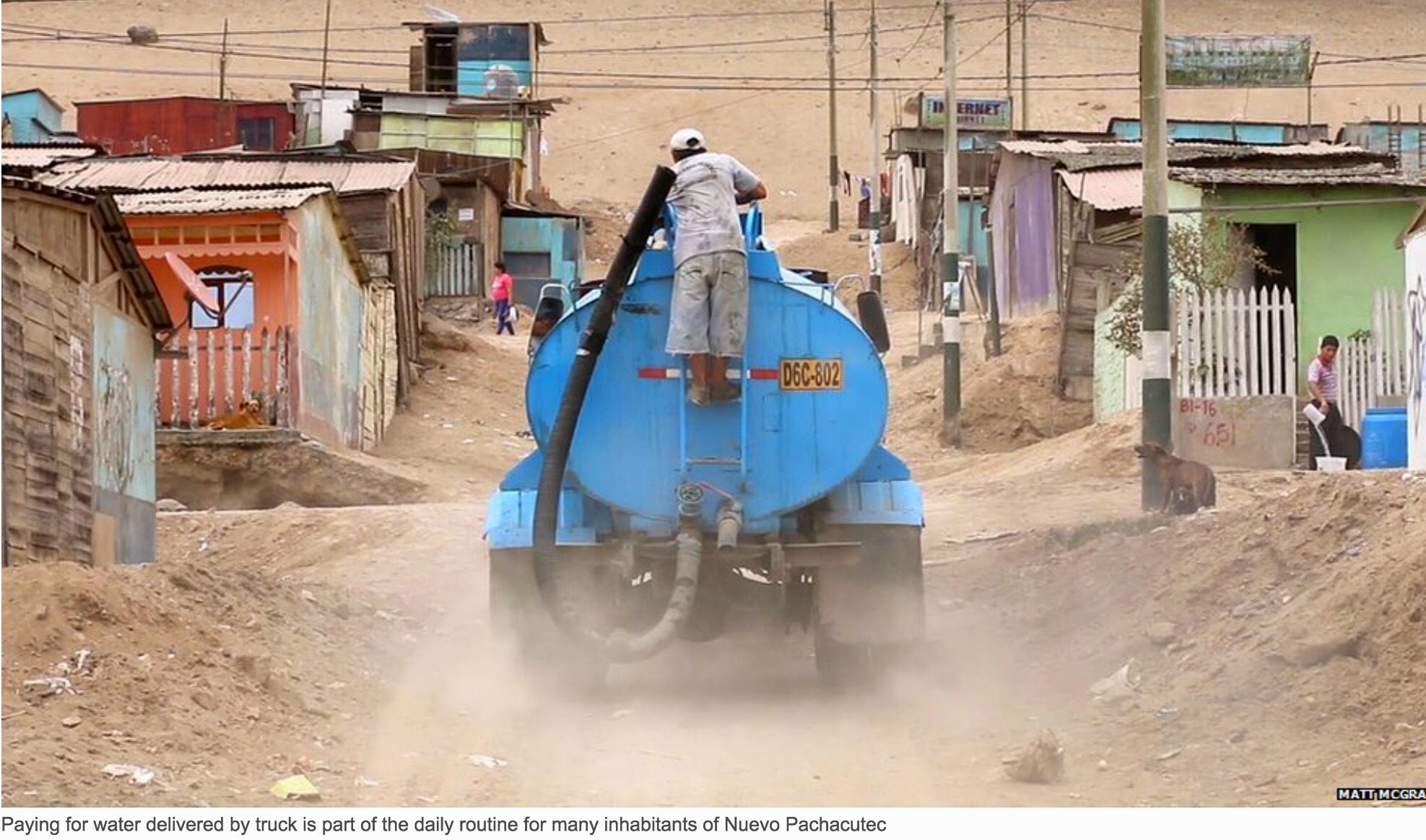
Snarling and screeching, the bouncing water truck speeds backwards down the steep hill, in a cloud of coarse dust.

It halts with a judder and a wild eyed, sweaty man jumps from the cab, grabs a large plastic pipe on the back and starts to fill a series of plastic containers on the ground, with little care.

Dressed in bright pink, a woman looks on nonchalantly.

The man runs up to her and holds out his hand. She drops some coins and away he goes, jumping onto the running board of his vehicle, already snorting its way to the next stop.

This is daily routine for tens of thousands of people who live in this sprawling hillside settlement that looks down on the Pacific Ocean, less than an hour north of Lima, Peru.

Water in Nuevo Pachacutec is not just the vital substance for life, it is a measure of social status and progress.

People first came to these hazy hills in the 1980s, in response to politicians who promised them land in return for votes.

When they first arrived the women said their feet would just sink in the sand. That's all that was here.

The politicians allowed them to take the ground - but most of the 160,000 people here do not have legal title. They are "possessors of the land" but not the owners.

And land is too grand a word. This is really a desert. After Cairo, Lima is said to be the world's second biggest city built in one. Rainfall here amounts to just 50mm of water per year.

A river runs through it

A few kilometres south of Nuevo Pachacutec, a miserable, dirty stream meanders under a motorway.

Bags of rubbish sit alongside the ubiquitous tractor tyres.

This is the Chillon river, the sole water source for around two million people in northern Lima.

The waters of the Chillon are fed by glaciers in the Andes. And this is a source of concern.

"We are worried here in Peru because climate change is already having a huge impact on our access to water," says Armando Mendoza a research officer with Oxfam in the country.

"In the last 40 years, the glacial coverage has retreated by 40% more or less, because of the increase in global warming.

"The predictions are that in the future access to water will become even more difficult and the ones who are most vulnerable to this are the poor."

These longer term water issues with glaciers are not the immediate priority in Nuevo Pachacutec.

As well as the speeding tuktuks, the sandy roads are festooned with signs for car washes, even private schools.

Despite the fact that 80% of the homes are made of wood, incomes and aspirations are rising here.

Access to water is critical in this development, as it is in developing nations all over the world.

With funding from the German government, a green group called Alternativa has helped build networks of white water tanks, connected by underground tubes that bring water directly to the houses.

They have also installed 900 outside water points in this sprawling settlement.

Their efforts to date have brought the vital liquid to 9,000 households.

In this community, water is more than just a key ingredient for life, it is a reflection of harsh social divisions.

The blue barrels

Despite the fact that 80% of the homes are made of wood, incomes and aspirations are rising here.

Access to water is critical in this development, as it is in developing nations all over the world.

With funding from the German government, a green group called Alternativa has helped build networks of white water tanks, connected by underground tubes that bring water directly to the houses.

They have also installed 900 outside water points in this sprawling settlement.

Their efforts to date have brought the vital liquid to 9,000 households.

In this community, water is more than just a key ingredient for life, it is a reflection of harsh social divisions.

Radios and children play loudly on the street where Daniza Cruz Navarro lives.

The homes on this stretch are known as the "casas azules" - the blue houses.

Outside many sit blue plastic barrels, some with lids, some without, that hold the water residents get from the trucks that constantly career about the local roads.

Dogs lap from the open containers. Mosquitoes lay their eggs in the water.

"You can see the effects of the way the water is being stored in the kids' health," says Daniza.

"They often get sick, there is often misuse and mismanagement of the water here."

She has moved on from the blue barrel and is now the owner of a more effective and efficient water tank that she has bought through the efforts of Alternativa.

However, as she still gets water directly from the delivery trucks, she has to pay significantly more than her neighbours.

Daniza says she pays 120 Nuevo Soles (£26; $40) per month for the precious water. This is about 10% of her household income.

Those who are connected to the main water grid pay just 6-12 Soles per month.

These are big sums of money and the differences can be a source of friction between neighbours.

Despite these problems, those who work with the people in Nuevo Pachacutec say progress is being made. It's really a story of local self-empowerment.

"Even if they are not perfect, they have bettered considerably," says engineer Osvaldo Caceres who works with Alternativa.

"This infrastructure is managed by them, for them. The local population know what they want, but they know and understand they have to participate to get it.

Plug and pay


"When we first got here it was all desert - there were no roads, it was pure sand," says Ycella Bonilla a resident of Nuevo Pachacutec.

She stands proudly in the doorway of her recently built bathroom cum laundry room, completed with the help of microfinance.

Ycella calls it her "unit of dignity".

Despite this advance, Ycella and her family are still paying heavily for water. She has a hose and a key that allows her family to plug into a water point. For this she pays 80 Nuevo Soles a month (£18; $27) a month.

Despite the gripes over cost, Ycella recognises that water is the bedrock of development for the community.

"We have roads, we have schools, we have a lot of the basic necessities now, including water."

The struggle for development and the need to have resources like water to empower that development is not just on the minds of those in Nuevo Pachacutec.

An hour down the road in Lima itself, UN climate negotiators are struggling with that same dilemma. How to balance the burgeoning needs of a growing population, with the need to limit those same enriching activities because they threaten the future of the planet.

Osvaldo Caceres says that as in solving the water stresses of Nuevo Pachacutec, the climate battle can be won, by everyone playing their part now. It's no use passing the buck down the generations.

"Every actor in this chain must take responsibility for what they have to do," he says.

"The governments, the authorities, and obviously the people, they all need to act." "There is no other way." More


Thursday, November 20, 2014

Wells Dry, Fertile Plains Turn to Dust

HASKELL COUNTY, Kan. — Forty-nine years ago, Ashley Yost’s grandfather sank a well deep into a half-mile square of rich Kansas farmland. He struck an artery of water so prodigious that he could pump 1,600 gallons to the surface every minute.

Last year, Mr. Yost was coaxing just 300 gallons from the earth, and pumping up sand in order to do it. By harvest time, the grit had robbed him of $20,000 worth of pumps and any hope of returning to the bumper harvests of years past.

“That’s prime land,” he said not long ago, gesturing from his pickup at the stubby remains of last year’s crop. “I’ve raised 294 bushels of corn an acre there before, with water and the Lord’s help.” Now, he said, “it’s over.”

The land, known as Section 35, sits atop the High Plains Aquifer, a waterlogged jumble of sand, clay and gravel that begins beneath Wyoming and South Dakota and stretches clear to the Texas Panhandle. The aquifer’s northern reaches still hold enough water in many places to last hundreds of years. But as one heads south, it is increasingly tapped out, drained by ever more intensive farming and, lately, by drought.

Vast stretches of Texas farmland lying over the aquifer no longer support irrigation. In west-central Kansas, up to a fifth of the irrigated farmland along a 100-mile swath of the aquifer has already gone dry. In many other places, there no longer is enough water to supply farmers’ peak needs during Kansas’ scorching summers.

And when the groundwater runs out, it is gone for good. Refilling the aquifer would require hundreds, if not thousands, of years of rains.

This is in many ways a slow-motion crisis — decades in the making, imminent for some, years or decades away for others, hitting one farm but leaving an adjacent one untouched. But across the rolling plains and tarmac-flat farmland near the Kansas-Colorado border, the effects of depletion are evident everywhere. Highway bridges span arid stream beds. Most of the creeks and rivers that once veined the land have dried up as 60 years of pumping have pulled groundwater levels down by scores and even hundreds of feet.

On some farms, big center-pivot irrigators — the spindly rigs that create the emerald circles of cropland familiar to anyone flying over the region — now are watering only a half-circle. On others, they sit idle altogether.

Two years of extreme drought, during which farmers relied almost completely on groundwater, have brought the seriousness of the problem home. In 2011 and 2012, the Kansas Geological Survey reports, the average water level in the state’s portion of the aquifer dropped 4.25 feet — nearly a third of the total decline since 1996.

And that is merely the average. “I know my staff went out and re-measured a couple of wells because they couldn’t believe it,” said Lane Letourneau, a manager at the State Agriculture Department’s water resources division. “There was a 30-foot decline.”

Kansas agriculture will survive the slow draining of the aquifer — even now, less than a fifth of the state’s farmland is irrigated in any given year — but the economic impact nevertheless will be outsized. In the last federal agriculture census of Kansas, in 2007, an average acre of irrigated land produced nearly twice as many bushels of corn, two-thirds more soybeans and three-fifths more wheat than did dry land.

Farmers will take a hit as well. Raising crops without irrigation is far cheaper, but yields are far lower. Drought is a constant threat: the last two dry-land harvests were all but wiped out by poor rains.

In the end, most farmers will adapt to farming without water, said Bill Golden, an agriculture economist at Kansas State University. “The revenue losses are there,” he said. “But they’re not as tremendously significant as one might think.”

Some already are. A few miles west of Mr. Yost’s farm, Nathan Kells cut back on irrigation when his wells began faltering in the last decade, and shifted his focus to raising dairy heifers — 9,000 on that farm, and thousands more elsewhere. At about 12 gallons a day for a single cow, Mr. Kells can sustain his herd with less water than it takes to grow a single circle of corn.

“The water’s going to flow to where it’s most valuable, whether it be industry or cities or feed yards,” he said. “We said, ‘What’s the higher use of the water?’ and decided that it was the heifer operation.”

The problem, others say, is that when irrigation ends, so do the jobs and added income that sustain rural communities.

“Looking at areas of Texas where the groundwater has really dropped, those towns are just a shell of what they once were,” said Jim Butler, a hydrogeologist and senior scientist at the Kansas Geological Survey.

The villain in this story is in fact the farmers’ savior: the center-pivot irrigator, a quarter- or half-mile of pipe that traces a watery circle around a point in the middle of a field. The center pivots helped start a revolution that raised farming from hardscrabble work to a profitable business.

Since the pivots’ debut some six decades ago, the amount of irrigated cropland in Kansas has grown to nearly three million acres, from a mere 250,000 in 1950. But the pivot irrigators’ thirst for water — hundreds and sometimes thousands of gallons a minute — has sent much of the aquifer on a relentless decline. And while the big pivots have become much more efficient, a University of California study earlier this year concluded that Kansas farmers were using some of their water savings to expand irrigation or grow thirstier crops, not to reduce consumption.

A shift to growing corn, a much thirstier crop than most, has only worsened matters. Driven by demand, speculation and a government mandate to produce biofuels, the price of corn has tripled since 2002, and Kansas farmers have responded by increasing the acreage of irrigated cornfields by nearly a fifth.

At an average 14 inches per acre in a growing season, a corn crop soaks up groundwater like a sponge — in 2010, the State Agriculture Department said, enough to fill a space a mile square and nearly 2,100 feet high.

Sorghum, or milo, gets by on a third less water, Kansas State University researchers say — and it, too, is in demand by biofuel makers. As Kansas’ wells peter out, more farmers are switching to growing milo on dry land or with a comparative sprinkle of irrigation water.

But as long as there is enough water, most farmers will favor corn. “The issue that often drives this is economics,” said David W. Hyndman, who heads Michigan State University’s geological sciences department. “And as long as you’ve got corn that’s $7, then a lot of choices get made on that.”

Of the 800 acres that Ashley Yost farmed last year in Haskell County, about 70 percent was planted in corn, including roughly 125 acres in Section 35. Haskell County’s feedlots — the county is home to 415,000 head of cattle — and ethanol plants in nearby Liberal and Garden City have driven up the price of corn handsomely, he said.

But this year he will grow milo in that section, and hope that by ratcheting down the speed of his pump, he will draw less sand, even if that means less water, too. The economics of irrigation, he said, almost dictate it.

“You’ve got $20,000 of underground pipe,” he said. “You’ve got a $10,000 gas line. You’ve got a $10,000 irrigation motor. You’ve got an $89,000 pivot. And you’re going to let it sit there and rot?

“If you can pump 150 gallons, that’s 150 gallons Mother Nature is not giving us. And if you can keep a milo crop alive, you’re going to do it.”

Mr. Yost’s neighbors have met the prospect of dwindling water in starkly different ways. A brother is farming on pivot half-circles. A brother-in-law moved most of his operations to Iowa. Another farmer is suing his neighbors, accusing them of poaching water from his slice of the aquifer.

A fourth grows corn with an underground irrigation system that does not match the yields of water-wasting center-pivot rigs, but is far thriftier in terms of water use and operating costs.

For his part, Mr. Yost continues to pump. But he also allowed that the day may come when sustaining what is left of the aquifer is preferable to pumping as much as possible.

Sitting in his Ford pickup next to Section 35, he unfolded a sheet of white paper that tracked the decline of his grandfather’s well: from 1,600 gallons a minute in 1964, to 1,200 in 1975, to 750 in 1976.

When the well slumped to 500 gallons in 1991, the Yosts capped it and drilled another nearby. Its output sank, too, from 1,352 gallons to 300 today.

This year, Mr. Yost spent more than $15,000 to drill four test wells in Section 35. The best of them produced 195 gallons a minute — a warning, he said, that looking further for an isolated pocket of water would be costly and probably futile.

“We’re on the last kick,” he said. “The bulk water is gone.” More


Tuesday, November 18, 2014

Water Resource Management- New Publication 2014

Department of Organic Food Quality and Food Culture, University of Kassel and Department of Archaeology and Heritage Management, Rajarata University, Sri Lanka are pleased to announce about the publication of their new research paper, titled "Water Resource Management in Dry Zonal Paddy Cultivation in Mahaweli River Basin, Sri Lanka: An Analysis of Spatial and Temporal Climate Change Impacts and Traditional Knowledge" in the Special Issue "Changes in precipitation and impacts on regional water resources", Climate Journal International.

The paper may be accessed at http://www.mdpi.com/2225-1154/2/4/329

Abstract: Lack of attention to spatial and temporal cross-scale dynamics and effects could be understood as one of the lacunas in scholarship on river basin management. Within the water-climate-food-energy nexus, an integrated and inclusive approach that recognizes traditional knowledge about and experiences of climate change and water resource management can provide crucial assistance in confronting problems in megaprojects and multipurpose river basin management projects.

The Mahaweli Development Program (MDP), a megaproject and multipurpose river basin management project, is demonstrating substantial failures with regards to the spatial and temporal impacts of climate change and socioeconomic demands for water allocation and distribution for paddy cultivation in the dry zone area, which was one of the driving goals of the project at the initial stage. This interdisciplinary study explores how spatial and temporal climatic changes and uncertainty n weather conditions impact paddy cultivation in dry zonal areas with competing stakeholders' interest in the Mahaweli River Basin.

In the framework of embedded design in the mixed methods research approach, qualitative data is the primary source while quantitative analyses are used as supportive data. The key findings from the research analysis are as follows: close and in-depth consideration of spatial and temporal changes in climate systems and paddy farmers' socioeconomic demands altered by seasonal changes are important factors. These factors should be considered in the future modification of water allocation, application of distribution technologies, and decision-making with regards to water resource management in the dry zonal paddy cultivation of Sri Lanka. More


Thursday, November 6, 2014

AGWA Launches Toolkit for Climate Change Adaptation in Water Resources Management


4 September 2014: The Alliance for Global Water Adaptation (AGWA) and partners have launched a manual for dealing with uncertainty under climate change by applying climate-informed decision-making to water resource management, project design and risk evaluation.


The manual was launched in a seminar held during World Water Week, on 4 September.


‘Beyond Downscaling: A Bottom-Up Approach to Climate Adaptation for Water Resources Management' is the result of two years' work by AGWA, the World Bank, the Inter-American Development Bank (IDB), US Army Corps of Engineers, University of Massachusetts and RTI International, among others.


It provides practical guidelines for practitioners and project coordinators for risk-based decision making and adaptation of water systems by using a bottom-up approach. The book aims to “provide an alternative approach contributing to improvement in the quality and effectiveness of water resources management planning and project design under climate variability and change uncertainty.”


The manual covers: AGWA's approach to sustainable water management; climate change impacts on water resources; mainstreaming adaptation into water resources management; key tools for supporting climate risk assessment; and approaches to identifying adaptation strategies for water projects. It also makes the case for moving beyond down-scaling global climate models, to a bottom-up approach to climate adaptation in the water sector, and presents a framework for an AGWA-supported adaptation approach.


The approach supported by AGWA, inter alia: recognizes the need to integrate climate adaptation into existing decision-making processes; advocates for bottom-up approaches to vulnerability assessment; supports the use of “systematic decision trees based on existing water resources management approaches”; stresses the importance of creating flexible decision pathways; and emphasizes the integration of flexible governance mechanisms into water resources management.


Speaking at the launch, Marcus Wijnen, Senior Water Resources Management Specialist, World Bank, noted that the book is “work in progress,” and invited stakeholders to provide feedback. More


The 2014 World Water Week took place from 31 August-5 September, in Stockholm, Sweden. [AGWA Publication Webpage] [Publication: Beyond Downscaling: A Bottom-up Approach to Climate Adaptation for Water Resources Management] [Video of Launch]


Tuesday, October 7, 2014

30 Percent of Singapore's Water Supply is Currently Met by Recycled Water

The South-east Asian island country has a population of 5 million residing on less than 750 square kilometers of land. Whilst known for its strong economy, Singapore is lacking one essential asset -- water.

Water security has long been a national priority in Singapore as half of its current water supplies are imported from neighboring Malaysia. "We are preparing for the day that should the water agreement expire, we should be ready to fulfill our own needs," says Chew Men Leong, Chief Executive of the Public Utilities Board.

The agreement with Malaysia is due to expire in 2061, so the country has time to be ready.

Singapore's strategy for a hydrated nation is four-fold: as well as importation, it includes desalinization plants, efficient catchment of rainwater and recycling of sewage.

Rainwater is collected through a network of drains, canals, rivers, storm water, collection ponds and reservoirs with the aim to catch water across two-thirds of the country. But the real hope lies in the membrane technology to treat wastewater known as 'NEWater', created by the country's public utilities board.

Through a four-step series of barriers and membranes, wastewater is made free of solids, microorganisms, and contaminants resulting in potable water supplies for use by humans and industry.

After one decade, the technology meets 30 percent of Singapore's water needs, with plans to triple volumes by 2060.

"The level of quality we receive from the Public Utility Board meets and exceeds the expectation," explains Jagadish CV, CEO of Systems on Silicon Manufacturing, where the water is used in their processing of silicon wafers. "We are using the water three times before we let it into the drain," he says.

The demand by industry is being further met by a new collaboration with Japanese firm Meiden that will supply factories with recycled industrial water. One and a half Olympic-sized swimming pools of water are currently filtered and treated every day.

The goal is to more cost-effectively treat industrial waste streams in the long run.

Professor Asit Biswas from the Lee Kuan School of Public Policy feels other countries should follow the example set by Singapore and even the current standards can be improved to eventually re-use every last drop of water. More

Source: CNN