Water Security is National Security

Water resources and how they are managed impact almost all aspects of society and the economy, in particular health, food production and security, domestic water supply and sanitation, energy, industry, and the functioning of ecosystems. Under present climate variability, water stress is already high, particularly in many developing countries, and climate change adds even more urgency for action. Without improved water resources management, the progress towards poverty reduction targets, the Millennium Development Goals, and sustainable development in all its economic, social and environ- mental dimensions, will be jeopardized. UN Water.Org

Showing posts with label syria. Show all posts

Tuesday, March 3, 2015

Climate change key in Syrian conflict – and it will trigger more war in future

Climate change was a key driver of the Syrian uprising, according to research which warns that global warming is likely to unleash more wars in the coming decades, with Eastern Mediterranean countries such as Jordan and Lebanon particularly at risk.

Experts have long predicted that climate change will be a major source of conflict as drought and rising temperatures hurt agriculture, putting a further strain on resources in already unstable regimes.

But the Syria conflict is the first war that scientists have explicitly linked to climate change. Researchers say that global warming intensified the region’s worst-ever drought, pushing the country into civil war by destroying agriculture and forcing an exodus to cities already straining from poverty, an influx of refugees from war-torn Iraq next door and poor government, the report finds.

“Added to all the other stressors, climate change helped kick things over the threshold into open conflict,” said report co-author Richard Seager, of Columbia University in New York.

“I think this is scary and it’s only just beginning. It’s going to continue through the current century as part of the general drying of the Eastern Mediterranean – I don’t see how things are going to survive there,” Professor Seager added.

Turkey, Lebananon, Israel, Jordan, Iraq and Afghanistan are among those most at risk from drought because of the intensity of the drying and the history of conflict in the region, he says. Israel is much better equipped to withstand climate change than its neighbours because it is wealthy, politically stable and imports much of its food. Drought-ravaged East African countries such as Somalia and Sudan are also vulnerable along with parts of Central America – especially Mexico, which is afflicted by crime, is politically unstable, short of water and reliant on agriculture, Prof Seager said.

The conflict in Syria began in spring 2011 and has evolved into a complex multinational war that has killed at least 200,000 people and displaced millions more, according to the Columbia study, which appears in the journal Proceedings of the National Academy of Sciences. It was preceded by a record drought that ravaged Syria between 2006 and 2010.The paper says the timing is unlikely to be a coincidence, citing a recent interview with a 38-year old farmer in Mohasen, an agricultural village in the north east of Syria.

Asked if the conflict was about the drought, Faten – a female farmer who did not want to give her last name – said: “Of course. The drought and unemployment were important in pushing people towards revolution. When the drought happened, we could handle it for two years, and then we said, ‘It’s enough’,” the report said.

The study combined climate, social and economic data relating to the so-called Fertile Crescent, spanning parts of Turkey and much of Syria and Iraq, where agriculture and herding are thought to have started 12,000 years ago and continue to be crucial.

The region has warmed by between 1 and 1.2C since 1900, reducing rainfall in the wet season by an average of 10 per cent. In addition to the warming – which has found to be caused by human greenhouse gas emissions – Syria has had to contend with rapid population growth, from 4 million in the 1950s to 22 million now.

The ruling al-Assad family encouraged water-intensive export crops such as cotton, while illegal drilling of irrigation wells dramatically depleted groundwater that might have provided valuable reserves, the report said. The drought’s effects were immediate. Agriculture production, which typically makes up a quarter of Syria’s economy, plummeted by a third.

In the hard-hit northeast, livestock herds were practically obliterated, cereal prices doubled and nutrition-related diseases among children increased dramatically. As many as 1.5m people fled from the country to the city.

“Whether it was a primary or substantial factor is impossible to know, but drought can lead to devastating consequences when coupled with pre-existing acute vulnerability,” said lead author Colin Kelley, who did the work at Columbia but is now the University of California, Santa Barbara.

The pressure exerted by climate change is even more dangerous because it comes against a backdrop of rising populations and growing scarcity of resources, experts say.

With demand for basic commodities such as wheat and copper set to soar over the next two decades, relatively small shocks to supply risk causing sudden price rises and triggering “overreactions or even militarised responses”, the Chatham House think-tank has warned.

Furthermore, while the effects of rising population and global warming may be felt hardest among the poorer countries most affected by climate change, the impact will be felt worldwide.

Global trade is so interconnected that no importer of resources is insulated from the problems of key exporters – a fact of concern to the UK, which imports 40 per cent of its food and a high proportion of fossil fuels and metals, the think-tank warns. More


Thursday, January 1, 2015

Behind the veil of the Islamic State is a war for water

A little known fact of the war in Syria is that it started at the end of the worst drought in Syrian history, a biblical drought which forced over 1 million farmers into the cities.

Pulitzer Prize-winner Thomas L. Friedman interviewed Syrian refugees and farmers in Syria about the link between this drought and the start of the civil war. He comes to the conclusion that the drought certainly played some role and was probably a key tipping point for a bad situation to turn into a full scale war. In the documentary “Years of living dangerously” we see how wiki-leaked diplomatic cables and high level US officials such as Condoleezza Rice acknowledge this link.

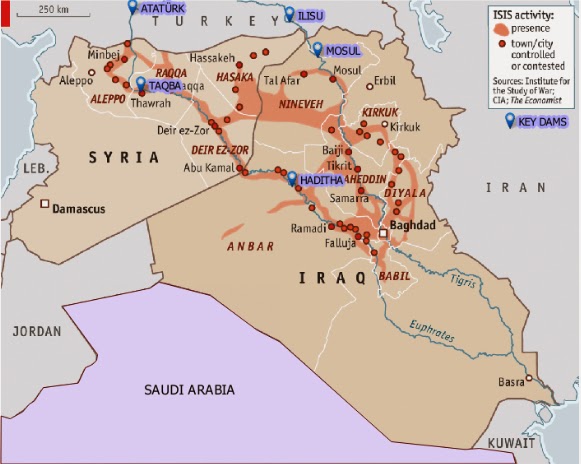
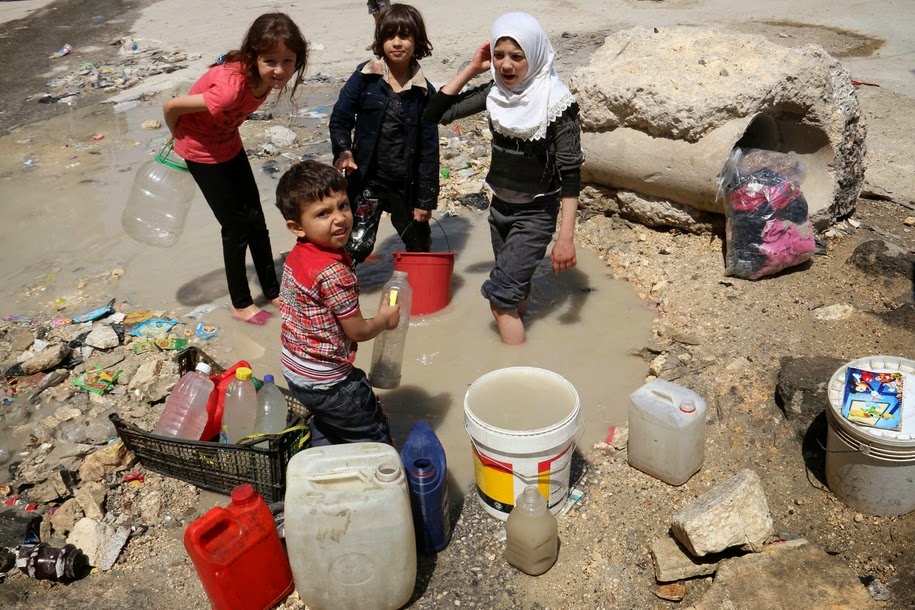
But there’s a lot more happening to explain why behind the veil of a quest for an Islamic State (IS), there’s also a war for water in Syria and Iraq. Making the plight of citizens worse is the continued targeting of water supply networks by both regime and opposition forces, which have attacked strategic lifelines, such as water channels, to gain control of territory and to punish and put pressure on their opponents.

Opening the flood gates …

The Islamic State’s quest for hydrological control began in Syria, when it captured the Tabqa Dam in 2013. Rebel-held areas had been systematically denied electricity by President Bashar al-Assad’s forces in their effort to turn the population against the insurgency. The Tabqa Dam was built more than 40 years ago with Russian help and aimed to make Syria self-sufficient in energy production. Behind the dam is Lake Assad, which provides millions of Syrians with drinking water and is a vital irrigation source for farms. After the capture of the dam, IS opened the flood-gates to get maximum electricity supply for the areas they control and win favour with the local population. As a result, the lake dropped six metres, to a record low in May, which worsened the plight of millions of already destitute Syrians as severe water cuts began to hit Aleppo province.

Conflict over the water flowing though the Euphrates and Tigris is of course nothing new and predates religious wars. They were the first rivers to be used for large scale irrigation, in the region once known as the Fertile Crescent. Somewhere between 1720 and 1684 BC, a grandson of Hammurabi dammed the Tigris to prevent the retreat of rebels led by Iluma-Ilum, who declared the independence of Babylon. The Euphrates was already used as a weapon somewhere around 2500 BC, in another fight for Babylon, when the king of Umma cut the banks of irrigation canals alongside the Euphrates dug by his neighbor, the king of Girsu.

The Euphrates and Tigris are the two major and longest rivers in the Middle East. They both originate in Turkey. The Euphrates flows through Syria and Iraq to reach the Persian Gulf while the Tigris flows through Kurdish territory, meeting up with the Euphrates in the Southern Mesopotamian Marshes of Iraq. There are currently at least 46 dams in the Tigris-Euphrates basin, with at least 8 more planned or under construction. These dams have become key pieces of geo-political control in the region.

… and shutting down the flows

While one act of war is opening the flood gates, another is closing them. In 1974, Iraq threatened to bomb the same Tabqa Dam in Syria, alleging that the dam had reduced the flow of Euphrates River water to Iraq. But between then and now, Turkey, through its position upstream, has taken over as the most powerful regional commander of water, by completing the giant Ataturk Dam. In 1990 Syria and Iraq protested that Turkey now has a weapon of war: by closing the gates they could leave them dry. They had good reason to protest. In mid-1990 Turkish president Turgut Özal threatened to restrict water flow to Syria to force it to withdraw support for Kurdish rebels operating in southern Turkey.

In April 2014, the Islamic State blamed the low water levels in Lake Assad to Turkey’s closure of the Ataturk Dam. Sources found by Al Jazeera said that these claims are disputed. But even if the allegations are only partly true: they were used by the Islamic State to issue threats to ‘liberate Istanbul’, if that was necessary. So while Turkey, IS and Assad fight over water, millions of ordinary Syrians and Iraqi’s see their water levels drop dramatically. Not just by a new drought, with rainfall down by 50-85 percent since October 2013, but mostly due to a power struggle.

Tensions over water control in the region are set to heat up further if Turkey completes the Ilisu Dam on the Tigris River near the border of Syria. The Ilisu Dam will generate 1,200 MW and is part of the vast and ambitious Southeastern Anatolia Project, known as GAP after its Turkish title (Guneydogu Anadolu Projesi): a network comprising 22 dams and 19 power plants. The Ilisu reservoir will flood 52 villages and 15 towns, including Hasankeyf, a Kurdish town of 5,500 people, which is the only town in Anatolia that has survived since the Middle Ages and is under archaeological protection. It will displace approximately 16,000 people in the troubled Kurdish region.

The World Bank (WB), the British construction company Balfour Beatty and the Italian company Impreglio have all withdrawn from the problematic project. So have international funds and export credit from Austria, Germany and Switzerland. However, the project is currently funded by Turkish banks. Iraq and also Syria will be the most heavily impacted if the dam and others go through, with the most extreme projections holding that, owing to a combination of climate change and upstream dam activity, the Tigris and Euphrates rivers won’t have sufficient flow to reach the sea by as early as 2040.

If you live in Syria or Iraq and the water irrigating your field stops coming you might join the ranks of any army promising to attack those who kept the water for themselves – no matter if they tell you the truth or not. As is often the case in conflicts or epidemics it is not the facts themselves that count most but what people believe to be the facts. Those who can convince it’s the enemies fault that there’s not enough water will have the key to where the hearts and minds of the people will go to – no matter what the facts are.

The US finally finds a Weapon of Mass Destruction in Iraq

The Tabqa Dam is not the only dam attacked by IS. They are also trying to take the Haditha Dam, the second-largest in Iraq, raising the possibility of catastrophic damage and flooding. On Sunday, the US was bombing IS positions close to the dam. The IS militants are also fighting for control of the Euphrates River Dam, about 120 miles northwest of Baghdad and government forces were fighting to halt their advance. Insurgents from IS seized the Falluja Dam in Iraq in February and closed the floodgates to cause upstream flooding and to cut downstream water supply. Some 40.000 people were displaced just to flood the area around the city of Falluja to force government troops to retreat and lift a siege, while cutting water supplies and hydroelectricity generation for other parts of the country. All that was peanuts compared to what IS did next.

On August 7 IS captured the 1GW Mosul Dam on the Tigris – sending shock waves through Bagdad, Kuwait and the US. Whoever controls the Mosul Dam, the largest in Iraq, controls most of the country’s water and power resources. Located on the Tigris River upstream of Mosul, the dam, 3.6 km long and with 320 MW of capacity daily, formerly known as the Saddam dam, was built beginning in 1980 at a cost of 1.5$ billion USD, to bolster the regime during the Iran-Iraq war by a German-Italian consortium that was led by Hochtief Aktiengesellschaft. Its construction submerged many archaeological sites in the region yet more troubling is that because the dam was constructed on a foundation of soluble gypsum, it requires continuous grouting of the dam’s foundation to promote stability. Due to the engineering problems it presents it has been described recently by US engineers as “the most dangerous dam in the world.” And that was before the “most dangerous terror group ever” captured it.

A senior U.S. administration official said that “The failure of the Mosul Dam could threaten the lives of large numbers of civilians, threaten U.S. personnel and facilities – including the U.S. Embassy in Baghdad – and prevent the Iraqi government from providing critical services to the Iraqi populace,” (Source: Reuters). A 2006 U.S. Army Corps of Engineers report obtained by the Washington Post said the dam, which blocks the Tigris and holds 12 billion cubic meters of water, could flood two cities killing over a half a million people if it were destroyed or collapsed. The tsunami going to Mosul, a city of 1.7 million people, can be 20m high if the dam breaks with a full reservoir.

But even without a catastrophic failure, the dam is already at the epicenter of the war. Soon after the Islamic State captured the Mosul Dam they cut supplies to some villages in the north of the country that have not joined their cause. Recapturing this instrument of war was a sufficient reason for US forced to deploy air power to support Kurdish forces to recapture the dam. Saving the Yazidis from their mountain captured most media attention, but a key reason for the US to bomb Iraqi soil for the first time since 2011 was the fact that IS took the Mosul Dam. After bombing IS positions for several days, freshly re-equipped Kurdish fighters recently regained control of the dam.

Mega Dams & Water Management Practices

The importance of hydro-infrastructure in these battles and how it can be wielded firstly underlines the need for a serious re-appraisal of water management practices. Big dams (with funding from Multilateral agencies such as the WB, national and regional development banks, private equity and pension funds as well as from the Clean Development Mechanism, etc.) cause large scale displacement of populations, are ecologically destructive, wash away any other source of livelihood, and often saddle countries with debt while performing well below planned outputs as regards electricity generation. Moreover, compounded by climate change, contemporary ecological crises are leading to ever more conflict over trans-boundary water rights, such as for example between Ethiopia and Egypt, which are also on the verge of war over the construction of the Grand Renaissance and Gibe 3 dams, which would become Africa’s tallest. The world’s Big Dam Fan Club should take note of what has just happened in Syria and Iraq and realise that once disaster hits, hatred will not go to any God but to those who constructed the weapon of mass destruction. Water, rather than oil, is shaping up to be the key strategic resource in the region. More


Saturday, June 21, 2014

Drought in Syria: a Major Cause of the Civil War?

Syria's devastating civil war that began in March 2011 has killed over 200,000 people, displaced at least 4.5 million, and created 3 million refugees.

Figure 1. The highest level of drought,
"Exceptional", was affecting much of
Western Syria in April 2014, as measured
by the one-year Standardized Precipitation
Index (SPI).
Image credit: NOAA's Global Drought Portal

While the causes of the war are complex, a key contributing factor was the nation's devastating 2006 - 2011 drought, one of the worst in the nation's history, according to new research accepted for publication in the journal Weather, Climate, and Society by water resources expert Dr. Peter Gleick of the Pacific Institute. The drought brought the Fertile Crescent's lowest 4-year rainfall amounts since 1940, and Syria's most severe set of crop failures in recorded history. The worst drought-affected regions were eastern Syria, northern Iraq, and Iran, the major grain-growing areas of the northern Fertile Crescent. In a press release that accompanied the release of the new paper, Dr. Gleick said that as a result of the drought, "the decrease in water availability, water mismanagement, agricultural failures, and related economic deterioration contributed to population dislocations and the migration of rural communities to nearby cities. These factors further contributed to urban unemployment, economic dislocations, food insecurity for more than a million people, and subsequent social unrest."

More

Vanishing Water Landscapes in the Middle East

On 11 June 2014 Francesca de Châtel successfully defended her PhD thesis on water in Syria. The Jordan River has been reduced to 2% of its historic size and is heavily polluted. Across Syria, rivers are shrinking, springs have dried up, and the desert is spreading. The water crisis in the Middle East, the most water-scarce region in the world, is rapidly worsening, yet decision-makers appear unwilling to acknowledge its severity and water remains low on the political agenda. How can this gap between the reality of growing scarcity on the ground and the continued illusion of plenty be explained?

2014.06.11 De Chatel

This is one of the key questions Francesca de Châtel explores in «Vanishing Water Landscapes in the Middle East», a study that combines extensive study on the ground in pre-conflict Syria and across the region with historic data to show how high population growth, overambitious agricultural development projects and uncontrolled water use over the last 60 years have irreversibly disrupted the Middle East’s fragile ecological balance.

acrobat icon Vanishing Water Landscapes in the Middle East

» Article (in German) in Neue Zürcher Zeitung: Die Rache der Verelendeten

» Article (in French) in Le Monde: La thèse qui associait sécheresse et guerre syrienne More


Thursday, September 12, 2013

Drought Called a Factor in Syria’s Uprising

Two-and-a-half years ago, a group of children in the Syrian city of Dara’a triggered one of the bloodiest conflicts in the 21st century when they painted some anti-government graffiti on a school wall in the ancient farming community.

The children were quickly detained and tortured, leading to widespread protests in the city that were met with harsh repression. The government’s brutal response led to a nationwide revolt that has now stagnated into a bloody stalemate with no end in sight. Dara’a is a mostly agricultural community in a region that has suffered an unrelenting drought since 2001.

Some experts say it’s no accident that Syria’s civil war began there. In 2009, the United Nations and other international agencies found that more than 800,000 Syrian farmers and herdsmen had been forced off their lands because of drought, with many crowding into cities like Dara’a. Additionally, thousands of illegal wells were drilled, drastically lowering the nation’s ground water supply.

The effects of drought and water-mismanagement in the region were highlighted recently by the publication of U.S. National Aeronautic and Space Administration satellite photographs of Syria, Turkey and Iraq. Faced with drought, Syrians crowding these farm towns started drilling deeper for fresh water in the aquifer beneath them. Experts estimated that 60 percent of the aquifer has been lost due to illegal drilling, and a total of 177 million-acre feet of water disappeared, the second-largest aquifer loss in the world.

Satellite images reveal depth of drought

“I actually don’t think the aquifer will recover,” said , a hydrologist and leader of a study of seven years of NASA satellite data that show the Tigris-Euphrates region second only to India in the speed of its groundwater loss. “The Middle East is the dry part of the world and now that climate change is expressing itself very clearly, one of the things that we will see is that the dry parts of the world will get drier,” Famiglietti said. “Think of it as a persistent prolonged drought.” Because of climate change, the Tigris-Euphrates basin and the underground reservoirs of fresh water that once nurtured this fragile desert climate may not be able to sustain future populations in Syria.

It all started in Dara’a

The Syrian uprising was unlike political uprisings in Egypt, Yemen and other Middle East states, all of which started in the major cities. Dara’a was a regional agricultural hub with a pre-war population of 90,000. “Dara’a is the capital of an agricultural province, one of the most significant agricultural areas,” said Syria scholar Ayel Zisser of the Tel Aviv University. Their protests spread from Dara’s at Syria’s southern border to communities north of Aleppo and across the vast al-Jazira plain that stretches from the banks of the Euphrates to the banks of the Tigris. The pattern of the protests followed the rural path of the drought. “Even until today it’s been a peasant revolt isolated to the rural areas,” Zisser said. Assad’s economic reforms focused on global trade that benefitted the urban middle classes, thereby worsening the plight of Syria’s farmers, according to Zisser. The reforms were implemented “at the expense of the population in the rural areas, where they abolished agricultural subsidies,” Zisser said. “The regime turned its back to the rural population and the result was the revolt.” Like other Middle Eastern countries, Syria’s population has increased dramatically in recent years. “This is the first time in history that in less than 30 years, the Middle East doubled its population. It was between 1950 and 1980,” said Arnon Soffer, a demographer and the head of research at the University of Haifa and Israel’s National Defense College. “If that’s not tragic enough, from 1980 to 2010 – another 30 years – this crazy area doubled itself again,” Soffer added. Even before climate change threatened less rainfall in the region, water was a hot-button issue. In 1973, Iraq rushed troops to Syria’s eastern border as upstream, Syria began filling its Tagba Dam with Euphrates water to create Lake Assad.

The real water power in basin is Turkey.

Syria and Iraq depend on the waters of the Euphrates and the Tigris, which flow from southern Turkey, for most of their agricultural irrigation. Farmers on both sides of the border also rely on traditional irrigation techniques that waste water resources. “Turks use most of the water of the Euphrates,” said Bogochan Benli, a water expert who worked in the Aleppo labs of the International Center for Agricultural Research in Dry Areas during the years of the drought. Aleppo and many northern Syrian communities traditionally also depended on the Euphrates for their drinking water, he said. In Turkey, Benli said since the 1970’s the Southeastern Anatolia project has created employment for a poor and arid region of Turkey. It’s the main income-generator for the region and their water policy “will never change.” The project is an ambitious development of 22 dams and 19 hydroelectric power plants to irrigate and provide electrical power in nine Turkish provinces. The centerpiece is the massive Ataturk Dam and hydroelectric power plant that opened in 1990. According Arnon Soffer of Haifa University a few months before the dam was completed, then-Turkish president Turgut Ozal told Syria’s president, Hafez al-Assad, “Now you can wash yourself for the next two months, but I will close the Ataturk Dam and I will dry the Euphrates River.” He said Ozal’s abrupt pronouncement to Hafez Assad was devastating to Syria. “The Euphrates became a wadi, a dry valley,” said Soffer. Assad Dam closed for a month. “The dam was empty and there was no electricity. Even up to today, I could not imagine how they could recover.” Though Turkey and its downstream neighbors have discussed sharing their waters, Turkey has not signed away any rights. With little or no regional cooperation on water issues, experts fear that the turmoil now wrecking Syria could be a prelude to other conflicts in the region. More

While there is still no regional conflict in the region there is a compelling need for an international organization to start a regional conversation on trans-boundary rivers. Rivers, although they may, as in this case originate in Turkey, are a critical element of the global commons, and must be fairly shared by all riverine states. We are no longer in colonial times where for instance Egypt got the lions share of the Nile, leaving very little for Ethiopia. Syria is already in turmoil, Turkey is simmering with protests, Jordan is being blown to and froe and Israel may go off on a tangent at any time. Let us therefore address this issue immediately.


Tuesday, March 12, 2013

Freshwater Stores Shrink in Tigris-Euphrates Basin

Scientists using the twin gravity-measuring satellites of the Gravity Recovery and Climate Experiment (GRACE) have found that a large portion of the Middle East lost freshwater reserves rapidly during the past decade. The research team observed the Tigris and Euphrates river basins—including parts of Turkey, Syria, Iraq, and Iran—and found that 117 million acre feet (144 cubic kilometers) of fresh water was lost from 2003 to 2009. That amount is roughly equivalent to the volume of the Dead Sea. About 60 percent of the loss was attributed to the pumping of groundwater from underground reservoirs.

The two natural-color images above were acquired by the Landsat 5 satellite and show the shrinking of the Qadisiyah Reservoir in Iraq between September 7, 2006 and September 15, 2009. The first graph shows the elevation of the water in that reservoir between January 2003 and December 2009. The elevation is a proxy measurement for the total volume of water stored there; labels show the water elevation at the time of the satellite images.

The second graph shows the water storage for the entire study area as measured by GRACE from January 2003 to December 2009. The gray line depicts total water storage in the region—groundwater, surface water bodies, and soil moisture—while the green line depicts changes in surface water. The difference between those two lines reflects the change in water stored in underground aquifers (ground water). The total water storage shows a seasonal fluctuation, but also an overall downward trend, suggesting that groundwater is being pumped and used faster than natural processes can replenish it.

“GRACE data show an alarming rate of decrease in total water storage in the Tigris and Euphrates river basins, which currently have the second fastest rate of groundwater storage loss on Earth, after India,” said Jay Famiglietti, principal investigator of the study. “The rate was especially striking after the 2007 drought. Meanwhile, demand for freshwater continues to rise, and the region does not coordinate its water management because of different interpretations of international laws.”

Obtaining ground-based data in Middle East can be difficult, so data from satellites such as GRACE are essential to providing a global picture of water storage trends. Within any given region on Earth, rising or falling water reserves alter the planet’s mass, influencing the gravity field of the area. By periodically measuring gravity in each region, the GRACE satellites tells us how water storage changes over time. (To learn more about GRACE’s ability to study fresh water on Earth, read The Gravity of Water.)

The researchers calculated that about one-fifth of the water losses in their Tigris-Euphrates study region came from snowpack shrinking and soil drying up, partly in response to a 2007 drought. Loss of surface water from lakes and reservoirs accounted for another fifth of the losses. The majority of the loss—approximately 73 million acre feet (90 cubic kilometers)—was due to reductions in groundwater. “That's enough water to meet the needs of tens of millions to more than a hundred million people in the region each year, depending on regional water-use standards and availability,” Famiglietti said. More


Sunday, February 10, 2013

Syria: Climate Change, Drought and Social Unrest

Syria’s current social unrest is, in the most direct sense, a reaction to a brutal and out-of-touch regime and a response to the political wave of change that began in Tunisia early last year.

However, that’s not the whole story. The past few years have seen a number of significant social, economic, environmental and climatic changes in Syria that have eroded the social contract between citizen and government in the country, have strengthened the case for the opposition movement, and irreparably damaged the legitimacy of the al-Assad regime. If the international community, and future policy-makers in Syria, are to address and resolve the drivers of unrest in the country, these changes will have to be better explored and exposed.

Out of the blue?

International pundits characterized the Syrian uprising as an “out of the blue” case in the Middle East - one that they didn’t see coming. Many analysts, right up to a few days prior to the first protests, predicted that Syria under al-Assad was “immune to the Arab Spring.” However, the seeds of social unrest were right there under the surface, if one looked closely. And not only were they there, they had been reported on, but largely ignored, in a number of forms.

Water shortages, crop-failure and displacement

From 2006-2011, up to 60% of Syria’s land experienced, in the terms of one expert, “the worst long-term drought and most severe set of crop failures since agricultural civilizations began in the Fertile Crescent many millennia ago.” According to a special case study from last year’s Global Assessment Report on Disaster Risk Reduction (GAR), of the most vulnerable Syrians dependent on agriculture, particularly in the northeast governorate of Hassakeh (but also in the south), “nearly 75 percent…suffered total crop failure.” Herders in the northeastlost around 85% of their livestock, affecting 1.3 million people.

The human and economic costs are enormous. In 2009, the UN and IFRC reportedthat over 800,000 Syrians had lost their entire livelihood as a result of the droughts. By 2011, the aforementioned GAR report estimated that the number of Syrians who were left extremely “food insecure” by the droughts sat at about one million. The number of people driven into extreme poverty is even worse, with aUN report from last year estimating two to three million people affected.

This has led to a massive exodus of farmers, herders and agriculturally-dependent rural families from the countryside to the cities. Last January, it was reported that crop failures (particularly the Halaby pepper) just in the farming villages around the city of Aleppo, had led “200,000 rural villagers to leave for the cities.” In October 2010, the New York Times highlighted a UN estimate that 50,000 families migrated from rural areas just that year, “on top of the hundreds of thousands of people who fled in earlier years.” In context of Syrian cities coping with influxes ofIraqi refugees since the U.S. invasion in 2003, this has placed additional strains and tensions on an already stressed and disenfranchised population.

Climate change, natural resource mis-management, and demographics

The reasons for the collapse of Syria’s farmland are a complex interplay of variables, including climate change, natural resource mis-management, and demographic dynamics.

A NOAA study published last October in the Journal of Climate found strong and observable evidence that the recent prolonged period of drought in the Mediterranean littoral and the Middle East is linked to climate change. On top of this, the study also found worrying agreement between observed climate impacts, and future projections from climate models. A recent model of climate change impacts on Syria conducted by IFPRI, for example, projects that if current rates of global greenhouse gas emissions continue, yields of rainfed crops in the country may decline “between 29 and 57 percent from 2010 to 2050.” More


Thursday, August 16, 2012

Climate change and the Syrian uprising

Two days short of Egyptian leader Hosni Mubarak's resignation, Al Jazeera published anarticle, headlined "A Kingdom of Silence," that contended an uprising was unlikely in Syria. The article cited the country's "popular president, dreaded security forces, and religious diversity" as reasons that the regime of Bashar al-Assad would not be challenged, despite the chaos and leadership changes already wrought by the so-called Arab Spring. Less than one month later, security forces arrested a group of schoolchildren in the Syrian city of Dara'a, the country's southern agricultural hub, for scrawling anti-government slogans on city walls. Subsequent protests illustrated the chasm between the regime's public image -- encapsulated in the slogan "Unity, Freedom and Socialism" -- and a reality of widespread public disillusion with Assad and his economic policies.

Among the many historical, political, and economic factors contributing to the Syrian uprising, one has been devastating to Syria, yet remains largely unnoticed by the outside world. That factor is the complex and subtle, yet powerful role that climate change has played in affecting the stability and longevity of the state.

The land now encompassed by Syria is widely credited as being the place where humans first experimented with agriculture and cattle herding, some 12,000 years ago. Today, the World Bank predicts the area will experience alarming effects of climate change, with the annual precipitation level shifting toward a permanently drier condition, increasing the severity and frequency of drought.

From 1900 until 2005, there were six droughts of significance in Syria; the average monthly level of winter precipitation during these dry periods was approximately one-third of normal. All but one of these droughts lasted only one season; the exception lasted two. Farming communities were thus able to withstand dry periods by falling back on government subsidies and secondary water resources. This most recent, the seventh drought, however, lasted from 2006 to 2010, an astounding four seasons -- a true anomaly in the past century. Furthermore, the average level of precipitation in these four years was the lowest of any drought-ridden period in the last century.

While impossible to deem one instance of drought as a direct result of anthropogenic climate change, a 2011 report from the National Oceanic and Atmospheric Administration regarding this recent Syrian drought states: "Climate change from greenhouse gases explained roughly half the increased dryness of 1902-2010." Martin Hoerling, the lead researcher of the study, explains: "The magnitude and frequency of the drying that has occurred is too great to be explained by natural variability alone. This is not encouraging news for a region that already experiences water stress, because it implies natural variability alone is unlikely to return the region's climate to normal." The Intergovernmental Panel on Climate Change predicts that global warming will induce droughts even more severe in this region in the coming decades.

It is estimated that the Syrian drought has displaced more than 1.5 million people; entire families of agricultural workers and small-scale farmers moved from the country's breadbasket region in the northeast to urban peripheries of the south. The drought tipped the scale of an unbalanced agricultural system that was already feeling the weight of policy mismanagement and unsustainable environmental practices. Further, lack of contingency planning contributed to the inability of the system to cope with the aftermath of the drought. Decades of poorly planned agricultural policies now haunt Syria's al-Assad regime. More