Water Security is National Security

Water resources and how they are managed impact almost all aspects of society and the economy, in particular health, food production and security, domestic water supply and sanitation, energy, industry, and the functioning of ecosystems. Under present climate variability, water stress is already high, particularly in many developing countries, and climate change adds even more urgency for action. Without improved water resources management, the progress towards poverty reduction targets, the Millennium Development Goals, and sustainable development in all its economic, social and environ- mental dimensions, will be jeopardized. UN Water.Org

Showing posts with label extreme temperatures. Show all posts

Thursday, November 6, 2014

AGWA Launches Toolkit for Climate Change Adaptation in Water Resources Management


4 September 2014: The Alliance for Global Water Adaptation (AGWA) and partners have launched a manual for dealing with uncertainty under climate change by applying climate-informed decision-making to water resource management, project design and risk evaluation.


The manual was launched in a seminar held during World Water Week, on 4 September.


‘Beyond Downscaling: A Bottom-Up Approach to Climate Adaptation for Water Resources Management' is the result of two years' work by AGWA, the World Bank, the Inter-American Development Bank (IDB), US Army Corps of Engineers, University of Massachusetts and RTI International, among others.


It provides practical guidelines for practitioners and project coordinators for risk-based decision making and adaptation of water systems by using a bottom-up approach. The book aims to “provide an alternative approach contributing to improvement in the quality and effectiveness of water resources management planning and project design under climate variability and change uncertainty.”


The manual covers: AGWA's approach to sustainable water management; climate change impacts on water resources; mainstreaming adaptation into water resources management; key tools for supporting climate risk assessment; and approaches to identifying adaptation strategies for water projects. It also makes the case for moving beyond down-scaling global climate models, to a bottom-up approach to climate adaptation in the water sector, and presents a framework for an AGWA-supported adaptation approach.


The approach supported by AGWA, inter alia: recognizes the need to integrate climate adaptation into existing decision-making processes; advocates for bottom-up approaches to vulnerability assessment; supports the use of “systematic decision trees based on existing water resources management approaches”; stresses the importance of creating flexible decision pathways; and emphasizes the integration of flexible governance mechanisms into water resources management.


Speaking at the launch, Marcus Wijnen, Senior Water Resources Management Specialist, World Bank, noted that the book is “work in progress,” and invited stakeholders to provide feedback. More


The 2014 World Water Week took place from 31 August-5 September, in Stockholm, Sweden. [AGWA Publication Webpage] [Publication: Beyond Downscaling: A Bottom-up Approach to Climate Adaptation for Water Resources Management] [Video of Launch]


Sunday, September 7, 2014

Drought apocalypse begins in California as wells run dry

(NaturalNews) Water wells in central California have begun to run dry, reports the LA Times. (1) "Extreme drought conditions have become so harsh for the Central Valley community of East Porterville [that] many of its residents dependent on their own wells have run out of water."

Tulare County has confirmed their wells have run out of water, and so far hundreds of homes have no running water.

According to the LA Times, rumors are also spreading that Child Protective Services officials will begin taking children away from families who have no running water, although the county claims the rumor is false.

It begins: the collapse of California's water aquifers

With this news, it is now official that the collapse of California's water aquifers has begun. With each passing month and year, more and more wells will run dry across the state as California plummets into the desert conditions from which it once sprang.

Extreme drought now covers 82% of California, according to the National Drought Mitigation Center. (2) Fifty-eight percent of the state is in "exceptional drought."

During the unfolding of this drought, California farmers and cities have siphoned unprecedented volumes of water out of the state's underground aquifers. This is called "fossil water" and it can take centuries to regenerate. Once this fossil water is used up, it's gone.

35-year "megadrought" may be on the way

"The southwestern United States has fifty percent change of suffering a 'megadrought' that lasts 35 years," reports the Daily Mail. (3)

"They say global warming has meant the chance of a decade long drought is at least 50 percent, and the chances of a 'megadrought' – one that lasts up to 35 years – ranges from 20 to 50 percent over the next century."

One scientist is quoted in the story as saying, "This will be worse than anything seen during the last 2,000 years and would pose unprecedented challenges to water resources in the region."

Unless politicians become magical wizards and figure out a way to create water out of nothing, what all this really means is that cities of the American southwest will not be able to support present-day populations. A mass migration (evacuation) out of the cities will be necessary sooner or later.

California's water deficit will lead to ecological and economic collapse

In an almost perfect reflection of California's state budget deficits, the state is also running an unsustainable water deficit. It is a mathematical certainty that when you remove far more water from the aquifers than is being replenished, the amount of water remaining in those aquifers will eventually reach zero.

This "zero day" water reality is still psychologically denied by most Californians. If the reality of this situation were widely recognized, California would be experiencing a glut of real estate inventory as millions of homeowners tried to sell their properties and evacuate the state. The fact that the real estate market has not yet collapsed in California tells us that Californians are still living in a state of denial about the future of their water supply.

Even as California's water supply collapses by the day, local farmers and towns have few options other than drilling for more water. "Drill! Drill! Drill!" is the mantra of the day, creating an 18-month backlog for well drilling companies. Each new well that's drilled must seek to go deeper than the previous wells which are running dry. It's a literal race to the bottom which can only end in catastrophe.

Then again, a willful acceleration toward catastrophe is merely a sign of the times when it comes to human civilization. There is almost no area in which humans have ever achieved balance: not in fossil fuels, metals mining, fossil water exploitation, debt creation, industrial chemical contamination, ecological exploitation or even global population. It's almost as if the human race is determined to destroy itself while racing to see who can achieve self destruction first. More


Sunday, August 24, 2014

Karachi thirsts for a water supply

KARACHI: On the outskirts of the slums of Pakistan’s biggest city, protesters burning tires and throwing stones have what sounds like a simple demand: They want water at least once a week.

In Karachi people go days without getting water from city trucks, sometimes forcing them to use groundwater contaminated with salt. A recent drought has only made the problem worse. And as the city of roughly 18 million people rapidly grows, the water shortages are only expected to get worse.

“During the last three months they haven’t supplied a single drop of water in my neighbourhood,” protester Yasmeen Islam said. “It doesn’t make us happy to come on the roads to protest but we have no choice anymore.”

Karachi gets most of its water from the Indus River — about 550 million gallons per day — and another 100 million gallons from the Hub Dam that is supplied by water from neighbouring Balochistan province. But in recent years, drought has hurt the city’s supply.

Misbah Fareed, a senior official with the Karachi Water and Sewerage Board that runs the city’s water supplies, said that only meets about half the city’s needs — 1.2 billion gallons a day.

Karachi’s water distribution network has exacerbated the problem by forcing much of the city to get its water through tankers instead of directly from pipes. The Karachi Water and Sewerage Board operates 12 water hydrants around the city where tankers fill up and then distribute. Even people in the richest areas of the city get their water through tankers that come a few times a week to fill up underground cisterns.

But criminals have illegally tapped into the city’s water pipes and set up their own distribution points where they siphon off water and sell it.

“I personally know some people previously associated with drug mafias who now switched to the water tanker business,” Fareed said. “Just imagine how lucrative the business is.”

Other areas of Pakistan pump massive amounts of groundwater. But in the coastal city of Karachi, the underground water is too salty to drink. Many people have pumps but they use the water for things such as showering or washing clothes.

The water shortage is exacerbated by Karachi’s massive population. Pakistani military operations and American drone strikes in the northern tribal regions, as well as natural disasters such as flooding and earthquakes, have pushed people toward a city long seen as the economic heart of Pakistan.

The city is trying to increase the amount of water it gets from the Indus River by building another canal — dubbed the K4 project. But even if they were to get political approval from the capital to take more water from the river, it would take a minimum of four years to build.

But analysts say supply isn’t the only problem. Farhan Anwar, who runs an organisation called Sustainable Initiatives in Karachi, said the Karachi Water and Sewerage Board is horribly overstaffed and many of those are political appointees. The cost for water is also very low and the agency doesn’t collect all that it’s due, Anwar said. That’s made it difficult to upgrade the ageing pipes the system does have, meaning contamination and leakages are common.

Meanwhile, Karachi residents have to spend more money or walk further and further to get water. One elderly resident Aisha Saleem said in recent months even the little water they get from the water board is salty.

“Women and kids have to go miles by foot and carry drinking water every day,” she said More


Saturday, August 23, 2014

How extensive is California's drought?

A snake-like trickle of water flows underneath Lake Oroville's Enterprise Bridge — just one striking example of how much California's chronic drought is affecting the state's lakes and reservoirs.

Situated at the foot of the Sierra Nevadas in Butte County, Lake Oroville is one of the largest reservoirs in California, second only to Shasta Lake. After enduring three straight years of drought, the lake is currently only filled to 32 percent of its capacity.

In any case, the drought in California is getting serious. Phase 2 of Los Angeles' mandatory water conservation ordinance is now in effect, which means a team of water-use inspectors are tasked with enforcing water restrictions and fining water wasters. If the drought continues through fall and winter, the ordinance will move to Phase 3, which entails even stricter rules and some prohibitions.

To get a better idea of the dire situation in the Golden State, continue below for a photo comparison of water levels taken in 2011 and 2014, looking at Lake Oroville and Folsom Lake, another major California reservoir located in Sacramento County that is now filled at 40 percent of its capacity.

Bidwell Marina, Lake Oroville

Folsam Dam, Folsom Lake

Enterprise Bridge, Lake Oroville


Thursday, June 26, 2014

Rains Failing Over India:

Feeble 2014 Monsoon Heightens Concerns That Climate Change is Turning A Once-Green Land into Desert

El Nino has yet to be declared. Though signs of the Pacific Ocean warming event abound, they are still in the early stages. But for all the impact on the current Indian Monsoon — the rains this vast sub-continent depends on each year for a majority of its crops — the current pre-El Nino may as well be a monster event comparable to 1998.

For the rains that have come so far have been feeble. By June 18, precipitation totals were more than 50% below the typical amount by this time of year for northern and central India and 45% below average for the country as a whole. A stunted Monsoon that many are saying is about as weak as the devastatingly feeble 2009 summer rains. And with Pacific Ocean conditions continuing to trend toward El Nino, there is concern that this year’s already diminished rains will snuff out entirely by mid-to-late summer, leaving an already drought-wracked India with even less water than before.

Through June 25th, the trend of abnormally frail monsoonal rains continued unabated:

India cloud cover on June 25, 2013 [Left Lower image] compared to India cloud cover on June 25 of 2014 [right upper image].

Note the almost complete lack of storms over India for this year compared to 2013 when almost the entire country was blanketed by rains. Image source: LANCE-MODIS.)

India’s Rain Pattern Has Changed

It’s not just that 2014 is a bad year for India. It’s that the current weakened monsoon comes at the tail end of a long period in which the rains have increasingly failed. Where in the past it took a strong El Nino to stall the rains, ever-increasing human atmospheric and ocean warming have pushed the threshold for Monsoonal failure ever lower. Now even the hint of El Nino is enough to set off a dry spell. A growing trend of moisture loss that is bound to have more and more severe consequences.

A new study by Stanford University bears out these observations in stark detail. For the yearly monsoon that delivers fully 80 percent of India’s rains has fallen in intensity by more than 10% since 1951. And though a 10% loss may seem relatively minor, year on year, the effects are cumulative. Overall, the prevalence of dry years increased from 1981 to 2011 by 27% and the number of years experiencing 3 or more dry spells doubled.

Meanwhile, though a general drying trend has taken hold, rain that does occur happens in more intense bursts, with more rain falling over shorter periods. These newly intensified storms are more damaging to lands and homes, resulting in both increasing destruction of property while also greatly degrading the land through more intense erosion.

25 Percent of India’s Land is Turning to Desert

Loss of annual monsoonal rains is coming along with a dwindling of water flows from the melting Himalayan glaciers. These two climate change induced drying effects are already having stark impacts.

For according to the Indian Government’s Fifth National Report on Desertification, Land Degradation and Drought, a quarter of India’s land mass is now experiencing desertification even as 32 percent is suffering significant degradation due to heightening dryness and erosion. This amounts to more than 80 million hectares of land facing desertification while more than 100 million hectares are steadily degrading. The report also noted that areas vulnerable to drought had expanded to cover 68% of the Indian subcontinent.

From the report: (India Monsoon.)

Desertification and loss of biological potential will restrict the transformation of dry lands into productive ecosystems. Climate change will further challenge the livelihood of those living in these sensitive ecosystems and may result in higher levels of resource scarcity.

Monsoonal Delay, Weakening Continues

By today, June 26, the long disrupted and weakened monsoon continues to sputter. Moisture flow remains delayed by 1-2 weeks even as the overall volume of rainfall is greatly reduced.

Though storms have exploded over some provinces, resulting in flash flooding, much of the country remained abnormally dry.

Overall, preliminary negative rainfall departures remained at greater than 40% below average for most of the nation with only five provinces receiving normal rainfall and the remaining 31 receiving either deficient or scant totals. More


Saturday, May 31, 2014

Monsoon Disrupted By El Nino + Climate Change as India Suffers Deaths, Crop Losses from Extreme Heat.

May is the month when the massive rainstorm that is the Asian Monsoon begins to gather and advance. This year, as in many other years, the monsoon gradually formed along the coast of Myanmar early in the month. It sprang forward with gusto reaching the Bay of Bengal by last week.

And there it has stalled ever since.

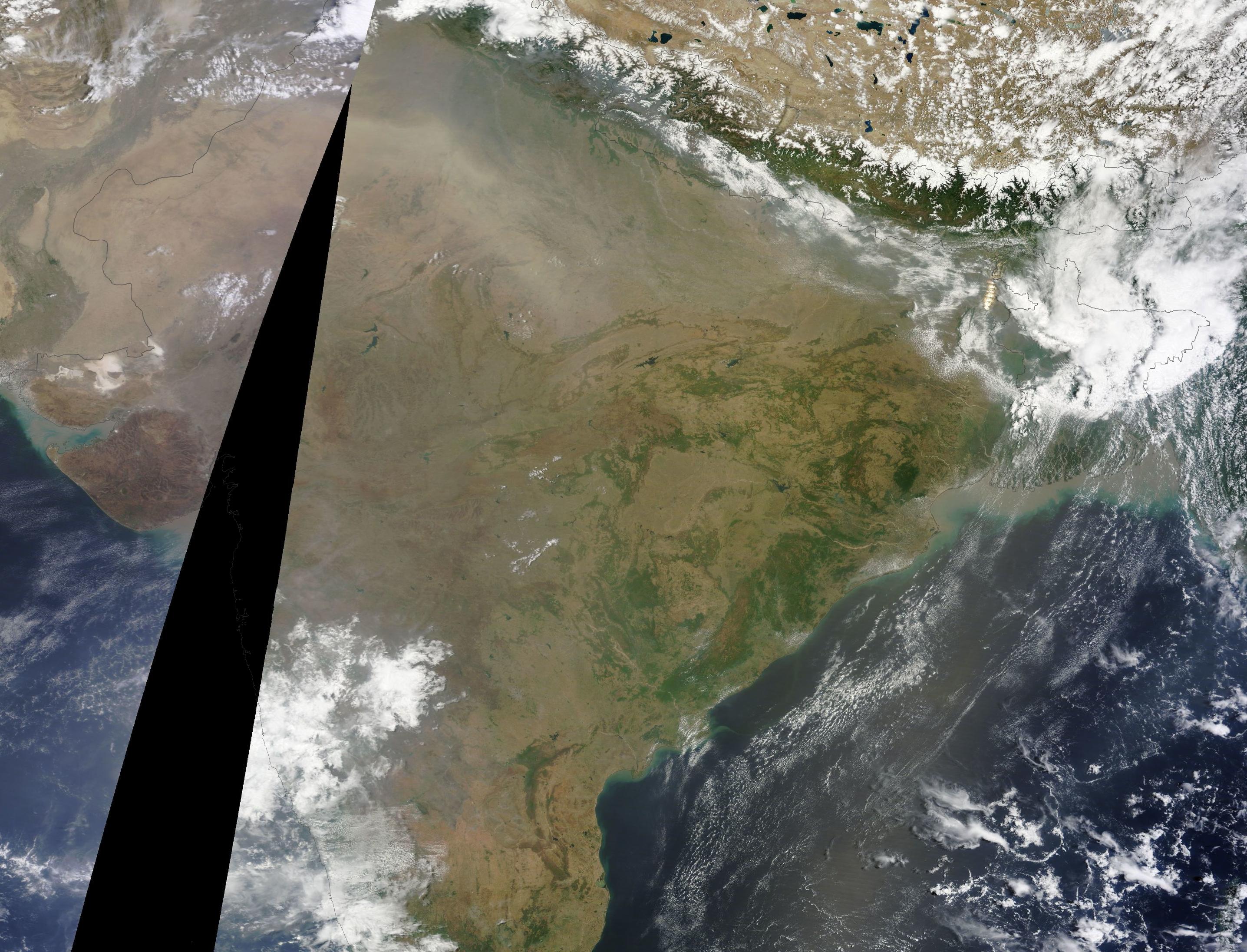
On May 25-27, an outburst of moisture from this stalled monsoonal flow splashed over the coasts of India. But by the 29th and 30th, these coastal storms and even the ones gathering over the Bengali waters had all been snuffed out. The most prominent feature in the MODIS shot of India today isn’t the rainfall that should be now arriving along the southeast coast, but the thick and steely-gray pallor of coal-ash smog trapped under a persistent and oppressive dome of intense heat.

(MODIS shot of India on May 30th. See the open stretch of blue water in the lower right frame? That’s the Bay of Bengal which borders coastal India. During a normal year at this time, that entire ocean zone should be filled with the storm clouds of a building monsoon that is already encroaching on coastal India. Today, there is nothing but a smattering of small and dispersed cloud through a mostly clear sky. Image source: LANCE-MODIS.)

Monsoon Described as Feeble

Official forecasts had already announced as of May 27th that the annual monsoon was likely to be delayed by at least a week for southeast regions of India. Meanwhile, expected monsoonal rainfall for western and northern sections of India for 2014 fell increasingly into doubt.

From The Times of India:

The monsoon is likely to be delayed by 10 days, according to scientists at the Indian Institute of Tropical Meteorology (IITM) here. The IITM’s third experimental real-time forecast says that a feeble monsoon will reach central India after June 20 as against the usual June 15. Last year, the monsoon had covered the entire country by June 15.

The annual monsoon is key to India’s agriculture. The substantial rains nurture crops even as they tamp down a powerful heating that typically builds throughout the sub-continent into early summer. Without these rains, both heat and drought tend to run rampant, bringing down crop yields and resulting in severe human losses due to excessive heat.

But, this year, heat and drought are already at extreme levels.

Major Heatwave Already Results in Loss of Life for 2014

As early as late March, the heatwave began to build over the Indian subcontinent. The heat surged throughout the state, setting off fires, resulting in a growing list of heat casualties, shutting down the power grid and spurring unrest. Meanwhile, impacts to India’s agriculture were already growing as the Lychee fruit crop was reported to have suffered a 40% loss.

By late May, temperatures across a broad region had surged above 105 degrees shattering records as the oppressive and deadly heat continued to tighten its grip.

In a country surrounded on three sides by oceans, it is a combination of heat, humidity and persistently high night-time temperatures that can be a killer. Wet bulb temperatures surge into a high-risk range for human mortality during the day even as night-time provides little respite for already stressed human bodies. Such extreme and long-duration heat doesn’t come without a sad toll. As of today, early reports indicated a loss of more than 56 lives due to heat stroke (In 2012 and 2013, total Indian heat deaths were near 1,000 each year). That said, final figures on heat losses are still pending awaiting complete reports from all of India’s provinces.

"Climatologically, we know that heatwaves are increasing in frequency and the number of days exceeding 45ºC temperatures is increasing. The frequency will increase further with global warming, hence this is a good example of a situation where science and disaster management can come together and avert damage," a spokesman for India’s National Disaster Management Authority noted on Friday.

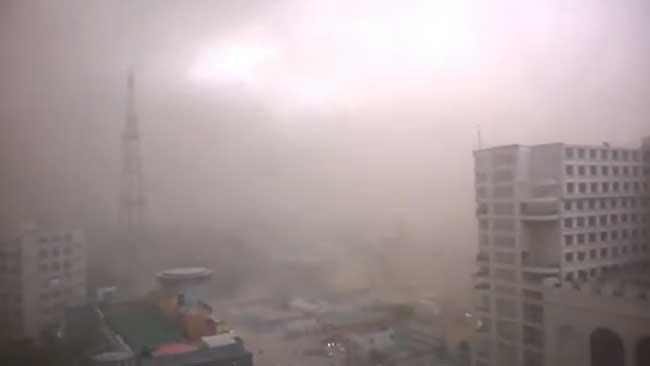
(Hot Dust. A dust storm rolls through New Delhi on Friday amidst furnace-like 113 degree heat snarling traffic and resulting in the tragic loss of 9 more lives. Image source: Gaurav Karoliwal/YouTube Screenshot.)

Today the heatwave continued to gain ground, with Kota and Rajasthan reaching an all-time record of 116 degree F (46.5 C) as New Delhi’s mercury hit 113 degrees F in the midst of a drought-induced dust storm. Dust shrouding the city spurred traffic chaos and in the heat, darkness, and confusion nine more souls were lost.

After two months of growing disruption due to heat and drought, the lands and peoples of India cry out for a Monsoon that is running later and later with each new weather report.

Climate Change + El Nino: Adding Heat and Beating Back the Monsoon

As systems approach tipping points, they are more likely to tilt toward the extremes.

For India this year, its seasonally warmest period from April to May found severe heat amplification from a number of global factors. First, climate change seeded the ground for the current Indian heatwave by adding general heat and evaporation to already hot conditions. With global average heating of +0.8 C above 1880s levels amplifying in the hot zones, early moisture loss due to higher-than-normal temperatures produces a kind of snowball effect for still more warming. Essentially, the cooling effect of water evaporation is baked out early allowing for heat to hit harder just as typical seasonal maximums are reached. More

Originally published by robertscribbler.wordpress.com/
 

Monday, May 19, 2014

The California Drought Is Far From Over, And The Entire State Is Suffering

For a few days last month, it rained in San Francisco. Residents across the city cheered a welcomed respite from a drought that has crippled California for more than two years -- but the celebration turned out to be premature.

On Thursday, for the first time this century, the U.S. Drought Monitor declared that all of California is in a “severe” drought, with many areas of the state in an even worse condition, from "extreme" to "exceptional," the poorest possible rating.

“This is a once-in-a-generation conversation,” Mark Svoboda, a climatologist at the National Drought Mitigation Center, told The Huffington Post. He added that the last time California experienced comparable conditions was in the mid-1970s.

“The state has doubled its population between then and now,” Svoboda said. “You’ve got a lot more people using a relatively finite amount of water.”

The map below, courtesy of the U.S. Drought Monitor, shows the varying levels of drought throughout California. The orange represents “severe,” the red is “extreme,” and the maroon is “exceptional” -- the agency’s highest level (Story continues below):

No area of the state is feeling the effects of the drought more harshly than San Diego, where wildfires have ripped through more than 10,000 acres of land and tens of thousands of residents have been forced to evacuate. “In a drought, the biggest threat to health and human safety is wildfire,” Doug Carlson, an information officer at the California Department of Water Resources, told HuffPost.

And there doesn’t appear to be an end in sight. “The drought has set the stage for a very busy, very long, potentially very dangerous fire season,” Daniel Berlant, a spokesperson for CAL FIRE, said to HuffPost. “As we move into the more traditional summer months, the days are only going to get longer, and the temperatures are only going to get higher.”

California’s wildfire season usually peaks during summer and fall months and then tapers during the typically rainy winter. But the drought has turned wildfires into a year-round issue. “With that lack of rain, the grass, brush and trees really have been tinder-dry all year long,” Berlant explained, noting such conditions help flames flourish.

Svoboda added that the state’s hot, dry surface leads to a hot, dry, atmosphere, which creates a prime environment for wildfires to spread. “You also typically see windier conditions,” he added. “These are all things that fires feed on.”

The damage in Southern California has ravaged hills, homes and businesses. Beloved craft brewery Stone Brewing Company evacuated its premises on Thursday. On Wednesday, KTLA senior producer Marcus Smith tweeted a widely-recirculated photo of a “firenado,” a dangerous phenomenon caused by strong winds whipping spirals of fire into the air. More