Water Security is National Security

Water resources and how they are managed impact almost all aspects of society and the economy, in particular health, food production and security, domestic water supply and sanitation, energy, industry, and the functioning of ecosystems. Under present climate variability, water stress is already high, particularly in many developing countries, and climate change adds even more urgency for action. Without improved water resources management, the progress towards poverty reduction targets, the Millennium Development Goals, and sustainable development in all its economic, social and environ- mental dimensions, will be jeopardized. UN Water.Org

Showing posts with label farming. Show all posts

Thursday, November 6, 2014

AGWA Launches Toolkit for Climate Change Adaptation in Water Resources Management


4 September 2014: The Alliance for Global Water Adaptation (AGWA) and partners have launched a manual for dealing with uncertainty under climate change by applying climate-informed decision-making to water resource management, project design and risk evaluation.


The manual was launched in a seminar held during World Water Week, on 4 September.


‘Beyond Downscaling: A Bottom-Up Approach to Climate Adaptation for Water Resources Management' is the result of two years' work by AGWA, the World Bank, the Inter-American Development Bank (IDB), US Army Corps of Engineers, University of Massachusetts and RTI International, among others.


It provides practical guidelines for practitioners and project coordinators for risk-based decision making and adaptation of water systems by using a bottom-up approach. The book aims to “provide an alternative approach contributing to improvement in the quality and effectiveness of water resources management planning and project design under climate variability and change uncertainty.”


The manual covers: AGWA's approach to sustainable water management; climate change impacts on water resources; mainstreaming adaptation into water resources management; key tools for supporting climate risk assessment; and approaches to identifying adaptation strategies for water projects. It also makes the case for moving beyond down-scaling global climate models, to a bottom-up approach to climate adaptation in the water sector, and presents a framework for an AGWA-supported adaptation approach.


The approach supported by AGWA, inter alia: recognizes the need to integrate climate adaptation into existing decision-making processes; advocates for bottom-up approaches to vulnerability assessment; supports the use of “systematic decision trees based on existing water resources management approaches”; stresses the importance of creating flexible decision pathways; and emphasizes the integration of flexible governance mechanisms into water resources management.


Speaking at the launch, Marcus Wijnen, Senior Water Resources Management Specialist, World Bank, noted that the book is “work in progress,” and invited stakeholders to provide feedback. More


The 2014 World Water Week took place from 31 August-5 September, in Stockholm, Sweden. [AGWA Publication Webpage] [Publication: Beyond Downscaling: A Bottom-up Approach to Climate Adaptation for Water Resources Management] [Video of Launch]


Friday, September 19, 2014

Jamaican's Cautioned Against False Sense Of Water Security

THE RAINS have returned, bringing with them relief from drought conditions that plagued the island during the summer, but Jamaicans must guard against a false sense of water security.

Hope River in dry season

So says Director of the Climate Studies Group Mona Dr Michael Taylor, who is supported in his caution by Herbert Thomas, deputy managing director of the Water Resources Authority.

Taylor, a physicist, urges Jamaicans to be mindful not only of the El Niño phenomenon that promises a return to the dry spell towards the end of this year and into next year. They need, too, he warned, to be cognisant of climate change, which will see the island experiencing longer and more severe dry spells over the long term, as well as flooding incidents.

"As El Niño peaks, we might revert to dry conditions somewhere between the end of the year and early next year, but as it declines, we are susceptible to the reverse, which is flooding, when the early rainfall season kicks in," he said.

"So the point is, we have to figure out how to be resilient to these swings in extremes from drought to flood within the course of a year, and these kinds of swings will become more and more the norm under climate change," the scientist posited.

This is borne out by research done over the last two to three years by the Climate Studies Group for the Planning Institute of Jamaica.

That research, Taylor said, looks at climate scenarios up to 2040, with a focus on projections for temperature and rainfall.

"The temperature will continue increasing about one degree up to 2040, and that is further from where we are now. We have warmed by about one degree over the last 50 years. What that really translates into is, the number of really hot days is increasing every year and the number of really hot nights is also increasing and will continue to increase," he said.

"Rainfall will continue with this form of variability, which is a yearly swing between drought and flood conditions, but by 2040 will show the beginning of an overall long-term drying trend. This means that, from 2040 onward, even though we will get rain, we will get less overall rain," added Taylor.

The solution, he said, is a comprehensive look at water security, something Government is attempting to tackle, with work ongoing on a new water policy that takes account of climate impacts.

"We need to be concerned about water capture, water storage, water access, conservation, efficiency, and using science to help us to better plan for these kinds of extreme variations," the head of the physics department at the University of the West Indies said.

Thomas agreed, noting that the island's long-term water security will depend on a comprehensive plan, informed by the new water policy now nearing completion, and with both private citizens and Government working in concert.

"Some people like to stand under the shower and sing. Cutting out things like those [is important]; you would be surprised to know the amount of water you waste that way," he told The Gleaner recently.

Retrofitting for conservation

In addition, Thomas said Jamaicans might have to look at retrofitting their homes and offices to include features such as low-flush toilets and faucets that use less water for showers. This, while the island looks at alternative energy sources in order to reduce the overall cost of getting water to the areas where it is needed.

Checks with communications manager at the National Water Commission, Charles Buchanan, revealed that current electricity cost for water stands at some of $500 million monthly.

Beyond that, Thomas said there is the need to look at rainwater harvesting and the comprehensive use of wastewater, to which the water policy also gives attention.

"For example, the treated sewage out at Soapberry, there is the thinking that some of the water could be used in St Catherine areas for agriculture and, therefore, the water normally used for agriculture could be freed up for domestic use in Kingston," he noted.

"And there are other things ... . You might have to consider a double-plumbing system so you separate grey water (water from bathroom sinks, tubs and washing machines, etc) from black water. Grey water you can use to flush toilets and water lawns," Thomas added. More


Tuesday, September 16, 2014

Wastewater recycling, part of the solution to water shortage?

After the report on mountaineering and my experiences on the ascent to Mount Aconcagua, I return to the subject of water, and the opportunities and challenges in recycling it.

In earlier posts here I wrote about a very sophisticated system of wastewater recycling in Singapore, which turns it back into drinking water.

And at this year’s Singapore International Water Week, the Californian Orange County received the highest recognition, for a scheme where perfectly treated wastewater is pumped back into underground aquifers, to be later pumped up again as drinking water. It also serves as a barrier to seawater intrusion.

These two examples, especially Singapore, are probably the most far-reaching examples I know of achievement in water recycling.

Places like San Diego, hit by a drought, are now re-considering again the idea to follow the Singapore example, despite some opposition from civil society. So, to what extent is it possible to scale up these kinds of activities globally; is there potential for wastewater to contribute in a substantial way to closing the gap of some 300 cubic kilometres between the level of water withdrawals and sustainable supply?

Estimates show close to 300 cubic kilometres of wastewater is generated by municipalities per year (average 2003-12). This is the equivalent of some 50% of global average annual withdrawals for household use.

Part of the other 50% of withdrawals not counted as ‘wastewater’ may well be lost in leakage in pipes (in some countries this accounts for up to 70% of the water withdrawn by the municipal water supply schemes). Another part could be ‘used’ through evapotranspiration in lawns and gardens, etc.

As the table below shows, only about half of this wastewater is actually collected and treated, but less than 10% of the treated wastewater is directly reused.

Table 1: Municipal wastewater generation and treatment data 2003-2012, country groups by income per capita

Source: FAO aquastat


To get an idea of how municipal water could contribute to closing the gap between withdrawals and sustainable supply, let me go through the water supply chain.

The first step would require a better understanding of what happens with the 50% of municipal water apparently ‘disappearing’. Where this is down to leakage, governments have to set the right incentives so municipal water authorities address the issue.

One way proposed by the 2030 Water Resources Group (2030 WRG) in South Africa, which has been implemented by the government there, is to measure both water delivery and water intake, and to pay a premium to the schemes where the difference (i.e., water unaccounted for) gets smaller.

According to 2030 WRG cost-curve estimates, the cost savings would by far exceed the necessary spending to reduce the leakage.

As part of my proposals for targets within the water goal for post-2015 sustainable development, I suggest primary treatment of all wastewater by 2030 - an idea I will come back to in a later post.

So, what happens with 285 km³ of estimated wastewater generated, and what needs to be done? We will first have to increase collection, particularly in economically deprived areas, to make sure wastewater is collected and available for proper treatment.

Actually, only 36% of the world’s population has a sewage connection; this leaves 4.6 billion people unconnected. According to a WHO study, initial investment to set up a sewer connection is about USD 170 per capita; so the investment cost to connect them would be somewhere close to USD 800 billion. The annual cost of capital, repayment and operating cost is estimated at USD 1 per m³.

Next: treatment of both the up-to-now untreated collected – and the newly collected – wastewater. Estimates amount to USD 0.35 per m³. A big part of this cost is energy, an often forgotten link in the water-food-energy nexus framework.

And last but not least: less than 10% of treated wastewater is used directly. This can and must be increased. Direct use is, for instance, the Singapore approach, bringing treated water back to consumers as so-called ‘NEWater’.

Another example is Australia: around 1.4 cubic kilometers of municipal wastewater are treated, of which 0.4 cubic kilometers are used directly, mostly in agriculture.

At Nestlé we have a similar approach. All our factories treat wastewater (in fact the first wastewater treatment plant in the group was built in the 1930s, so we understood the need for this very early) and as much of this treated wastewater as possible is used directly.

At the same time, we should keep in mind indirect use, even though it’s often difficult to measure. Treated wastewater is returned to rivers and then often withdrawn again and treated further for human consumption.

One might, for instance, assume that a significant part of the water in the River Thames, once it reaches London, is treated wastewater from communities further up the river. Increasing the share of direct use of wastewater should clearly be encouraged – in a form accepted by local communities.

So, all in all there are some significant opportunities to use treated wastewater as a resource, helping to close the gap between freshwater withdrawals and sustainable supply. But these opportunities need to be carefully evaluated, to make sure they are fully accepted, but also cost and energy effective when compared to other solutions. Via Peter Brabeck-Letmathe - Linkedin More


Wednesday, September 3, 2014

California’s New Groundwater Legislation Is Unfair. The Governor Should Sign It Anyway.

In California, the score is now: Drought 1, Farmers 0. After years of shockingly dry conditions, fallow fields, freeloading salmon, and forced livestock sales, the state’s legislature has finally taken action.

On Friday, California lawmakers approved a historic measure that would regulate groundwater for the first time in state history. California was the only Western state without controls on the amount of water taken from wells. Gov. Jerry Brown is expected to sign the legislation later this month.

The legislation, which is really three separate bills, intends to limit overpumping by directing local agencies to construct their own "groundwater sustainability plans," with fines for violations. There are also provisions for the state to usurp local plans if they continue to result in groundwater depletions after 2025. A $7.5 billion water bond, another major effort at expanding the state’s already vast water storage and delivery infrastructure, was previously agreed upon and will be placed in front of voters on the November ballot.

The measures were passed hours before the legislative session came to a close, drawing the ire of state agricultural interests, which will likely be most affected by the new rules. The contentious final votes came not along Republican-Democratic lines but a rural-urban divide, with a bipartisan contingent from the agriculturally rich Central Valley staunchly opposed. In California, farmers use more than 80 percent of the state’s water. They’re also the most productive in the nation, leading the way in growing everythingfrom asparagus to walnuts. Farmers there deserve to get the majority of the state’s water, a resource they’ve molded into a multibillion dollar industry that feeds each of us every day. The problem is, there’s currently no real incentive to save dwindling aquifers there, as huge subsidies continue to tempt big agriculture into water-intensive crop choices. Last week’s actions by the state legislature are an attempt to change that.

Despite what essentially amounts to an unjust loss of water rights for Central Valley landowners, the bill should be celebrated. Without a legislative step of this magnitude, it’s only a matter of time before agriculture in its current form becomes impossible in California. Farmers must adapt to a future with less water, and there’s no time like the present.

Earlier this year, I wrote extensively about California water issues in a Slate series called the Thirsty West. On my drought-themed road trip, I met rancher and Tulare County Deputy Agricultural Commissioner Gavin Iacono and Central Valley almond farmer Benina Montes. This week, I spoke with both of them again by phone to gauge their initial reaction to the new regulations.

Iacono says the Central Valley has turned into an arms race of drilling for water. "It’s amazing in just my commute each day, how many well rigs I see out and around. It’s a one- to two-year wait to get a well crew in. I know people that are on a waiting list for four or five different well companies."

According to Montes, the new rules may help make things fairer. As it is currently, he says, "If you’ve got more money, you can go deeper. It’s like, ‘Great, you win.’ "

The drought has hit Iacono hard. This year, he sold his cattle herd because there was no hay left to feed them. Friends are starting to talk about leaving. "More and more, we’ve thought of it, too," he says.

He’s worried—with good reason—that the drought in California may just be getting started. New research led by Cornell University calculated up to a 50 percent chance of a 35-year megadrought later this century. Lead author Toby Ault told the university’s press office that "with ongoing climate change, [the current drought in the West] is a glimpse of things to come. It’s a preview of our future."

Said Iacono, "If that’s true, none of us will survive out here."

Still, Iacono says he has mixed feelings on the new rules. "If they limit how much [groundwater] you can use, that will dictate what crops you can grow. It’s going to lower your property value, and potentially your ability to use the land." He continued, "When you’re legislated out of something that’s been in your family for generations, it’s hard to stomach when you have other people telling you what you can and can’t do."

In the meantime, farmers like Montes are flying a bit blind. Montes pumps vast quantities of water each year for her family’s almond orchard, but has taken steps to try to be as efficient as possible, using drip irrigation and organic management methods. The new legislation should help encourage more farmers to adopt water-saving practices like these.

Montes repeated a groundwater analogy she overheard at a recent Farm Bureau meeting: "Right now we have a bank account, but you don’t really know how much is there. We can’t keep making withdrawals forever." She continued, "It’s hard, because nobody likes being told what to do, but we gotta protect it." More


Thursday, August 28, 2014

Brazil Vows Water Supply Is Under Control as Basins Dry

The state of Sao Paulo is facing its worst drought in eight decades, threatening the water supplies for 20 million people — but you wouldn’t know that by asking Brazil’s elected officials.

Sao Paulo Governor Geraldo Alckmin, who is seeking re-election in October, has been minimizing the crisis for the region, which includes South America’s largest city. The reaction is a far cry from the response in drought-stricken California, where Governor Jerry Brown has declared a state of emergency and residents are being fined for watering their lawns.

Sao Paulo state is already rationing water for more than 2 million people in 18 cities. The capital city’s main reservoir is now at only 12 percent of capacity, according to the water utility Cia. de Saneamento Basico do Estado de Sao Paulo, known as Sabesp. While the utility received a warning at the end of July that it risks running out of drinking water in 100 days, officials vow the situation is under control.

“Sao Paulo is denying this crisis because we are in the middle of the political campaign,” said Joao Simanke, a hydrogeologist consultant who worked for Sabesp for more than two decades. “The crisis is already in place and it is getting worse, but until now it has been possible to mask it.”

Blaming unusual weather in a city traditionally known as “drizzly Sao Paulo,” Alckmin denied last week he was slow to respond to the drop in the city’s main reservoir, which began in May 2013, because of the political cost of rationing.

“The situation in Sao Paulo is serious, but it is under control,” Mauro Arce, water resources secretary for the state, said in a telephone interview.

Reduced Flow

While Brazil’s largest city isn’t rationing water, thousands of residents are already complaining of reduced flow from their taps in the past two months.

In February, Sabesp began offering 30 percent discounts to customers who cut consumption by at least 20 percent of their 12-month average. The utility is spending money on special equipment to pull water known as “dead volume” from the very bottom of the Cantareira reservoir and to get supplies from other reservoirs.

In California, an estimated 82 percent of the state is experiencing extreme drought. Most of its major reservoirs are at less than half of capacity, state records show, as residents face restrictions on car washes and restaurants only serve water to customers who request it.

Spring Rains

Relief may be slow to come before more Sao Paulo residents have to contend with water limits. According to weather forecaster Climatempo, the spring season that starts in September will bring rains at or below historical averages — not enough to refill basins. The drenching El Nino rains that caused floods in southern Brazil won’t travel far enough north to help refill reservoirs in Sao Paulo.

Sao Paulo’s water situation is “scary,” given the historical humid weather condition of the region, said Benedito Braga, president of World Water Council, an international organization that promotes awareness of water issues.

“Sao Paulo’s situation is not devastating such as the California’s situation, because the American state has experienced droughts many times,” he said. “We have never seen anything similar in Sao Paulo, so we are in an uncomfortable situation.”

Sao Paulo should be already adopting more measures in an attempt to reduce water usage, such as a progressive water rate in which consumers pay more for exceeding a certain level of water consumption, said Braga, who was on the board of Brazil’s national water agency from 2001 to 2009.

‘Serious’ Situation

Sao Paulo’s water resources secretary said there’s no need to adopt more measures to reduce demand and pressure on the city’s water reservoirs. The government isn’t minimizing the crisis and it’s reaching out to increase awareness of the issue, Arce said. Irrigation in the upper reaches of rivers is already being limited, he said.

“The situation is serious and we are dealing with it with the seriousness it deserves,” Arce said. Sabesp says its voluntary demand reduction programs are working and some, including Gesner Oliveira, a consultant who served as Sabesp’s president from 2007 to 2010, agree.

“The set of measures adopted were correct to manage the situation of water scarcity,” said Oliveira.

But reductions in demand haven’t held steady. In July, water consumption in Sao Paulo rose as tourists filled the city for the World Cup soccer tournament and fewer people joined the consumption reduction program, Sabesp executives said on an Aug. 19 conference call.

Water Fines?

“The water saving campaign is not enough to avoid a bigger problem and people don’t exactly know what is going on,” said Samuel Barreto, a coordinator with the Nature Conservancy. “The government must better inform the population.”

Sao Paulo’s governor press office didn’t respond to a phone call seeking comment.

Marco Antonio Barros, superintendent of water production of Sabesp, downplayed the possibility the company would fine customers for excessive water use, saying such penalties took a long time to be established in California. Limiting secondary uses of water, for washing cars and other non-drinking consumption, is possible, he said.

According to a July report by Citigroup Inc., if the water flow remains below average for the remainder of the year, the Cantareira reservoir “will dry up by December in spite of the use of dead-storage volume.”

Sabesp expects to be able to supply water until the rainy season ends in March and says the chance of rationing in the capital by the end of the year is zero. Recovery of its reservoirs in the first months of the next season is unlikely “even if it rains a lot,” Sabesp Chief Financial Officer Rui Affonso said on the conference call. “The constancy of the rains is what matters.” More

To contact the reporter on this story: Vanessa Dezem in Sao Paulo at vdezem@bloomberg.net

To contact the editors responsible for this story: Reed Landberg at landberg@bloomberg.net Tina Davis, Randall Hackley
 

Thursday, June 26, 2014

Is the UN turning its back on the human right to water?

One of the biggest threats to economic and social development is that the world's freshwater supplies are rapidly becoming scarce and polluted. A new set of actors are now engaging in the global development arena to define and write the rules ofaccess to water to ensure people's needs are protected.

It is alarming to see that the human right to water and sanitation continues to be marginalised in UN policy discussions. The exclusion of this right to water in the most recent draft of the sustainable development goals reveals policy more conducive to promoting water security for economic growth than ensuring the preservation of watersheds and the equitable distribution of scarce water supplies.

When the UN general assembly passed a resolution in 2010 affirming water and sanitation as a human right, it was celebrated as a victory for communities dealing with the health impacts of polluted water, the indignity of not having access to clean drinking water and sanitation or the inability to produce food owing to water shortages. Social movements saw the human right to water and sanitation as a tool in the fight against a global water crisis produced by inequality, social exclusion and abuse of the water commons.

The global water crisis is also a big concern for industries seeking secure access to water supplies to sustain and expand operations in a never-ending quest for economic growth. The extractive industries, large drinks companies, big banks investing in water stocks, and companies involved in providing water and sanitation services have positioned themselves as stakeholders within global water policy discussions and as being able to provide solutions to the crisis.

The latest trend in global and national water policy is for corporations to participate in decision-making bodies and promote corporate-driven solutions through public-private partnerships. Over the past decade or so, the efforts of corporations such as Nestlé and Unilever to engage in global water policy discussions has shifted the debate from one of injustice and inequality to a depoliticised discussion of scarcity solved by technological fixes. These are offered by multinational corporations and market mechanisms that further deregulate water resource allocation.

When global policymakers – including the working group on sustainable development goals (SDGs) – focus simply on improving "water efficiency" for these ever-expanding industries without anchoring discussions of access to water as a right, they are ignoring communities that are challenging the very presence of the industries that are destroying watersheds.

The human right to water and sanitation holds promise for these communities. It has been invoked in Plachimada, in south India, to challenge Coca Cola's accessto aquifers; by anti-mining activists throughout Latin America; and, more recently, by the Kalahari Bushmen in a struggle to access traditional water sources on land coveted by industries such as tourism, diamond mining and fracking.

It has also been used to democratise water and sanitation services. In Uruguay, recognition of the human right to water led to the ban of private water services. When a recent ruling by a top Greek court blocked the privatisation of the country's largest water utility, in Athens, it was a victory for activists across Europe who had condemned forced privatisation through loan conditions in bailout packages for Greece, Portugal and Italy.

So it is deeply troubling that the human right to water continues to be contested at the UN. For those living without access to adequate drinking water and sanitation, the SDG on water focuses on universal access. As special rapporteur on the human right to safe drinking water and sanitation, Catarina de Albuquerque arguesthat an emphasis on universality alone fails to eliminate inequality.

At the very minimum, the human right to water calls for the elimination of discrimination and the adoption of special measures for marginalised communities. Social movements pursuing public control over water supplies, and democratic and participatory governance models, are also drawn to the elements of public participation in decision-making, accountability and access to justice underscored by the human right to water.

While this right is hardly the silver bullet for all global water woes, it goes a long way towards balancing unequal power relationships. More


Saturday, May 31, 2014

Monsoon Disrupted By El Nino + Climate Change as India Suffers Deaths, Crop Losses from Extreme Heat.

May is the month when the massive rainstorm that is the Asian Monsoon begins to gather and advance. This year, as in many other years, the monsoon gradually formed along the coast of Myanmar early in the month. It sprang forward with gusto reaching the Bay of Bengal by last week.

And there it has stalled ever since.

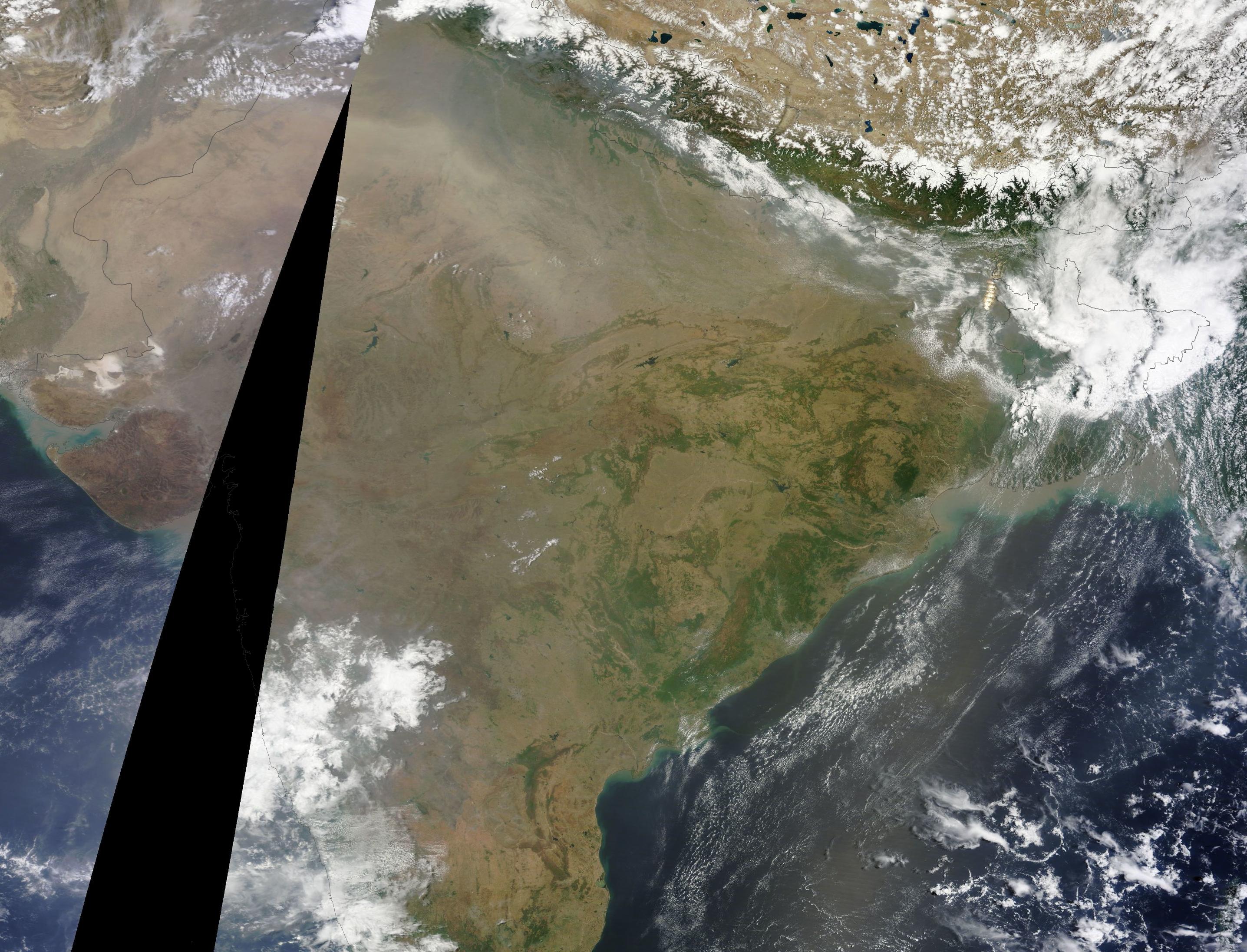
On May 25-27, an outburst of moisture from this stalled monsoonal flow splashed over the coasts of India. But by the 29th and 30th, these coastal storms and even the ones gathering over the Bengali waters had all been snuffed out. The most prominent feature in the MODIS shot of India today isn’t the rainfall that should be now arriving along the southeast coast, but the thick and steely-gray pallor of coal-ash smog trapped under a persistent and oppressive dome of intense heat.

(MODIS shot of India on May 30th. See the open stretch of blue water in the lower right frame? That’s the Bay of Bengal which borders coastal India. During a normal year at this time, that entire ocean zone should be filled with the storm clouds of a building monsoon that is already encroaching on coastal India. Today, there is nothing but a smattering of small and dispersed cloud through a mostly clear sky. Image source: LANCE-MODIS.)

Monsoon Described as Feeble

Official forecasts had already announced as of May 27th that the annual monsoon was likely to be delayed by at least a week for southeast regions of India. Meanwhile, expected monsoonal rainfall for western and northern sections of India for 2014 fell increasingly into doubt.

From The Times of India:

The monsoon is likely to be delayed by 10 days, according to scientists at the Indian Institute of Tropical Meteorology (IITM) here. The IITM’s third experimental real-time forecast says that a feeble monsoon will reach central India after June 20 as against the usual June 15. Last year, the monsoon had covered the entire country by June 15.

The annual monsoon is key to India’s agriculture. The substantial rains nurture crops even as they tamp down a powerful heating that typically builds throughout the sub-continent into early summer. Without these rains, both heat and drought tend to run rampant, bringing down crop yields and resulting in severe human losses due to excessive heat.

But, this year, heat and drought are already at extreme levels.

Major Heatwave Already Results in Loss of Life for 2014

As early as late March, the heatwave began to build over the Indian subcontinent. The heat surged throughout the state, setting off fires, resulting in a growing list of heat casualties, shutting down the power grid and spurring unrest. Meanwhile, impacts to India’s agriculture were already growing as the Lychee fruit crop was reported to have suffered a 40% loss.

By late May, temperatures across a broad region had surged above 105 degrees shattering records as the oppressive and deadly heat continued to tighten its grip.

In a country surrounded on three sides by oceans, it is a combination of heat, humidity and persistently high night-time temperatures that can be a killer. Wet bulb temperatures surge into a high-risk range for human mortality during the day even as night-time provides little respite for already stressed human bodies. Such extreme and long-duration heat doesn’t come without a sad toll. As of today, early reports indicated a loss of more than 56 lives due to heat stroke (In 2012 and 2013, total Indian heat deaths were near 1,000 each year). That said, final figures on heat losses are still pending awaiting complete reports from all of India’s provinces.

"Climatologically, we know that heatwaves are increasing in frequency and the number of days exceeding 45ºC temperatures is increasing. The frequency will increase further with global warming, hence this is a good example of a situation where science and disaster management can come together and avert damage," a spokesman for India’s National Disaster Management Authority noted on Friday.

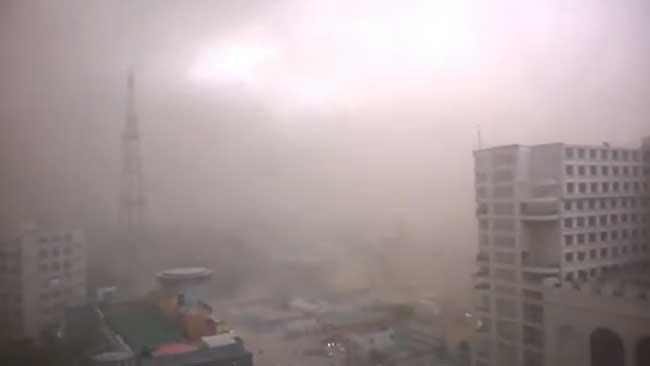
(Hot Dust. A dust storm rolls through New Delhi on Friday amidst furnace-like 113 degree heat snarling traffic and resulting in the tragic loss of 9 more lives. Image source: Gaurav Karoliwal/YouTube Screenshot.)

Today the heatwave continued to gain ground, with Kota and Rajasthan reaching an all-time record of 116 degree F (46.5 C) as New Delhi’s mercury hit 113 degrees F in the midst of a drought-induced dust storm. Dust shrouding the city spurred traffic chaos and in the heat, darkness, and confusion nine more souls were lost.

After two months of growing disruption due to heat and drought, the lands and peoples of India cry out for a Monsoon that is running later and later with each new weather report.

Climate Change + El Nino: Adding Heat and Beating Back the Monsoon

As systems approach tipping points, they are more likely to tilt toward the extremes.

For India this year, its seasonally warmest period from April to May found severe heat amplification from a number of global factors. First, climate change seeded the ground for the current Indian heatwave by adding general heat and evaporation to already hot conditions. With global average heating of +0.8 C above 1880s levels amplifying in the hot zones, early moisture loss due to higher-than-normal temperatures produces a kind of snowball effect for still more warming. Essentially, the cooling effect of water evaporation is baked out early allowing for heat to hit harder just as typical seasonal maximums are reached. More

Originally published by robertscribbler.wordpress.com/


Monday, April 14, 2014

Quenching Kenya: Can New Water Discoveries Save East Africa?

Water scarcity is becoming the defining international crisis of the twenty-first century. Water conflicts rage across the world as communities struggle to secure a clean, reliable supply.

One of the world’s most water-stressed regions is East Africa. Overexploitation of water resources there has been compounded by declining snowpacks on Mount Kilimanjaro and Mount Kenya, which have shrunk since the late 1980s due to global warming. Meanwhile, Lake Turkana -- the world’s largest perennial desert lake -- has largely disappeared from Ethiopian territory, retreating south into Kenya.

In this light, the discovery of two significant aquifers in mostly arid Kenya by a Japanese-financed UNESCO project has been hailed as a potential game changer. The first, the Lotikipi Basin Aquifer, is situated just west of Lake Turkana. The second, the smaller Lodwar Basin Aquifer, is near Lodwar, the capital of Turkana county. The aquifers were discovered by a French firm, Radar Technologies International (RTI), using a space-based exploration technology called WATEX that was originally designed to reveal mineral deposits. The company blended satellite and radar imagery with geographical surveys and seismic data to detect moisture. Subsequent drilling by UNESCO confirmed the presence of aquifers. Three other suspected aquifers in the region have yet to be verified through drilling.

For parched and economically backward Turkana, more than one-third of whose residents are malnourished, the discovery of major groundwater reserves is a godsend. Not only will the reserves provide lifesaving water, they will also spur the development of agricultural and hydrocarbon sectors and improve the lives of the impoverished residents in this conflict-ridden region, which extends from Kenya into the borderlands of Ethiopia and South Sudan. More [Subscription]


Tuesday, March 4, 2014

After 54 years of thirst, the U.S. and Mexico partner to save the Colorado River Delta

Since 1960, the Colorado River has not flowed regularly to the sea. While pockets of green remain, the Colorado in its delta is a parched river begging for relief. The dry, sandy channel glares in the bright sun, abandoned by the river that has been overtapped and overworked for too long.

Colorado River

It’s hard not to think of the lost potential of an ecosystem that once thrived. After an adventure there in 1922, American author, scientist and environmentalist Aldo Leopold wrote:

“On the map, the delta was bisected by the river, but in fact the river was nowhere and everywhere, for he could not decide which of a hundred green lagoons offered the most pleasant and least speedy path to the Gulf [of California].”

The Colorado’s delta was once a landscape of plenty, the basis of rural economic activity and local employment. Tourism, recreational hunting, sport and commercial fishing – all have been lost to overuse and over exhaustion of a limited resource.

For decades, it seemed nothing could be done. I spent much of the past 15 yearsshining a spotlight on the sorry state of the Colorado River Delta for audiences across the country. And while it is true that these conversations would quickly turn to the byzantine complexities of water law and the difficulties of caring for shared cross-border resources, it is also true that most people are truly unsettled by the reality that the Colorado stops short of its natural destination.

Now we are taking a major step to right the wrong that has been done to the Colorado River Delta. For the first time in history, the U.S. and Mexico will send a modest volume of water into the Colorado River Delta in the form of a temporary “pulse flow,” which will mimic the natural spring floods that once nourished the delta. Never before have we deliberately sent water below Morelos Dam, the last dam on the river just south of the U.S.-Mexico border, to benefit the environment. This month, water from the Colorado River will literally pulse through the border as a sign to the rest of the world of what we can accomplish through cooperation between nations. It feels like a triumph of human optimism over acquiescence.

Some may grumble that this is not the time to send water to the environment, but that objection ignores the broader context of the recent binational agreement and the many benefits it brings to both countries. In addition to breathing life back into the delta, this new framework more broadly allows the U.S. and Mexico to share surpluses in times of plenty and reductions in times of drought, provides incentives for leaving water in storage, and conserves water through joint investments in projects from water users in both countries. These benefits extend to water users throughout the Colorado River Basin – in all seven U.S. and two Mexican states.

By abandoning the old framework of “who gets what” and establishing cooperative management of our shared resource, the U.S. and Mexico are achieving benefits for communities and nature alike. With this kind of cooperation, I have renewed hope that in the not-so-distant future we will see delta ecosystems and economies thrive once again. More

On a potentially dying planet shared resources are a no-brainer. Editor


Sunday, January 19, 2014

Egypt-Ethiopia Nile dam talks hit dead end

Technical negotiations among water ministers from Egypt, Sudan and Ethiopia have reached a dead end after all parties refused the proposals set forth to solve the crisis that revolves around the repercussions Ethiopia’s Renaissance Dam have on Egypt’s water security. These repercussions were discussed during three rounds of negotiations in the Sudanese capital Khartoum.

Security guards at Ethiopia's Great Renaissance Dam

The third round of negotiations held in Khartoum on Jan. 4 — and attended by technical delegations represented by water ministers from Egypt, Sudan and Ethiopia — did not yield any clear results. Egypt withdrew from the meeting, describing the Ethiopian stance as “intransigent,” as Ethiopia refused the Egyptian proposal that ensures Egyptian water security, as noted in a statement issued by the Egyptian Ministry of Water Resources and Irrigation.

Al-Monitor secured a copy of the statement, which stated: “The dispute between Egypt and Ethiopia during the negotiations is related to two points. First, Ethiopia refused the participation of international experts in the new mechanism put in place to follow up on Ethiopian studies about the consequences of the Renaissance Dam. These studies will be conducted in accordance with the report of the international committee. Second, Ethiopia refused to discuss the document on 'principles of confidence-building' between the countries of the eastern Nile basin — namely Egypt, Sudan and Ethiopia. Egypt proposed this document to provide guarantees for the downstream countries against any negative effects that may be generated from the construction of the dam.”

In a phone interview with Al-Monitor, Egypt’s Water Minister Mohammed Abdel Moteleb said: “We tried to set forth more than one initiative to build the trust Ethiopia always talks about when promising not to cause Egypt any harm. However, we will not attend or participate in any technical negotiations concerning theRenaissance Dam until we make sure Ethiopia is proposing genuine initiatives that are in line with the Egyptian view, so that these meetings will be meaningful.

“Egypt has concerns and reservations over the Renaissance Dam. It is not logical to build a dam that big without completing the technical and environmental studies required by the international committee. Ethiopia agreed to these studies and signed [the committee’s] final report.”

He went on: “Egypt agreed on attending the three rounds of negotiations, so that it could not be accused of rejecting cooperation. We are always striving [to hold] a dialogue that is based on the principles of not causing harm and creating benefits for all parties. Currently, we do not have the luxury of giving up any drop of water from Egypt’s share of Nile water.”

An informed Egyptian security source concerned with the issue of the Nile basin told Al-Monitor: “Egypt will follow new courses to solve its crisis with Ethiopia in regard to the Renaissance Dam. It will adopt measures to push the issue forward on the international level. Egypt will not accept for its historical share of the Nile water, which is preserved by agreements and provisions of international law, to be diminished.”

“We do not rule out [the possibility of adopting] any technical, political or security measures to solve this crisis. We are waiting for the referendum on the constitutionto be over. After that, we will launch a series of official and nonofficial movements,” the source affirmed. He pointed out the “possibility of referring to international courts and filing a claim with international institutions, such as the UN, to preserve Egypt’s rights.”

A diplomatic source, closely tied to the Egyptian Cabinet, told Al-Monitor, “Egypt has already launched diplomatic movements to convince donor countries to stop the financial aids serving the construction of the dam until it is assured that it will not harm Egypt.” The source affirmed, “This campaign will be put in focus after the completion of parliamentary and presidential elections, and once relative stability has been achieved.”

Interim President Adly Mansour held a closed meeting with the National Defense Council on Jan. 8. The meeting was attended by Defense Minister Abdel Fattah al-Sisi and Prime Minister Hazem el-Biblawi, who discussed the crisis of the Renaissance Dam and the deadlock surrounding the technical negotiations. The council reiterated the importance of “not wasting the water rights of Egypt and not accepting any violation against Egyptian national security.”

Former Water Minister and Nile Basin Studies Unit head Mohammad Nasreddin Allam, told Al-Monitor, “We are currently drafting an international claim comprising five parts, which will be filed to donor countries, international institutions and organizations entitled to settle this dispute. Such a dispute can threaten peace and security in the East African region.”

“The memorandum will comprise a legal part documenting the historical rights of Egypt to the Nile water, and another part stating the Ethiopian violations of the law and international agreements, after it constructed a large dam without taking into consideration the safety of downstream countries. It will also include a call to form a fact-finding committee to prove the dangerous impact of the dam on Egyptian water security, as stipulated by the regional dispute settlement mechanisms, the UN pact and the African Union Peace and Security Council,” Allam added.

Allam also affirmed, “The memorandum will call for the immediate halt of all construction works at the site until the fact-finding committee fulfills its task.”

Despite the warning messages Egypt is conveying to affirm it will not give up on protecting its share of Nile water, the Egyptian prime minister was optimistic about the possibility of negotiating again and resolving the crisis. He said during a press conference on Jan. 9, attended by , “Negotiations do not end in one session. Things will continue to progress, and the issue of the dam remains until now open for discussion.”

A technical source who attended the latest negotiations commented on the prime minister’s statement, telling Al-Monitor, “Negotiations reached a deadlock. The Ethiopian water minister publicly refused during an official meeting the request of Egypt to host negotiations in Cairo, claiming that the security situation in Egypt was the reason for his refusal.”

“Egypt is now wasting its chance. Calling for more negotiations is time-consuming because Ethiopia is proceeding with the constructions as a de facto situation,” the source warned.

For his part, Ethiopian Water and Energy Minister Alemayehu Tegenu said in a statement on Jan. 13: “The construction of the Renaissance Dam is taking place without any hassles or difficulties. The project will be finalized according to the decided time frame,” reiterating that “the project is not facing technical or funding problems.” More