Water Security is National Security

Water resources and how they are managed impact almost all aspects of society and the economy, in particular health, food production and security, domestic water supply and sanitation, energy, industry, and the functioning of ecosystems. Under present climate variability, water stress is already high, particularly in many developing countries, and climate change adds even more urgency for action. Without improved water resources management, the progress towards poverty reduction targets, the Millennium Development Goals, and sustainable development in all its economic, social and environ- mental dimensions, will be jeopardized. UN Water.Org

Showing posts with label extreme weather. Show all posts

Sunday, September 7, 2014

Drought apocalypse begins in California as wells run dry

(NaturalNews) Water wells in central California have begun to run dry, reports the LA Times. (1) "Extreme drought conditions have become so harsh for the Central Valley community of East Porterville [that] many of its residents dependent on their own wells have run out of water."

Tulare County has confirmed their wells have run out of water, and so far hundreds of homes have no running water.

According to the LA Times, rumors are also spreading that Child Protective Services officials will begin taking children away from families who have no running water, although the county claims the rumor is false.

It begins: the collapse of California's water aquifers

With this news, it is now official that the collapse of California's water aquifers has begun. With each passing month and year, more and more wells will run dry across the state as California plummets into the desert conditions from which it once sprang.

Extreme drought now covers 82% of California, according to the National Drought Mitigation Center. (2) Fifty-eight percent of the state is in "exceptional drought."

During the unfolding of this drought, California farmers and cities have siphoned unprecedented volumes of water out of the state's underground aquifers. This is called "fossil water" and it can take centuries to regenerate. Once this fossil water is used up, it's gone.

35-year "megadrought" may be on the way

"The southwestern United States has fifty percent change of suffering a 'megadrought' that lasts 35 years," reports the Daily Mail. (3)

"They say global warming has meant the chance of a decade long drought is at least 50 percent, and the chances of a 'megadrought' – one that lasts up to 35 years – ranges from 20 to 50 percent over the next century."

One scientist is quoted in the story as saying, "This will be worse than anything seen during the last 2,000 years and would pose unprecedented challenges to water resources in the region."

Unless politicians become magical wizards and figure out a way to create water out of nothing, what all this really means is that cities of the American southwest will not be able to support present-day populations. A mass migration (evacuation) out of the cities will be necessary sooner or later.

California's water deficit will lead to ecological and economic collapse

In an almost perfect reflection of California's state budget deficits, the state is also running an unsustainable water deficit. It is a mathematical certainty that when you remove far more water from the aquifers than is being replenished, the amount of water remaining in those aquifers will eventually reach zero.

This "zero day" water reality is still psychologically denied by most Californians. If the reality of this situation were widely recognized, California would be experiencing a glut of real estate inventory as millions of homeowners tried to sell their properties and evacuate the state. The fact that the real estate market has not yet collapsed in California tells us that Californians are still living in a state of denial about the future of their water supply.

Even as California's water supply collapses by the day, local farmers and towns have few options other than drilling for more water. "Drill! Drill! Drill!" is the mantra of the day, creating an 18-month backlog for well drilling companies. Each new well that's drilled must seek to go deeper than the previous wells which are running dry. It's a literal race to the bottom which can only end in catastrophe.

Then again, a willful acceleration toward catastrophe is merely a sign of the times when it comes to human civilization. There is almost no area in which humans have ever achieved balance: not in fossil fuels, metals mining, fossil water exploitation, debt creation, industrial chemical contamination, ecological exploitation or even global population. It's almost as if the human race is determined to destroy itself while racing to see who can achieve self destruction first. More


Saturday, August 23, 2014

How extensive is California's drought?

A snake-like trickle of water flows underneath Lake Oroville's Enterprise Bridge — just one striking example of how much California's chronic drought is affecting the state's lakes and reservoirs.

Situated at the foot of the Sierra Nevadas in Butte County, Lake Oroville is one of the largest reservoirs in California, second only to Shasta Lake. After enduring three straight years of drought, the lake is currently only filled to 32 percent of its capacity.

In any case, the drought in California is getting serious. Phase 2 of Los Angeles' mandatory water conservation ordinance is now in effect, which means a team of water-use inspectors are tasked with enforcing water restrictions and fining water wasters. If the drought continues through fall and winter, the ordinance will move to Phase 3, which entails even stricter rules and some prohibitions.

To get a better idea of the dire situation in the Golden State, continue below for a photo comparison of water levels taken in 2011 and 2014, looking at Lake Oroville and Folsom Lake, another major California reservoir located in Sacramento County that is now filled at 40 percent of its capacity.

Bidwell Marina, Lake Oroville

Folsam Dam, Folsom Lake

Enterprise Bridge, Lake Oroville


Sunday, August 10, 2014

“Containing the Resource Crisis”

LONDON – The proclamation of a new Cold War, following Russia’s annexation of Crimea, turned out to be alarmist and premature. However, it reflected the anxiety of today’s decision-makers in the face of a crumbling global order.


With emerging economies far from committed to established norms in international relations, many governments and multinational companies are feeling vulnerable about relying on others for vital resources – the European Union’s dependence on Russian gas being a case in point.

Competition for scarce resources is sorely testing our assumptions about global governance and cooperation, at a time when collective leadership is becoming ever more necessary. But even in the absence of overarching global legal frameworks, it is possible to maintain a sense of common security if the terms of resource investments are founded on long-term political understanding and commercial relationships, rather than short-term competition.

The stakes are high. Resource scarcity is closely linked to political risks. Consider, for example, the drought that decimated Russia’s 2010 wheat harvest. In response, Russia imposed export restrictions to shore up its domestic supplies, sending food prices soaring in its main export markets, especially Egypt. This in turn helped spark the political uprisings that spread rapidly across North Africa and the Middle East. Climate change is expected to trigger many more such chains of events.

One test case for such cooperation is the potentially explosive issue of the Nile Delta’s water resources. Britain’s colonial-era treaty has, since 1929, given Egypt a veto over any upstream river project that might affect the country’s water supply

One test case for such cooperation is the potentially explosive issue of the Nile Delta’s water resources. Britain’s colonial-era treaty has, since 1929, given Egypt a veto over any upstream river project that might affect the country’s water supply. Several Nile Basin countries, including Sudan and Ethiopia, have now ratified a new, Nile River Basin Cooperative Framework agreement, which Egypt has yet to sign. Given Egypt’s concerns about potential water shortages arising from Ethiopia’s new upstream hydropower plants, its assent is far from assured.

Indeed, in Egypt’s febrile political atmosphere, its newly elected president, General Abdul Fattah el-Sisi, may be tempted to escalate the threat of military action in response to Ethiopia’s hydropower projects. Such a move would send shockwaves through a region already reeling from conflict in South Sudan, Syria, Iraq, and Lebanon.

To avoid another dangerous political-environmental chain reaction, nudging all sides toward agreement will require achieving mutual recognition of resource concerns. Ethiopia must credibly guarantee the supply of water downstream, for example, by establishing a water-replenishment rate at its dam reservoirs that does not threaten the onward flow of water to Egypt. At the same time, Egypt, while retaining the fundamental right to protect its water supply, must recognize the interests of its upstream neighbors and be ready to negotiate in good faith a new Nile Basin treaty.

Multinational companies and sovereign investors like China, which have financed hydropower projects upstream, will come under increasing pressure to adopt a position. They, too, can play a positive role by considering the cross-border investments that will address critical interdependencies, like Egypt’s wasteful agricultural irrigation practices.

Similar resource-related tensions are surfacing in other parts of the world. Water stress and food security threaten to constrain India’s economic promise, as increasing coal-powered electricity generation diverts water resources away from agriculture. The political risks of investing in Nigeria’s agriculture sector are also rising as a result of the country’s demographic explosion, high inflation, weak rule of law, and insecure land rights, with wider political consequences.

These resource strains are aggravated by foreign investments that seek to meet developed-country consumers’ voracious demand for resources without attention to their impact on sustainability in the host countries. This virtual outsourcing of the industrialized world’s environmental impacts, apart from being hypocritical, is no basis for building a strategy for global environmental sustainability.

Instead, the world needs to invest in sustainable agriculture, renewable energy, and green infrastructure. To be sure, the most promising efforts by leading multinationals today must confront entrenched subsidies and vested political interests. Unless the necessary policy frameworks are put in place green investment initiatives will continue to struggle to achieve a meaningful scale. Moreover, developed and developing countries seem unable even to agree on a fair division of environmental responsibilities, even though they have become increasingly interdependent in trade, investment, and the supply of natural resources.

These difficulties should not stop us from trying. The Earth Security Initiative is working with the BMW Foundation to develop global roundtables on resource security over a two-year period, starting in Hangzhou, China, on July 17- 20. These high-level, informal meetings will bring together leaders from politics, business, and civil society in Europe and emerging economies in an effort to bridge just such differences.

We know what needs to be done, why it is important, and who must be involved to secure our planet’s long-term future. We must now address the equally vital question of how this will be achieved.

Read more at http://www.project-syndicate.org/commentary/alejandro-litovsky-addresses-the-increasingly-close-links-between-resource-scarcity-and-political-risk#qFDfi1xP668YyhLg.99


Saturday, May 31, 2014

Monsoon Disrupted By El Nino + Climate Change as India Suffers Deaths, Crop Losses from Extreme Heat.

May is the month when the massive rainstorm that is the Asian Monsoon begins to gather and advance. This year, as in many other years, the monsoon gradually formed along the coast of Myanmar early in the month. It sprang forward with gusto reaching the Bay of Bengal by last week.

And there it has stalled ever since.

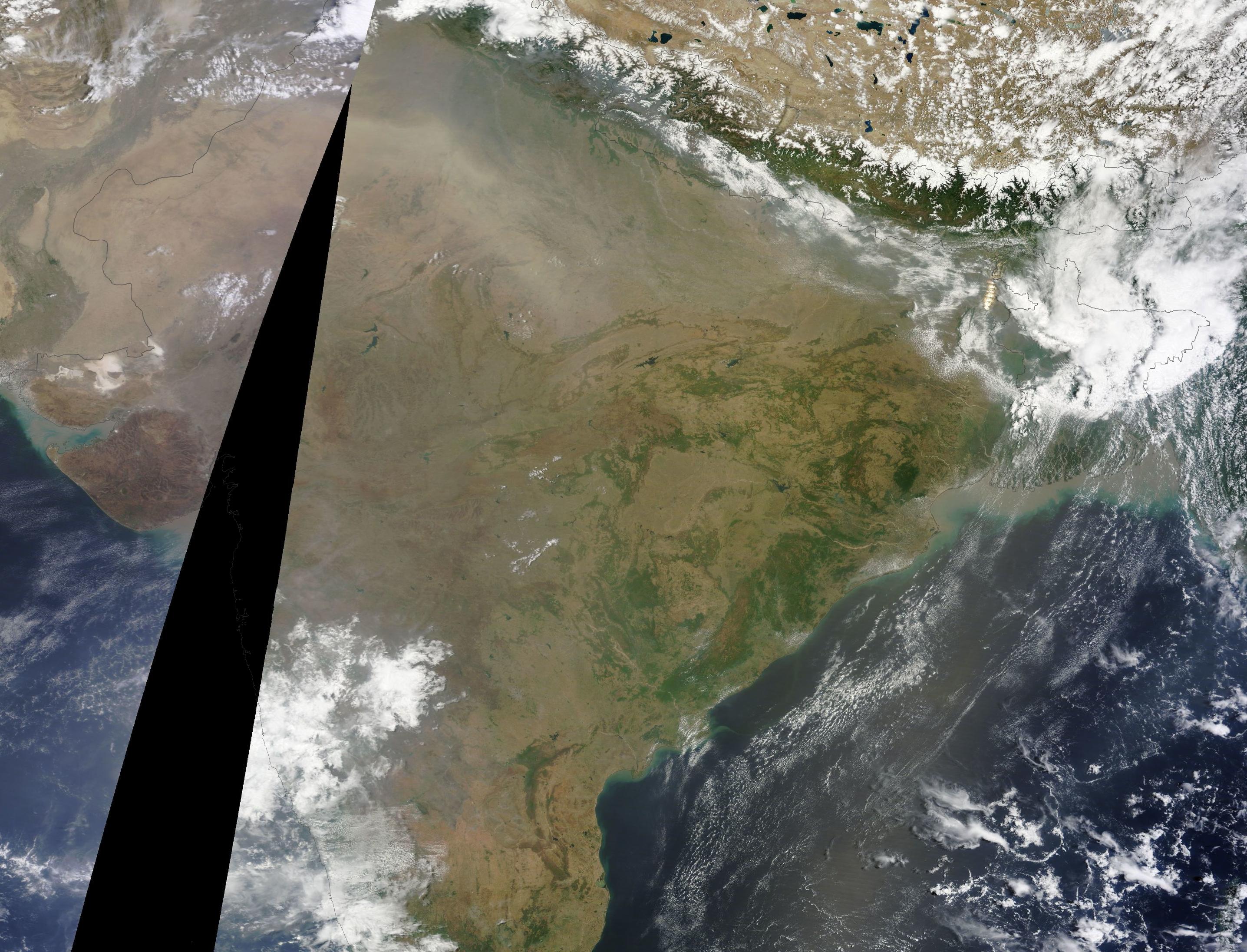
On May 25-27, an outburst of moisture from this stalled monsoonal flow splashed over the coasts of India. But by the 29th and 30th, these coastal storms and even the ones gathering over the Bengali waters had all been snuffed out. The most prominent feature in the MODIS shot of India today isn’t the rainfall that should be now arriving along the southeast coast, but the thick and steely-gray pallor of coal-ash smog trapped under a persistent and oppressive dome of intense heat.

(MODIS shot of India on May 30th. See the open stretch of blue water in the lower right frame? That’s the Bay of Bengal which borders coastal India. During a normal year at this time, that entire ocean zone should be filled with the storm clouds of a building monsoon that is already encroaching on coastal India. Today, there is nothing but a smattering of small and dispersed cloud through a mostly clear sky. Image source: LANCE-MODIS.)

Monsoon Described as Feeble

Official forecasts had already announced as of May 27th that the annual monsoon was likely to be delayed by at least a week for southeast regions of India. Meanwhile, expected monsoonal rainfall for western and northern sections of India for 2014 fell increasingly into doubt.

From The Times of India:

The monsoon is likely to be delayed by 10 days, according to scientists at the Indian Institute of Tropical Meteorology (IITM) here. The IITM’s third experimental real-time forecast says that a feeble monsoon will reach central India after June 20 as against the usual June 15. Last year, the monsoon had covered the entire country by June 15.

The annual monsoon is key to India’s agriculture. The substantial rains nurture crops even as they tamp down a powerful heating that typically builds throughout the sub-continent into early summer. Without these rains, both heat and drought tend to run rampant, bringing down crop yields and resulting in severe human losses due to excessive heat.

But, this year, heat and drought are already at extreme levels.

Major Heatwave Already Results in Loss of Life for 2014

As early as late March, the heatwave began to build over the Indian subcontinent. The heat surged throughout the state, setting off fires, resulting in a growing list of heat casualties, shutting down the power grid and spurring unrest. Meanwhile, impacts to India’s agriculture were already growing as the Lychee fruit crop was reported to have suffered a 40% loss.

By late May, temperatures across a broad region had surged above 105 degrees shattering records as the oppressive and deadly heat continued to tighten its grip.

In a country surrounded on three sides by oceans, it is a combination of heat, humidity and persistently high night-time temperatures that can be a killer. Wet bulb temperatures surge into a high-risk range for human mortality during the day even as night-time provides little respite for already stressed human bodies. Such extreme and long-duration heat doesn’t come without a sad toll. As of today, early reports indicated a loss of more than 56 lives due to heat stroke (In 2012 and 2013, total Indian heat deaths were near 1,000 each year). That said, final figures on heat losses are still pending awaiting complete reports from all of India’s provinces.

"Climatologically, we know that heatwaves are increasing in frequency and the number of days exceeding 45ºC temperatures is increasing. The frequency will increase further with global warming, hence this is a good example of a situation where science and disaster management can come together and avert damage," a spokesman for India’s National Disaster Management Authority noted on Friday.

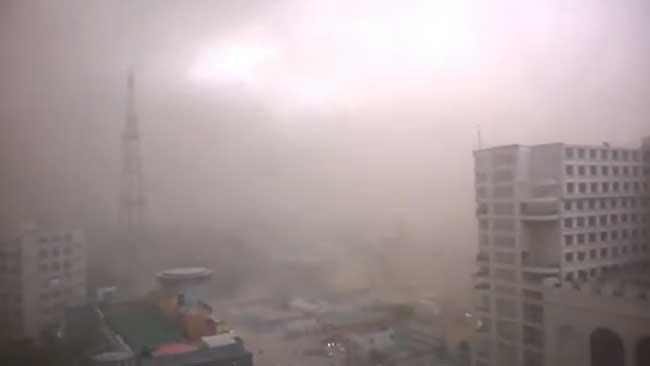
(Hot Dust. A dust storm rolls through New Delhi on Friday amidst furnace-like 113 degree heat snarling traffic and resulting in the tragic loss of 9 more lives. Image source: Gaurav Karoliwal/YouTube Screenshot.)

Today the heatwave continued to gain ground, with Kota and Rajasthan reaching an all-time record of 116 degree F (46.5 C) as New Delhi’s mercury hit 113 degrees F in the midst of a drought-induced dust storm. Dust shrouding the city spurred traffic chaos and in the heat, darkness, and confusion nine more souls were lost.

After two months of growing disruption due to heat and drought, the lands and peoples of India cry out for a Monsoon that is running later and later with each new weather report.

Climate Change + El Nino: Adding Heat and Beating Back the Monsoon

As systems approach tipping points, they are more likely to tilt toward the extremes.

For India this year, its seasonally warmest period from April to May found severe heat amplification from a number of global factors. First, climate change seeded the ground for the current Indian heatwave by adding general heat and evaporation to already hot conditions. With global average heating of +0.8 C above 1880s levels amplifying in the hot zones, early moisture loss due to higher-than-normal temperatures produces a kind of snowball effect for still more warming. Essentially, the cooling effect of water evaporation is baked out early allowing for heat to hit harder just as typical seasonal maximums are reached. More

Originally published by robertscribbler.wordpress.com/


Thursday, May 22, 2014

Challenge in Sao Paulo: Overcoming Water Scarcity in South America’s Largest City

Last March, one of Brazil’s most important newspapers, O Estado de S. Paulo, published a version of the article below, which summarizes the Conservancy’s efforts to help secure Sao Paulo’s water supply. It is translated and reprinted here with permission.

By João Campari and Samuel Barrêto, The Nature Conservancy

The inhabitants of Sao Paulo have been dealing with discouraging images of cracked riverbeds where they used to see flowing water, making this temperate part of Brazil look more like the country’s semi-arid region. Unfortunately, these stark images show the worsening struggles of the Cantareira system, one of the greatest water supply systems in the world.

Right now, the Cantareira’s reservoirs — responsible for providing water for more than 12 million inhabitants of the Sao Paulo Metropolitan Region (RMSP) and Campinas — are operating at less than 15% capacity*, the lowest level recorded since the Cantareira’s creation in the early 1970s.

The images, the symbol of the current crisis, show that water doesn’t really come from the taps in our houses. It comes from nature, and in Sao Paulo much of that nature is the Atlantic Forest. While water rationing gets peoples’ attention and is one of the necessary responses to water scarcity, rationing alone is not enough to solve the long-term problem of securing lasting access to fresh water.

We must look beyond the tap and work to take care of our water supplies at their sources. We need a systemic response for the management of watersheds to restore the sources of our water that have been degraded, polluted and deforested. Forests are very important for healthy fresh water supplies. Unfortunately, the Cantareira system alone has lost 70% of its original forest cover, aggravating the sedimentation of rivers and dams, and decreasing their ability to supply water.The degradation of native vegetation also worsens the effects of erosion and drought.

The interaction of all these factors — deforestation, sedimentation, erosion and drought — leads to a situation of extreme risk and represents an environmental, social and economic threat not just to Sao Paulo, but to the entire country of Brazil. The Sao Paulo Metropolitan Region and Campinas together are responsible for more then 22% of the country’s GDP. Therefore, it is a priority to create a strong and strategic response to the increasing and urgent problems of water quantity, quality, access and supply for urban centers.

Protecting Water Supplies at their Sources

We must go beyond conventional interventions, such as engineering works — more dams or aqueducts are not the answer. Wider, systemic responses are necessary, and the responsibility to act is not limited to the government. We all need water and it is the shared responsibility of businesses, communities and civil society as a whole to search for solutions together. The government’s role is to foster and implement multiple solutions that reach multiple stakeholders at once.

The Conservancy’s work shows that one of the highest priorities for securing Sao Paulo’s water supplies is strengthening the Cantareira system’s “green infrastructure” by restoring the degraded forests of the Atlantic Forest, as well as conserving existing forest remnants. Such initiatives ensure the health of a watershed. This type of solution, when well managed, minimizes the risk of extreme events and reduces the vulnerability of populations to floods and prolonged droughts. Healthy forests also store water and reduce erosion and provide environmental services of water regulation and security to the population.

New York City illustrates this equation quite clearly. Decades ago, the city’s administration compared the costs of both natural and built infrastructure for protecting and providing water. Preserving the forests that were source of the city’s drinking water cost US $1 to 1.5 billion over 10 years. That amount was seven times lessthan the estimated US $6 to 8 billion needed to build a traditional, engineered water treatment and distribution network. (That amount doesn’t include the additional and ongoing operational and maintenance costs of $300 to $500 million a year that would have been necessary.) Obviously, nature was the better buy for the people of New York.

It is something for Sao Paulo to consider. A recent study by the Conservancy showed that restoring about 35,000 acres of deforested areas and preventing erosion on 5000 acres within the basins of the Piracicaba, Capivari, Jundiaí and Alto Tietê rivers would decrease the level of sediments that clog the rivers by 50%. Reducing erosion would increase the capacity of water reservoirs and simultaneously decrease the cost of treatment for the removal of sediments.

What the Conservancy is doing in Sao Paulo

To help accomplish restoration goals in the lands around Sao Paulo’s Cantareira system, the Conservancy-led Water Producers Project provides payments to farmers and ranchers who conserve forests on properties that are part of the watershed that feeds the Cantareira reservoirs. This payment-for-environmental-services program recognizes and compensates landowners for the water-producing value their lands provide.

The Conservancy also leads the Water for Sao Paulo Movement. This initiative fosters conversation and working relationships between different stakeholders and focuses on the importance of both water conservation and nature-based solutions for securing the water supply of the region. Because healthy forests are so important for healthy rivers and water supplies, Water for Sao Paulo seeks to restore degraded forests near the urban area.

Finally, Sao Paulo must strengthen the existing Watersheds Committees. Created by the Brazilian Legislature, Watersheds Committees discuss and make decisions about the use of water from specific river basins and are some of the most important collaborations for achieving a balance between water supply and demand.Committees include representatives of local governments, water supply companies and civil society, who are responsible for tasks such as approving water management plans, defining actions for conservation of biodiversity and mediating conflicts about the use of water resources. There are more than 200 of these groups in Brazil.

The current crisis in the Cantareira system is both a challenge and an opportunity to learn from the past and make better decisions for the future. If we have the discernment to act in a systemic way and the political and institutional capacity for change, we will be able to reduce the risks of a permanent cycle of water shortage. In addition to this, we have the opportunity to show how healthy watersheds contribute to water security, which is indispensable for Sao Paulo’s social and economic stability into the future.

To learn more about how the Conservancy is helping to secure Brazil’s water supplies, please visit Where Does Your Water Come From?

*Since this article was published in March, the need for concerted action in Sao Paulo has become even more urgent. The level of water in the Cantareira system has now dropped – to about 8% of its overall capacity. As an emergency stopgap to provide water to the city, the government of Sao Paulo spent US$36 million on emergency constructions to allow access to water stored below the level of the pumps. Known to water managers as “dead volume,” this water was never intended to be part of the water supply, and the reservoirs are now, essentially, operating at a deficit. More


Monday, May 19, 2014

The California Drought Is Far From Over, And The Entire State Is Suffering

For a few days last month, it rained in San Francisco. Residents across the city cheered a welcomed respite from a drought that has crippled California for more than two years -- but the celebration turned out to be premature.

On Thursday, for the first time this century, the U.S. Drought Monitor declared that all of California is in a “severe” drought, with many areas of the state in an even worse condition, from "extreme" to "exceptional," the poorest possible rating.

“This is a once-in-a-generation conversation,” Mark Svoboda, a climatologist at the National Drought Mitigation Center, told The Huffington Post. He added that the last time California experienced comparable conditions was in the mid-1970s.

“The state has doubled its population between then and now,” Svoboda said. “You’ve got a lot more people using a relatively finite amount of water.”

The map below, courtesy of the U.S. Drought Monitor, shows the varying levels of drought throughout California. The orange represents “severe,” the red is “extreme,” and the maroon is “exceptional” -- the agency’s highest level (Story continues below):

No area of the state is feeling the effects of the drought more harshly than San Diego, where wildfires have ripped through more than 10,000 acres of land and tens of thousands of residents have been forced to evacuate. “In a drought, the biggest threat to health and human safety is wildfire,” Doug Carlson, an information officer at the California Department of Water Resources, told HuffPost.

And there doesn’t appear to be an end in sight. “The drought has set the stage for a very busy, very long, potentially very dangerous fire season,” Daniel Berlant, a spokesperson for CAL FIRE, said to HuffPost. “As we move into the more traditional summer months, the days are only going to get longer, and the temperatures are only going to get higher.”

California’s wildfire season usually peaks during summer and fall months and then tapers during the typically rainy winter. But the drought has turned wildfires into a year-round issue. “With that lack of rain, the grass, brush and trees really have been tinder-dry all year long,” Berlant explained, noting such conditions help flames flourish.

Svoboda added that the state’s hot, dry surface leads to a hot, dry, atmosphere, which creates a prime environment for wildfires to spread. “You also typically see windier conditions,” he added. “These are all things that fires feed on.”

The damage in Southern California has ravaged hills, homes and businesses. Beloved craft brewery Stone Brewing Company evacuated its premises on Thursday. On Wednesday, KTLA senior producer Marcus Smith tweeted a widely-recirculated photo of a “firenado,” a dangerous phenomenon caused by strong winds whipping spirals of fire into the air. More


Monday, April 14, 2014

Quenching Kenya: Can New Water Discoveries Save East Africa?

Water scarcity is becoming the defining international crisis of the twenty-first century. Water conflicts rage across the world as communities struggle to secure a clean, reliable supply.

One of the world’s most water-stressed regions is East Africa. Overexploitation of water resources there has been compounded by declining snowpacks on Mount Kilimanjaro and Mount Kenya, which have shrunk since the late 1980s due to global warming. Meanwhile, Lake Turkana -- the world’s largest perennial desert lake -- has largely disappeared from Ethiopian territory, retreating south into Kenya.

In this light, the discovery of two significant aquifers in mostly arid Kenya by a Japanese-financed UNESCO project has been hailed as a potential game changer. The first, the Lotikipi Basin Aquifer, is situated just west of Lake Turkana. The second, the smaller Lodwar Basin Aquifer, is near Lodwar, the capital of Turkana county. The aquifers were discovered by a French firm, Radar Technologies International (RTI), using a space-based exploration technology called WATEX that was originally designed to reveal mineral deposits. The company blended satellite and radar imagery with geographical surveys and seismic data to detect moisture. Subsequent drilling by UNESCO confirmed the presence of aquifers. Three other suspected aquifers in the region have yet to be verified through drilling.

For parched and economically backward Turkana, more than one-third of whose residents are malnourished, the discovery of major groundwater reserves is a godsend. Not only will the reserves provide lifesaving water, they will also spur the development of agricultural and hydrocarbon sectors and improve the lives of the impoverished residents in this conflict-ridden region, which extends from Kenya into the borderlands of Ethiopia and South Sudan. More [Subscription]


Friday, April 11, 2014

Water Crisis: 2020 Statement by Mikhail Gorbachev on 20th Anniversary of Green Cross

Water crisis – clear and present danger

We live in urgent times. The sum of the concurrent crises that have been engulfing everything from climate to energy, to the economy, is creating a spiral of need for change. But the water crisis sticks out of this list in terms of being an explicitly clear and present danger with deadly implications.

Mikhail Gorbachev

The mounting water crisis and its geography make it clear that without resolute counteraction, it will overstretch many societies’ adaptive capacities within the coming decades. This could result in massive migration, severe socio-economic stress, destabilization and violence, jeopardizing national and international security to a new degree.

By 2025, a predicted 1.8 billion people will live in regions suffering from absolute water scarcity. Two-thirds of the world population could be under hydric stress conditions. Demand for water will rise: water withdrawals in developing countries will increase by 50%, and 18% in developed countries by 2025.

Despite these demands, what state is the world’s water in? Despite the fact that we use slightly more than half the world’s (54%) accessible water, more than 50% of the 3.5 billion people living in urban circumstances around the world already do not have access to adequate water and sanitation.

But the really bad news is that the water use is growing even faster than the population: the 20th century water consumption grew twice as fast as the world population. As a result, a third of the world's population lives in water-stressed countries now. By 2025, this is expected to rise to two-thirds.

In addition to unsustainable water use we are polluting our lakes, rivers and streams to death. Most wastewater (about 80%) from residential and industrial sources enters the environment untreated.

The growing human need for water, to sustain life and wellbeing, plus the pressures on the resource itself, from mismanagement, pollution and a general lack of foresight, make for the most telling case for improved global water conservation and consumption.

But too little is being done on these fronts. We have been waiting since 1997 for just 35 countries to sign the UN Watercourses Convention, to promote the management and sharing of the world’s 276 cross-border rivers and connected underground water sources, and we are still a handful short.

The lack of a global framework to manage water sources that cross national borders endangers the world in many ways, not least of all in terms of the risk of conflict between countries over who controls the same river that runs through their respective frontiers.

Then there is the Right to Water and Sanitation, which Green Cross was a loud advocate of before it finally came into being in 2010. While this recognition itself, that access to safe drinking water and sanitation are basic human rights, is a success, what must be happening at breakneck speed now is the realization of this right. This means creation of national legislation enshrining the right (alongside education, health and others) and investing in the infrastructure needed to make safe water and sanitation services available to all.

Despite UN adoption of this vital principle, the deficit of fresh water is becoming increasingly severe and large-scale – whereas, unlike other resources, there is no substitute for water.

While the Millennium Development Goal for access to drinking water and sanitation was announced met in 2012, almost 800 million people still have no access to safe water today, and three times that number lack adequate sanitation. Thousands of children die daily in the developing world due to related waterborne diseases.

The scale and global nature of the water crisis demand stronger statesmanship, vision and international action. To master the water crisis, we must address its effects and causes. The economic, social, water and environmental aspects must be properly coordinated in any response.

A comprehensive “water goal” must be injected into the post-2015 development agenda, linking development and environment in analyses and in governance policies. Such a goal would address the three interdependent dimensions of water: water, sanitation and hygiene; water management; and wastewater management and water quality.

This goal must be based on principles of equity, solidarity, recognition of limits of planet and rights approach, coupled with effective means to check and demand the accountability of all stakeholders.

We live in volatile and transformative times, faced with the awe-inspiring global challenge of climate change, the devastation of civil wars, and the hope-crushing scourge of extreme poverty. But one thing is constant: our need for water. Whole regions are languishing in poverty and conflict, effectively held hostage by their hydrology: we must break this cycle and give people a chance for their future. Benjamin Franklin said that "when the well's dry, we know the worth of water." The alarm clock has been ringing on deaf ears for far too long, it is time to wake-up before it is too late, before the wells of the world have run dry. More


Wednesday, April 9, 2014

Pakistan has only 30 days of water reserves - researchers

ISLAMABAD, Pakistan (Thomson Reuters Foundation) – Inadequate planning is exposing Pakistan to water-related threats from climate change and putting the country’s agriculture, industry and hydropower at risk, water experts say.

Speaking at a water summit in Pakistan recently, they said the country desperately needs more reservoirs to increase its water storage capacity, and they called for conservation awareness campaigns, the introduction of drought-tolerant crop varieties and more economical irrigation.

“The country is gravely vulnerable to water-related (effects) of the changing weather patterns,” said Pakistan’s minister for planning, development and reform, Ahsan Iqbal, in a keynote address at the summit in the nation’s capital.

In December, the World Resources Institute ranked Pakistan among the 36 most water-stressed countries in the world.

Iqbal said that Pakistan needs a minimum storage capacity of 40 percent of the around 115 million acre-feet of water available in the Indus river system throughout the year. But the country’s storage capacity is only 7 percent and is decreasing due to sediment build-up in reservoirs.

This gives Pakistan a stored water supply, adequate to meet its needs, of just 30 days. By contrast, “carryover capacity” in other countries ranges from 200 days in India to 1,000 days in Egypt, he said.

“In Pakistan, planners and policy makers across different sectors, including agriculture and industry, energy and health now have ... a daunting challenge before them of increasing the country’s water storage capacity,” Iqbal said.

The minister urged the finance ministry to explore funding avenues for new water storage projects to boost storage capacity. Many of these are hydroelectric dams, which would also produce power.

THREATS TO HYDROPOWER, AGRICULTURE

But Pakistan Water Partnership’s country director, Pervaiz Amir, warned that if climate change leads to lower water flows in the northwest of the country, it would cut the amount of hydroelectricity that can be produced.

More variable rainfall and glacier melt in the face of climate change also means that agriculture, which he said accounts for over 96 percent of the country’s water consumption, will be affected, Amir said.

Without more facilities to divert and store water, heavy rainfall and flooding in some parts of the country will continue to damage crops, increase soil erosion and delay planting and harvesting, he said.

Pakistan ranks ninth among countries most affected by floods, according to UN-Water’s World Water Development Report.

Arun Shrestha, a senior climate change specialist at the International Centre for Integrated Mountain Development (ICIMOD), said that many South Asian countries lack preparedness for water-related hazards, including flood, droughts and glacial lake outburst floods, and instead focus mainly on post-disaster relief.

What is “more appalling,” he said, is that climate change is dealt with as a separate problem rather than integrated into planning for water-related areas of the government and economy including agriculture, industry, health and energy.

Shrestha urged South Asian countries to include disasters attributable to climate change in their respective water-related planning and policies.

He called for them to analyse their vulnerabilities to increasingly frequent flooding, droughts and glacial lake outburst floods, and to share the findings with each other to develop a regional action plan for dealing with climate-related disasters.

Shrestha underlined the need for regional coordination between government agencies so that river basins can be managed more efficiently, for example by sharing data about river flows.

Stephen Davies, a senior research fellow at the International Food Policy Research Institute, said that water, food and energy are closely interconnected, yet energy models do not properly address water constraints in South Asia and other regions.

Industrial growth and accelerating urbanisation are creating greater demand for energy, he said, but efforts to expand hydropower generation are being hampered by the shrinking availability of water.

Limitations on water availability also are impacting food production to meet the country’s galloping population growth, he added.

Chief executive of LEAD Pakistan and climate policy expert Tauqeer Ali Sheikh urged policymakers to incorporate the interdependence of water, food and energy into their planning.

In South Asia, “energy planning is often made without taking into account possible changes in water availability due to climate change or other water competing uses,” he pointed out. More

Saleem Shaikh and Sughra Tunio are climate change and development reporters based in Islamabad, Pakistan.


Saturday, March 22, 2014

Today is World Water Day

Conserve and recycle water.

Life is Water and water is life!

22nd March is the annual World Water Day which focuses attention on the importance of freshwater and advocates for the sustainable management of freshwater resources. Each year, World Water Day highlights a specific aspect of freshwater. This year's international theme highlights the issue of "Water and Energy". The Main objective is to draw attention to this topic and to show the close linkages between these two basic needs.

In Somaliland water is in extremely scarce. Only 43% of the population have access to improved water sources. The lack of water is a major concern for both urban and rural populations. For livestock, water is essential and the population is reliant on rain-fed dams, balleys and water pans.

Responding to the water shortage in Somaliland, the Minster of Water Resources with help from its partners wished to promote "Rain Water Harvesting" for World Water Day. This theme will raise awareness and promote actions at the local level. During the World Water Day, Somaliland Government, EU officials (The largest water sector donor in Somaliland), UN agencies and International NGOs will promote the importance of "Rain Water Harvesting". It will generate local interest among Somaliland people and both urban and rural communities will be targeted. In addition, the link between rainwater and "Water & Energy" will be made by promoting rainwater harvesting as a low-cost, readily available and energy-saving method of water collection, which does not require any external energy inputs, unlike most other forms of water supply which require motorized pumping, road transport, human resources, etc.

Every person has the right to have access to safe drinking water. Access to clean water is the key to finding a quality life free from water-borne diseases. Good health starts with having access to clean water. In developing countries, almost 80% of diseases are caused by poor water hygiene. One in every five child deaths is attributed to water-related diseases. Especially, children are more vulnerable to diseases transmitted through diseases.

European Union has made their commitment to reduce the burden of water scarcity in Somaliland and is funding significant water programmes in Somaliland the moment. The EU is the largest water sector donor in Somaliland. The goal of EU-funded water programmes is to improve the quality and quantity of fresh water available to Somaliland people and its future generations. These Water programmes are being implemented by a different partners such UN-Habitat, UNICEF, Caritas and Terresolidali. The EU is committed to Somaliland development and growth.

Among these projects, Hargiesa Urban Water Supply Upgrading Project- HUWSUP- is the largest European Union funded water programme in Somaliland and is implemented by UN-Habitat in partnership with Hargeisa Water Agency (HWA) and the Ministry of Water Resources (MoWR).

The principal water infrastructure for Hargeisa was constructed in the 1970s to supply what was then a city of 180,000 inhabitants. Following rapid urbanisation and resettlement, the estimated population of the city is now over 750,000 people, while the daily supply from the existing water system is just 9 million litres – the same as it was in 1988, with only about a quarter of the current population. The

chronic lack of water is only half the story. The twenty-five- to forty-year-old pumping mains between Geed Deeble and Hargeisa are heavily deteriorated and regularly burst, leaving the city without piped water. Throughout the year, Hargeisa Water Agency carries out continuous maintenance of the old pipeline that brings water to the growing city of Hargeisa. More


Tuesday, January 28, 2014

China's largest freshwater lake dries up

For visitors expecting to see China's largest freshwater lake, Poyang is a desolate spectacle. Under normal circumstances it covers 3,500 sq km, but last month only 200 sq km were underwater.

A dried-out plain stretches as far as the eye can see, leaving a pagoda perched on top of a hillock that is usually a little island. Wrapped in the mist characteristic of the lower reaches of the Yangtze river, the barges are moored close to the quayside beside a pitiful trickle of water. There is no work for the fisheries.

According to the state news agency Xinhua, the drought – the worst for 60 years – is due to the lack of rainfall in the area round Poyang and its tributaries. Poor weather conditions this year are partly responsible. But putting the blame on them overlooks the role played by the colossal Three Gorges reservoir, 500km upstream. The cause and effect is still not officially recognised, even if the government did admit last May that the planet's biggest dam had given rise to "problems that need to be solved very urgently".

"Every year, when the Three Gorges reservoir stores water – to power the dam's turbines during the winter – the flow rate in the Yangtze drops. This in turn increases the rate at which the level of Poyang lake falls, and the period of low water comes sooner," said Ye Xuchun, a researcher at China's Southwest University. In partnership with scientists at the Lake Science and Environment laboratory at Nanking University, he has published a comparative analysis of water levels in the Three Gorges basin and at the lake's northern extremity, near the city of Hukou, where the outflow from Poyang joins the Yangtze.

The authors conclude that the artificial regulation of the reservoir, which must be kept full to optimise electricity output, reduces the water level in the lower reaches of the Yangtze. This means that the big river no longer "plugs" the lake's northern outlet, so the other rivers feeding into Poyang simply pass through the dwindling lake and run on downstream. This was the case in 2006, a very dry year that coincided with the period when the Three Gorges reservoir was filling up. "When the depth of the reservoir was increased by 15 metres, to reach 155 metres in October, the lake dropped very low at Hukou," the scientists said.

The beginning of 2012 has proved even worse. The region's environmental balance was "seriously affected", said Dai Nianhua, deputy head of the Lake Poyang Research Centre in Nanchang, the provincial capital. When the water level is too low there are no fish, so there is no food for the migrating birds that usually break their journey at Poyang. The government has decided to drop fish and shellfish into the lake from helicopters.

The economic impact is just as disastrous. "Freighters can only cross the lake empty," said a worker at the shipyard in Xingzi, whereas usually the lake is a hive of activity in rural Jiangxi province. Some people are now suggesting that a dam should be built where the lake joins the Yangtze, but no one knows what side-effects that might have.

As for the fisheries, they have upturned their boats on the shore or abandoned them on the dried-out bed of Poyang. Guo Jintao, a resident of Yumincun, a village with about 100 fishers, has not been out on the water for over a year. He started fishing when he was 13 and in 50 years he has not seen the lake this dry. He and his wife have switched to casual labouring in the building trade.

"Next year we'll see. If there's enough water, we'll go fishing again, otherwise we'll carry on with our new work," Guo said. His wife, Zhang Jingzen, 55, finds stacking bricks hard work. "I prefer fishing. Our family's been fishing for four generations," she said.

The family used to earn $1,600 to $3,200 a year, but last year's earnings only amounted to $800. The local authorities offered them around $600 in compensation. Another fisherman, intrigued by our conversation, butted in to say that he only got $80 from the municipal council, whereas the province had allocated $160 for each member of the fishing community.

"The incomes in fishing villages are dropping as fast as the water in the lake. Some residents will have move on to other trades," said Xu Bin, the author of a thesis on the socio-economic consequences of the lake's environmental disorders. He warns: "The soil of China is dry, so the Yangtze is vital. Poyang is one of the key elements and its current predicament is a warning for the future." More