Water Security is National Security

Water resources and how they are managed impact almost all aspects of society and the economy, in particular health, food production and security, domestic water supply and sanitation, energy, industry, and the functioning of ecosystems. Under present climate variability, water stress is already high, particularly in many developing countries, and climate change adds even more urgency for action. Without improved water resources management, the progress towards poverty reduction targets, the Millennium Development Goals, and sustainable development in all its economic, social and environ- mental dimensions, will be jeopardized. UN Water.Org

Showing posts with label flooding. Show all posts

Thursday, December 28, 2017

A Landmark California Plan Puts Floodplains Back in Business


A Landmark California Plan Puts Floodplains Back in Business — Water Deeply

SOMETHING MONUMENTAL HAPPENED on August 25 in California water management that received almost no media attention: It became official policy to reconnect the state’s major rivers with their floodplains.

The action by the Central Valley Flood Protection Board, an obscure panel appointed by the governor, clears the way for the state to embrace projects that allow floods to recharge groundwater. This could include projects like breaching levees, building setback levees and creating flood bypass structures so rivers can inundate historic floodplains for the first time in a century.

In short, it means rivers must no longer be confined within levees as a standard practice.

The result could be not only reduced flood risk, but reviving severely depleted groundwater aquifers, restoring wildlife habitat and improving the capabilities of existing water storage reservoirs.

The state calls these “multibenefit” flood-control projects, said Mike Mierzwa, chief of the office of flood planning at the California Department of Water Resources. They’re a major focus of the Central Valley Flood Protection Plan, a massive policy document the board adopted at its August 25 meeting.
Read More

Thursday, May 22, 2014

Challenge in Sao Paulo: Overcoming Water Scarcity in South America’s Largest City

Last March, one of Brazil’s most important newspapers, O Estado de S. Paulo, published a version of the article below, which summarizes the Conservancy’s efforts to help secure Sao Paulo’s water supply. It is translated and reprinted here with permission.

By João Campari and Samuel Barrêto, The Nature Conservancy

The inhabitants of Sao Paulo have been dealing with discouraging images of cracked riverbeds where they used to see flowing water, making this temperate part of Brazil look more like the country’s semi-arid region. Unfortunately, these stark images show the worsening struggles of the Cantareira system, one of the greatest water supply systems in the world.

Right now, the Cantareira’s reservoirs — responsible for providing water for more than 12 million inhabitants of the Sao Paulo Metropolitan Region (RMSP) and Campinas — are operating at less than 15% capacity*, the lowest level recorded since the Cantareira’s creation in the early 1970s.

The images, the symbol of the current crisis, show that water doesn’t really come from the taps in our houses. It comes from nature, and in Sao Paulo much of that nature is the Atlantic Forest. While water rationing gets peoples’ attention and is one of the necessary responses to water scarcity, rationing alone is not enough to solve the long-term problem of securing lasting access to fresh water.

We must look beyond the tap and work to take care of our water supplies at their sources. We need a systemic response for the management of watersheds to restore the sources of our water that have been degraded, polluted and deforested. Forests are very important for healthy fresh water supplies. Unfortunately, the Cantareira system alone has lost 70% of its original forest cover, aggravating the sedimentation of rivers and dams, and decreasing their ability to supply water.The degradation of native vegetation also worsens the effects of erosion and drought.

The interaction of all these factors — deforestation, sedimentation, erosion and drought — leads to a situation of extreme risk and represents an environmental, social and economic threat not just to Sao Paulo, but to the entire country of Brazil. The Sao Paulo Metropolitan Region and Campinas together are responsible for more then 22% of the country’s GDP. Therefore, it is a priority to create a strong and strategic response to the increasing and urgent problems of water quantity, quality, access and supply for urban centers.

Protecting Water Supplies at their Sources

We must go beyond conventional interventions, such as engineering works — more dams or aqueducts are not the answer. Wider, systemic responses are necessary, and the responsibility to act is not limited to the government. We all need water and it is the shared responsibility of businesses, communities and civil society as a whole to search for solutions together. The government’s role is to foster and implement multiple solutions that reach multiple stakeholders at once.

The Conservancy’s work shows that one of the highest priorities for securing Sao Paulo’s water supplies is strengthening the Cantareira system’s “green infrastructure” by restoring the degraded forests of the Atlantic Forest, as well as conserving existing forest remnants. Such initiatives ensure the health of a watershed. This type of solution, when well managed, minimizes the risk of extreme events and reduces the vulnerability of populations to floods and prolonged droughts. Healthy forests also store water and reduce erosion and provide environmental services of water regulation and security to the population.

New York City illustrates this equation quite clearly. Decades ago, the city’s administration compared the costs of both natural and built infrastructure for protecting and providing water. Preserving the forests that were source of the city’s drinking water cost US $1 to 1.5 billion over 10 years. That amount was seven times lessthan the estimated US $6 to 8 billion needed to build a traditional, engineered water treatment and distribution network. (That amount doesn’t include the additional and ongoing operational and maintenance costs of $300 to $500 million a year that would have been necessary.) Obviously, nature was the better buy for the people of New York.

It is something for Sao Paulo to consider. A recent study by the Conservancy showed that restoring about 35,000 acres of deforested areas and preventing erosion on 5000 acres within the basins of the Piracicaba, Capivari, Jundiaí and Alto Tietê rivers would decrease the level of sediments that clog the rivers by 50%. Reducing erosion would increase the capacity of water reservoirs and simultaneously decrease the cost of treatment for the removal of sediments.

What the Conservancy is doing in Sao Paulo

To help accomplish restoration goals in the lands around Sao Paulo’s Cantareira system, the Conservancy-led Water Producers Project provides payments to farmers and ranchers who conserve forests on properties that are part of the watershed that feeds the Cantareira reservoirs. This payment-for-environmental-services program recognizes and compensates landowners for the water-producing value their lands provide.

The Conservancy also leads the Water for Sao Paulo Movement. This initiative fosters conversation and working relationships between different stakeholders and focuses on the importance of both water conservation and nature-based solutions for securing the water supply of the region. Because healthy forests are so important for healthy rivers and water supplies, Water for Sao Paulo seeks to restore degraded forests near the urban area.

Finally, Sao Paulo must strengthen the existing Watersheds Committees. Created by the Brazilian Legislature, Watersheds Committees discuss and make decisions about the use of water from specific river basins and are some of the most important collaborations for achieving a balance between water supply and demand.Committees include representatives of local governments, water supply companies and civil society, who are responsible for tasks such as approving water management plans, defining actions for conservation of biodiversity and mediating conflicts about the use of water resources. There are more than 200 of these groups in Brazil.

The current crisis in the Cantareira system is both a challenge and an opportunity to learn from the past and make better decisions for the future. If we have the discernment to act in a systemic way and the political and institutional capacity for change, we will be able to reduce the risks of a permanent cycle of water shortage. In addition to this, we have the opportunity to show how healthy watersheds contribute to water security, which is indispensable for Sao Paulo’s social and economic stability into the future.

To learn more about how the Conservancy is helping to secure Brazil’s water supplies, please visit Where Does Your Water Come From?

*Since this article was published in March, the need for concerted action in Sao Paulo has become even more urgent. The level of water in the Cantareira system has now dropped – to about 8% of its overall capacity. As an emergency stopgap to provide water to the city, the government of Sao Paulo spent US$36 million on emergency constructions to allow access to water stored below the level of the pumps. Known to water managers as “dead volume,” this water was never intended to be part of the water supply, and the reservoirs are now, essentially, operating at a deficit. More


Friday, June 21, 2013

Water: the Connecting Link to Climate Change Adaptation

The global climate community is addressing adaptation to climate change under entities such as the Nairobi Work Programme, the Green Climate Fund, the Adaptation Committee, and others. The Adaptation Committee is working to ensure coherence on adaptation in the various negotiation streams in the climate change process.

Another message from the side event was that until the world puts water security at the centre of adaptation as part of national development, gains made in economic growth and development will continue to be undermined by water-related disasters such as droughts and floods, threatening food security, energy security, and livelihood security worldwide. “Water is as important for adaptation as energy for mitigation,” said Dr. Schaefer-Preuss.

“We have to realize that droughts are here to stay and floods are here to stay,” said Alex Simalabwi, GWP’s Global Coordinator for the Water and Climate Programme. “The world needs to prepare for this new reality,” he said.

Mr. Simalabwi said governments need to ensure investments for climate resilient development. But he recognized that there are several challenges, such as low absorption capacity in national planning systems, inadequate institutional capacity, and lack of policy coherence across various economic sectors.

Capitalizing on the National Adaptation Plans (NAPs) was acknowledged as key, but it was also pointed out that water resources do not respect national borders so transboundary solutions are essential.

GWP and AMCOW (the Africa Ministers’ Council on Water) are supporting climate change adaptation from the global to the local level through their joint Water and Climate Programme. For example, in Africa the Programme is working in five transboundary river basins such as the Bugasera, shared by Rwanda and Burundi. Through a partnership approach, the Programme is bridging the divide between the climate, development, and water communities.

At a press briefing the next day, the following statements were made:

Dr Ursula Schaefer-Preuss, GWP Chair: “Adaptation has received more focus in the climate change negotiation process which means a greater importance for water. Water and climate are two sides of one coin, and we need to reduce silo thinking when talking about adaptation measures”.

Bai Mass Taal, AMCOW Executive Secretary, outlined the joint AMCOW-GWP Water, Climate and Development Programme for Africa, and commented: “Africa is all about water security, because without water Africa cannot achieve economic growth”.

Lovisa Selander, Communications Manager at the Stockholm International Water Institute: “There can be no successful adaptation measures without taking water into account. Water runs across all sectors so whatever issue you address, you have to talk about water”.

Sabina Bokal, Project Manager of the Integrated Drought Management Programme (IDMP) for GWP Central and Eastern Europe: “Although the Central and Eastern European region is currently facing major floods, drought is a very serious issue in the region. GWP runs a programme together with the region and countries to make them more proactive instead of being reactive to the impact of drought.”

Pervais Amir, representing GWP South Asia, said: “South Asia has one-fourth of the world’s population and faces challenges such as melting glaciers, floods, droughts, and coastal sea rise. In a region which is vulnerable to conflict - there is already a war on terror - we don’t want one on water”. More


Wednesday, March 13, 2013

Philippines still far from water security — ADB

Although the Philippines is surrounded by water and experiences at least 20 cyclones in a year, it is still far from achieving water security, according to the Asian Development Bank (ADB).

Based on the National Water Security Index, the Philippines comes out of level two out of five, said Wouter Lincklaen Arriens, ADB’s water resources specialist.

“It means it still has some quite a way to go,” Arriens said Wednesday.

The index contained in the Asian Water Development Outlook 2013 measures the water adequacy of 48 countries in Asia and the Pacific region.

Although institutional arrangement and levels of public investment has been increasing, a level two in the index means that the Philippine government had “inadequate” legislation and policy toward securing water.

Focus on Philippines

According to the latest study, the Philippine lagged in urban water security index, which gauges water services and management in cities. The country scored one out of five.

Urban water security also gauges the country’s public infrastructure and utilities, especially wastewater treatment.

To this, Arriens noted: “Much has to be done, especially in cities which is an area of serious concern.”

The fastest increase in water demand now comes from industries and cities, ADB revealed. “Cities occupy 2 percent of the world’s land, [but] uses 75 percent of its resources.”

The city’s wastewater was often released into rivers and lakes with only a fifth or 22 percent of discharges being treated, the study showed.

The study added that 80 percent of Asia’s rivers are in poor health, jeopardizing economies and quality of life. It estimated that about $1.75 trillion “ecosystem services” per year are threatened while rivers devastation continues.

“In Asia and the Pacific, waste water is often released into rivers, lakes and groundwater untreated or only partially treated… This region has the lowest environmental water security, posing huge challenges for sustainable development,” the study read.

“Public investments, market based approaches, and support from the private sector can reduce pollution and finance the restoration of healthy rivers. Every $1 invested in river restoration program can return more than $4 in benefits,” it added.

Meanwhile, the Philippines scored four out of five in the area of economic water security, which measures a country’s productive use of water to sustain economic growth in food production, industry and energy.

Solutions are available but…

ADB’s outlook estimated that the region needs $59 billion in investments for water supply and $71 billion for improved sanitation.

“Countries should double the current rates in sanitation… Every dollar invested in water and sanitation is likely to return $5 to $46 in reduce health care cost and increased economic productivity,” it said.

To prevent a possible water crisis, ADB explained that water governance should be improved.

“Major changes in water governance are needed in nearly all Asian developing countries. If some Asian developing countries face a water crisis in the future, it will not be of physical scarcity of water, but because of inadequate water governance,” the multilateral agency said. More


Monday, December 17, 2012

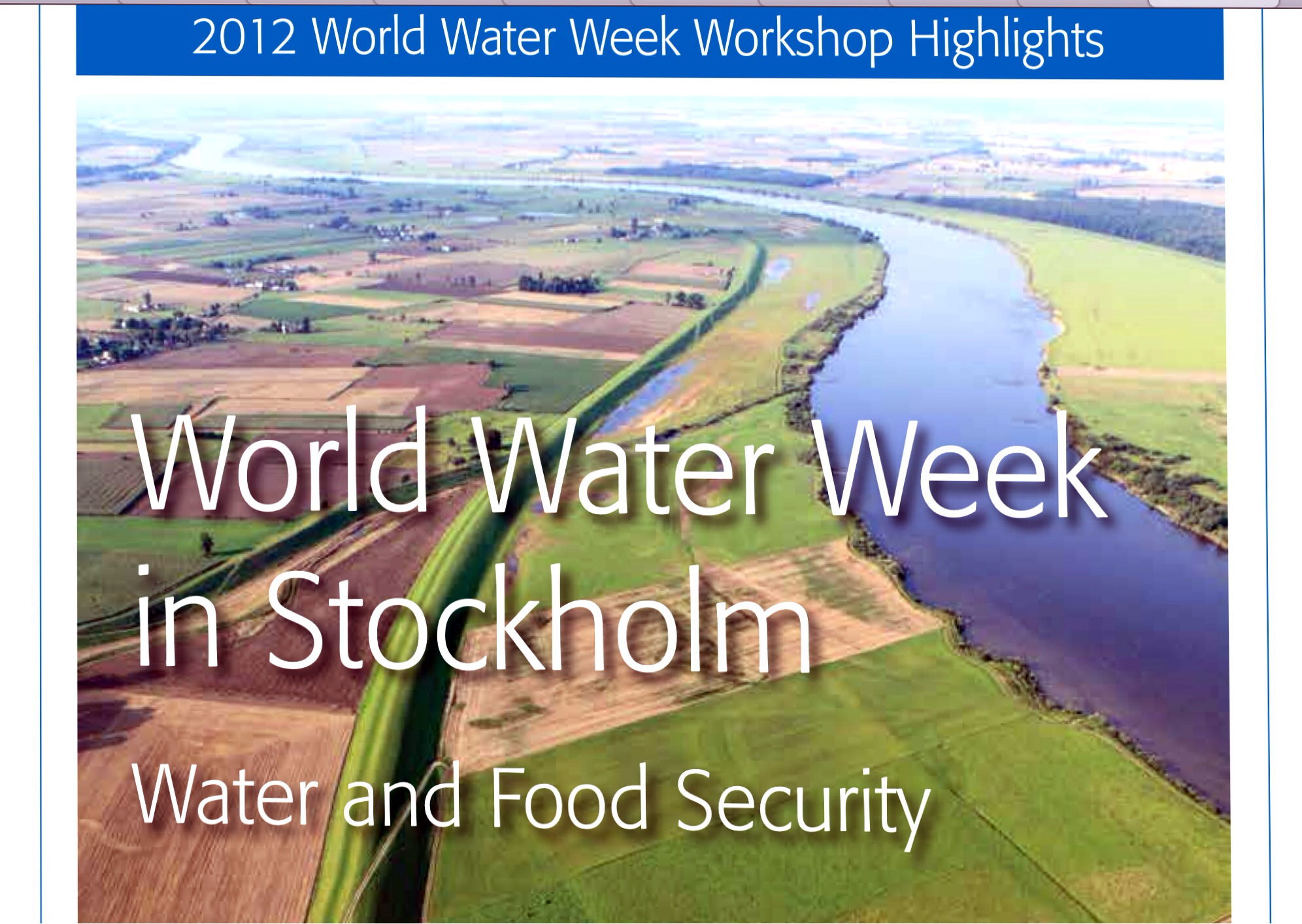
SIWI Publishes Highlights of World Water Week Workshop Outcomes

SIWI Publishes Highlights of World Water Week Workshop Outcomes

21 November 2012: The Stockholm International Water Institute (SIWI) has released a report on outcomes of workshops taking place during World Water Week 2012, on the topic of water and food security. Issues addressed by workshops included governance, green economy, health, food security and trade.

The report, “2012 World Water Week Workshop Highlights,” provides overviews of workshops on: best use of blue water resources for food security; governance for water and food security; towards a green economy - the water, energy and food security nexus; health and food security; safeguarding global food security and life-supporting ecosystems; rainfed production under growing rain variability - closing the yield gap; securing water and food in an urbanizing world; and trade and food security.

The report provides brief overviews of issues discussed during each workshop and concludes identifying key messages. The workshops addressed a number of issues such as land tenure and local cultural rights, integrated water resources management (IWRM), health risks of water reuse and payment for ecosystem services (PES). [Publication: 2012 World Water Week Workshop Highlights]


Tuesday, November 6, 2012

UK water resources 'left to weather's mercy'

A new report blames the government for leaving the UK's water resources at the mercy of the weather.

The document from 16 leading environmental organisations says it took the wettest ever summer to avert serious drought.

It warns that another series of dry winters would put Britain back on drought alert.

The government said its draft Water Bill would build resilience into the UK's water infrastructure.

The Blueprint for Water report measures the Government's performance against 10 steps to sustainable water by 2015.

It applauds ministers' commitment to tackle unsustainable abstraction from rivers and wetlands, extend the use of metering at a fair price and develop a catchment-based approach to managing the water environment.

But it says ministers are still failing to produce a long-term, sustainable approach which works with our natural water systems.

The groups want much more use of moors, marshes and plants to store and clean rain water, instead of allowing it to run straight into rivers and thus increase the risk of flooding. This would help tackle droughts as well as floods.

The chair of the Blueprint for Water coalition, Carrie Hume, said: "Lack of action to fix our broken water system is a false economy. We cannot continue to lurch between flooding and drought which is damaging for people, businesses and wildlife."

The Blueprint for Water was launched in November 2010. The Government is scored every two years on its progress. More


Thursday, August 23, 2012

Our Oversized Groundwater Footprint

We don’t see it, smell it or hear it, but the tragedy unfolding underground is nonetheless real – and it spells big trouble.

A dried up well

I’m talking about the depletion of groundwater, the stores of H2O contained in geologic formations called aquifers, which billions of people depend upon to supply their drinking water and grow their food.

For a long time, we had only a vague sense of the scale of this depletion, mostly through anecdotal evidence and selected country studies. While researching my 1999 book Pillar of Sand, I gathered the best data I could find at the time, and with all the necessary caveats, estimated that about 8-10 percent of the world’s food supply depended upon the draining of underground aquifers.

About a decade later, modeling work by Marc Bierkens of Utrecht University in the Netherlands and his colleagues arrived at a global depletion estimate that produced a similar figure: their estimated 283 billion cubic meters of groundwater depleted in 2000 is sufficient to produce 188.6 million tons of grain, equal to 10 percent of that year’s global grain production. While not all groundwater pumped from the earth is used to produce grain, the vast majority of it is.

In recent years a number of other studies, along with NASA’s GRACE (Gravity Recovery and Climate Experiment) mission, have corroborated the dangerous trend. From the Arabian deserts to the North China Plain, and from the breadbasket of India to the fruit and vegetable bowl of the United States, we are increasingly dependent on the unsustainable use of groundwater.

In effect, we’re robbing the Peters of the future to feed the Pauls of today.

Now a new study, led by Tom Gleeson of McGill University in Montreal and published last week in the journal Nature, provides perhaps the most compelling and informative assessment to date of what’s happening with groundwater globally.

Gleeson and his team build upon the concept of our “ecological footprint,” which expresses humanity’s consumption as the area of biomass needed to support that consumption sustainably. Today, according to the Global Footprint Network, humanity uses the equivalent of 1.5 planet Earths. In other words, we’ve overshot sustainable levels by half an Earth.

In a creative adaptation, Gleeson’s team applied a similar approach to assessing humanity’s groundwater footprint. They estimate that the size of the global groundwater footprint – defined as the area required to sustain groundwater use and groundwater-dependent ecosystem services — is about 3.5 times the actual area of aquifers tapped for water supplies. More


Sunday, August 19, 2012

Troubled Waters: Can a Bridge Be Built over the Indus?

Whereas once the Indus Waters Treaty could correctly be described as a beacon of light in an otherwise gloomy relationship between India and Pakistan, this is no longer so.

The odds now are that the crumbling IWT will be a cause for further tension and conflict between India and Pakistan. It is also true that with far-sighted political leadership, especially in India but also in Pakistan, a bridge could be built over these troubled waters and the Indus could, again, become a catalyst for cooperation.

Preamble

t has been one of the great privileges of my life to work for almost 40 years on the challenges of water management in the south Asian subcontinent. Starting with a Harvard University/Government of India collaborative programme on planning of the Ganga and Narmada rivers in the early 1970s. I lived in Bangladesh (in the 1970s) and Delhi (from 2002 to 2005 when I was senior water advisor at the World Bank). In 2006 I published, with Indian colleagues a book titled India’s Water Economy: Facing a Turbulent Future and with Pakistani col- leagues, one titled Pakistan’s Water Economy: Running Dry.

Writing on a subject as fraught with mis- trust as the Indus requires a level of “personal declaration” that is not necessary in most other contexts. So whose views do I represent? America? No, I am not American but South African. The World Bank? No, but this requires a bit more explanation. I worked for 20 years for the World Bank, the last 10 as Senior Water Advisor and then as the country director for Brazil until the end of 2008 when I accepted a faculty position at Harvard University.

Institutions like the World Bank necessarily have to craft institutional positions on complex issues. Healthy institutions ensure that there is space for the expression of a wide variety of views in coming to decisions. As is described in detail in Chapter 13 of Sebastian Mallaby’s (2005) landmark history of the World Bank, my views were frequently different from the views of management of the Bank. Furthermore, I have not been involved in any internal discussion in the World Bank on Indian and Pakistan water issues since 2005. The interpretations in this article do not depend on any confidential information but are based entirely on my own reading of documents and reports that are in the public domain. So this paper represents the personal views of a mere university professor, who speaks in the name of no one else or no other institution. Over these 40 years I have acquired a deep affection for the people of both India and Pakistan, and am dismayed by what I see as a looming trainwreck on the Indus, with potentially disastrous consequences for both countries. Whereas once the Indus Waters Treaty (IWT) could correctly be described as a beacon of light in an other- wise gloomy relationship, the situation has changed: because of the growing invest- ment in hydropower in Indian-held Kashmir; because of the declining water availability in Pakistan; because the Baglihar verdict of the Neutral Expert has gutted the IWT of its essential balance, because the World Bank has withdrawn from its once-heroic en- gagement with the Indus and because of the appropriation of the water dialogue by extremists on both sides. The purpose of this article is to delve into some of these questions, and to suggest how to find a way out before it is too late.

The Indus Waters Treaty

In the 19th century, the British constructed most of what is today the world’s largest contiguous irrigation system in the Indus Basin. However, the boundaries between the two states drawn in 1947 paid no attention to hydrology. Eighty per cent of the irrigated area was in Pakistan, but after Partition a large portion of the headwaters for the rivers which serviced most of this immense area were in Indian-held Kashmir.

Seeing that India and Pakistan were un- able to resolve this issue, the World Bank offered its help. After 10 years of intense negotiation, in 1960 the IWT was signed by then Indian Prime Minister Jawaharlal Nehru, Pakistani President Ayub Khan and the World Bank.

There are four essential elements to the treaty. The first relates to the division of the waters. The waters of the three western rivers (the Indus, the Jhelum and the Chenab) were allocated to Pakistan, and the waters of the three eastern rivers (the Ravi, the Beas and the Sutlej) were allocated to India. More


Wednesday, July 25, 2012

The Battle for Water - Harvesting and conserving rainwater key to boosting crop yields

In its Rio+20 call for action, CGIAR urged Rio+20 actors to address the unequal sharing and unsustainable use of natural resources such as water and land, through improved governance and technology dissemination. World food production, hence food security depends on water but water availability per capita is drastically decreasing.

To sustainably ensure a steady food production especially in poor smallholdings in the (global) south, mainly practicing rain fed agriculture, one priority is to help local rural communities better manage “green water” – the rainwater captured by the soil and available for plants.

For decades the International Crops Research Institute for the Semi-Arid Tropics (ICRISAT) has been working on successful local and farmer participatory water governance models.

Whether it's bread, meat, milk or bananas, whatever we eat demands water. But with a rapidly growing population (already more than 7 billion people), water availability gets more and more scarce.

There is a correlation between poverty, hunger and water stress. The UN Millennium Project has identified the "hot spot" countries in the world with the highest number of malnourished people.

These countries coincide closely with semi-arid and dry sub-humid hydroclimates, savannahs and steppe ecosystems, where rainfed agriculture is the dominating source of food, and where water constitutes a key limiting factor to crop growth.

The Food and Agriculture Organisation (FAO) estimates that we need to increase agricultural production by 70% to feed the projected 9 billion people expected on the planet by 2050. But, given the current global food crisis, boosting agricultural production will certainly increase water stress.

PRODUCING MORE WITH LESS WATER

We urgently need to increase water productivity. But how do we produce more cereals, milk and bananas with less water? And what type of water are we talking about?

At the last World Water Forum in Marseille in March, experts talked about the colour of water: blue water (irrigation), green water (rainwater captured by the soil and available for plants) and grey water (polluted water that could be treated and recycled). More