Water Security is National Security

Water resources and how they are managed impact almost all aspects of society and the economy, in particular health, food production and security, domestic water supply and sanitation, energy, industry, and the functioning of ecosystems. Under present climate variability, water stress is already high, particularly in many developing countries, and climate change adds even more urgency for action. Without improved water resources management, the progress towards poverty reduction targets, the Millennium Development Goals, and sustainable development in all its economic, social and environ- mental dimensions, will be jeopardized. UN Water.Org

Sunday, June 29, 2014

Himalayan Water Security: The Challenges for South and Southeast Asia

The scramble for control of natural resources to support economic and population growth, combined with the uncertain effects of climate change on the Tibetan Plateau, is raising tensions in Asia over Himalayan water resources.

Ten of the region’s largest and longest rivers (the Amu Darya, Brahmaputra, Ganges, Indus, Irrawaddy, Mekong, Salween, Tarim, Yangtze, and Yellow) originate in the Himalayas. These rivers help provide water, food, and energy for nearly 4 billion people in China and across South and Southeast Asia—nearly half of the world’s population. However, depletion and diversion of these transborder resources to meet growing industrial, agricultural, and urban demands have the potential to trigger far-reaching economic, social, and environmental challenges.

The lack of comprehensive and effective regional frameworks for cooperation hinders sustainable management of these waterways. China, which controls the headwaters of these rivers, has an enormous need for Himalayan water to satisfy economic and energy demands but has little incentive to participate in formal water-sharing and water-management agreements with its neighbors. China’s dam-building and water-diversion projects are a source of major concern to the countries downstream, which often complain about Beijing’s lack of transparency and reluctance to share information. Although managing water-sharing relations with China might be the most prominent challenge, cooperation is not much easier at the middle and lower reaches of the rivers. Collaboration in South and Southeast Asia is frequently frustrated by competing national interests, economic priorities, political disputes, and weak regional organizations. In addition to the environmental impacts of man-made diversion projects and unsustainable freshwater usage, there is also inadequate cooperation on scientific research to understand and prepare for the effects of climate change on the region’s water supplies.

This Asia Policy roundtable contains seven essays that discuss the challenges and implications of water security in Asia and recommend steps that both upstream and downstream countries could take to better manage the region’s shared water resources.

Asia’s Unstable Water Tower: The Politics, Economics, and Ecology of Himalayan Water Projects
Kenneth Pomeranz

China’s Upstream Advantage in the Great Himalayan Watershed
Jennifer L. Turner, Susan Chan Shifflett, and Robert Batten

Melting the Geopolitical Ice in South Asia
Robert G. Wirsing

Himalayan Water Security: A South Asian Perspective
Tushaar Shah and Mark Giordano

Hydropower Dams on the Mekong: Old Dreams, New Dangers
Richard P. Cronin

Climate Change and Water Security in the Himalayan Region
Richard Matthew

Securing the Himalayas as the Water Tower of Asia: An Environmental Perspective
Jayanta Bandyopadhyay

Download PDF


As I have been arguing for a number of years South Asia needs to re-negotiate the Indus Water Treaty to encompass Afghainstan, Bangladesh, Bhutan, China, India, Nepal and Pakistan before the region starts to suffer from water insecurity and the effects of climate change. Editor


Thursday, June 26, 2014

Rains Failing Over India:

Feeble 2014 Monsoon Heightens Concerns That Climate Change is Turning A Once-Green Land into Desert

El Nino has yet to be declared. Though signs of the Pacific Ocean warming event abound, they are still in the early stages. But for all the impact on the current Indian Monsoon — the rains this vast sub-continent depends on each year for a majority of its crops — the current pre-El Nino may as well be a monster event comparable to 1998.

For the rains that have come so far have been feeble. By June 18, precipitation totals were more than 50% below the typical amount by this time of year for northern and central India and 45% below average for the country as a whole. A stunted Monsoon that many are saying is about as weak as the devastatingly feeble 2009 summer rains. And with Pacific Ocean conditions continuing to trend toward El Nino, there is concern that this year’s already diminished rains will snuff out entirely by mid-to-late summer, leaving an already drought-wracked India with even less water than before.

Through June 25th, the trend of abnormally frail monsoonal rains continued unabated:

India cloud cover on June 25, 2013 [Left Lower image] compared to India cloud cover on June 25 of 2014 [right upper image].

Note the almost complete lack of storms over India for this year compared to 2013 when almost the entire country was blanketed by rains. Image source: LANCE-MODIS.)

India’s Rain Pattern Has Changed

It’s not just that 2014 is a bad year for India. It’s that the current weakened monsoon comes at the tail end of a long period in which the rains have increasingly failed. Where in the past it took a strong El Nino to stall the rains, ever-increasing human atmospheric and ocean warming have pushed the threshold for Monsoonal failure ever lower. Now even the hint of El Nino is enough to set off a dry spell. A growing trend of moisture loss that is bound to have more and more severe consequences.

A new study by Stanford University bears out these observations in stark detail. For the yearly monsoon that delivers fully 80 percent of India’s rains has fallen in intensity by more than 10% since 1951. And though a 10% loss may seem relatively minor, year on year, the effects are cumulative. Overall, the prevalence of dry years increased from 1981 to 2011 by 27% and the number of years experiencing 3 or more dry spells doubled.

Meanwhile, though a general drying trend has taken hold, rain that does occur happens in more intense bursts, with more rain falling over shorter periods. These newly intensified storms are more damaging to lands and homes, resulting in both increasing destruction of property while also greatly degrading the land through more intense erosion.

25 Percent of India’s Land is Turning to Desert

Loss of annual monsoonal rains is coming along with a dwindling of water flows from the melting Himalayan glaciers. These two climate change induced drying effects are already having stark impacts.

For according to the Indian Government’s Fifth National Report on Desertification, Land Degradation and Drought, a quarter of India’s land mass is now experiencing desertification even as 32 percent is suffering significant degradation due to heightening dryness and erosion. This amounts to more than 80 million hectares of land facing desertification while more than 100 million hectares are steadily degrading. The report also noted that areas vulnerable to drought had expanded to cover 68% of the Indian subcontinent.

From the report: (India Monsoon.)

Desertification and loss of biological potential will restrict the transformation of dry lands into productive ecosystems. Climate change will further challenge the livelihood of those living in these sensitive ecosystems and may result in higher levels of resource scarcity.

Monsoonal Delay, Weakening Continues

By today, June 26, the long disrupted and weakened monsoon continues to sputter. Moisture flow remains delayed by 1-2 weeks even as the overall volume of rainfall is greatly reduced.

Though storms have exploded over some provinces, resulting in flash flooding, much of the country remained abnormally dry.

Overall, preliminary negative rainfall departures remained at greater than 40% below average for most of the nation with only five provinces receiving normal rainfall and the remaining 31 receiving either deficient or scant totals. More


Is the UN turning its back on the human right to water?

One of the biggest threats to economic and social development is that the world's freshwater supplies are rapidly becoming scarce and polluted. A new set of actors are now engaging in the global development arena to define and write the rules ofaccess to water to ensure people's needs are protected.

It is alarming to see that the human right to water and sanitation continues to be marginalised in UN policy discussions. The exclusion of this right to water in the most recent draft of the sustainable development goals reveals policy more conducive to promoting water security for economic growth than ensuring the preservation of watersheds and the equitable distribution of scarce water supplies.

When the UN general assembly passed a resolution in 2010 affirming water and sanitation as a human right, it was celebrated as a victory for communities dealing with the health impacts of polluted water, the indignity of not having access to clean drinking water and sanitation or the inability to produce food owing to water shortages. Social movements saw the human right to water and sanitation as a tool in the fight against a global water crisis produced by inequality, social exclusion and abuse of the water commons.

The global water crisis is also a big concern for industries seeking secure access to water supplies to sustain and expand operations in a never-ending quest for economic growth. The extractive industries, large drinks companies, big banks investing in water stocks, and companies involved in providing water and sanitation services have positioned themselves as stakeholders within global water policy discussions and as being able to provide solutions to the crisis.

The latest trend in global and national water policy is for corporations to participate in decision-making bodies and promote corporate-driven solutions through public-private partnerships. Over the past decade or so, the efforts of corporations such as Nestlé and Unilever to engage in global water policy discussions has shifted the debate from one of injustice and inequality to a depoliticised discussion of scarcity solved by technological fixes. These are offered by multinational corporations and market mechanisms that further deregulate water resource allocation.

When global policymakers – including the working group on sustainable development goals (SDGs) – focus simply on improving "water efficiency" for these ever-expanding industries without anchoring discussions of access to water as a right, they are ignoring communities that are challenging the very presence of the industries that are destroying watersheds.

The human right to water and sanitation holds promise for these communities. It has been invoked in Plachimada, in south India, to challenge Coca Cola's accessto aquifers; by anti-mining activists throughout Latin America; and, more recently, by the Kalahari Bushmen in a struggle to access traditional water sources on land coveted by industries such as tourism, diamond mining and fracking.

It has also been used to democratise water and sanitation services. In Uruguay, recognition of the human right to water led to the ban of private water services. When a recent ruling by a top Greek court blocked the privatisation of the country's largest water utility, in Athens, it was a victory for activists across Europe who had condemned forced privatisation through loan conditions in bailout packages for Greece, Portugal and Italy.

So it is deeply troubling that the human right to water continues to be contested at the UN. For those living without access to adequate drinking water and sanitation, the SDG on water focuses on universal access. As special rapporteur on the human right to safe drinking water and sanitation, Catarina de Albuquerque arguesthat an emphasis on universality alone fails to eliminate inequality.

At the very minimum, the human right to water calls for the elimination of discrimination and the adoption of special measures for marginalised communities. Social movements pursuing public control over water supplies, and democratic and participatory governance models, are also drawn to the elements of public participation in decision-making, accountability and access to justice underscored by the human right to water.

While this right is hardly the silver bullet for all global water woes, it goes a long way towards balancing unequal power relationships. More


Saturday, June 21, 2014

Drought in Syria: a Major Cause of the Civil War?

Syria's devastating civil war that began in March 2011 has killed over 200,000 people, displaced at least 4.5 million, and created 3 million refugees.

Figure 1. The highest level of drought,
"Exceptional", was affecting much of
Western Syria in April 2014, as measured
by the one-year Standardized Precipitation
Index (SPI).
Image credit: NOAA's Global Drought Portal

While the causes of the war are complex, a key contributing factor was the nation's devastating 2006 - 2011 drought, one of the worst in the nation's history, according to new research accepted for publication in the journal Weather, Climate, and Society by water resources expert Dr. Peter Gleick of the Pacific Institute. The drought brought the Fertile Crescent's lowest 4-year rainfall amounts since 1940, and Syria's most severe set of crop failures in recorded history. The worst drought-affected regions were eastern Syria, northern Iraq, and Iran, the major grain-growing areas of the northern Fertile Crescent. In a press release that accompanied the release of the new paper, Dr. Gleick said that as a result of the drought, "the decrease in water availability, water mismanagement, agricultural failures, and related economic deterioration contributed to population dislocations and the migration of rural communities to nearby cities. These factors further contributed to urban unemployment, economic dislocations, food insecurity for more than a million people, and subsequent social unrest."

More

Vanishing Water Landscapes in the Middle East

On 11 June 2014 Francesca de Châtel successfully defended her PhD thesis on water in Syria. The Jordan River has been reduced to 2% of its historic size and is heavily polluted. Across Syria, rivers are shrinking, springs have dried up, and the desert is spreading. The water crisis in the Middle East, the most water-scarce region in the world, is rapidly worsening, yet decision-makers appear unwilling to acknowledge its severity and water remains low on the political agenda. How can this gap between the reality of growing scarcity on the ground and the continued illusion of plenty be explained?

2014.06.11 De Chatel

This is one of the key questions Francesca de Châtel explores in «Vanishing Water Landscapes in the Middle East», a study that combines extensive study on the ground in pre-conflict Syria and across the region with historic data to show how high population growth, overambitious agricultural development projects and uncontrolled water use over the last 60 years have irreversibly disrupted the Middle East’s fragile ecological balance.

acrobat icon Vanishing Water Landscapes in the Middle East

» Article (in German) in Neue Zürcher Zeitung: Die Rache der Verelendeten

» Article (in French) in Le Monde: La thèse qui associait sécheresse et guerre syrienne More


Saturday, May 31, 2014

Monsoon Disrupted By El Nino + Climate Change as India Suffers Deaths, Crop Losses from Extreme Heat.

May is the month when the massive rainstorm that is the Asian Monsoon begins to gather and advance. This year, as in many other years, the monsoon gradually formed along the coast of Myanmar early in the month. It sprang forward with gusto reaching the Bay of Bengal by last week.

And there it has stalled ever since.

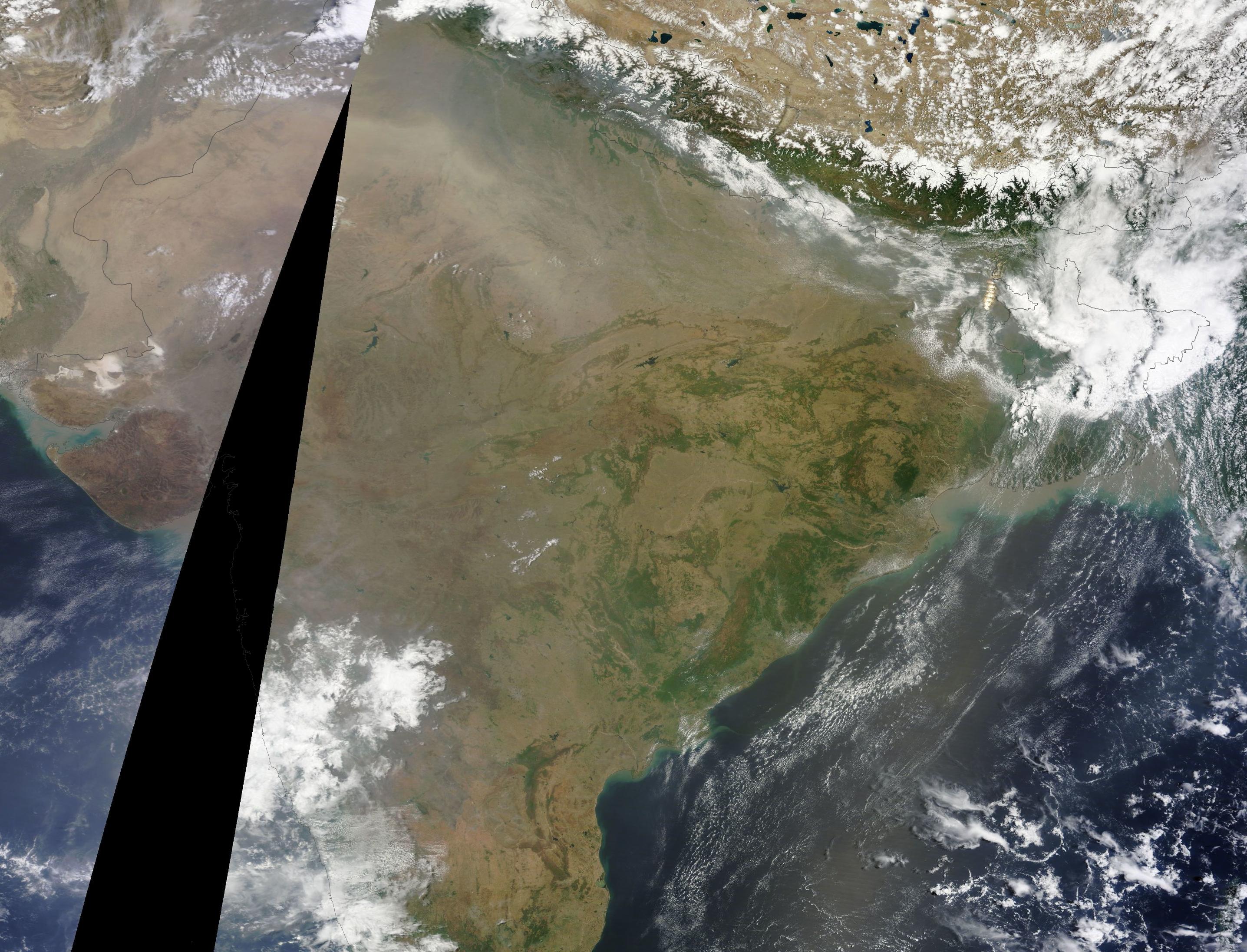
On May 25-27, an outburst of moisture from this stalled monsoonal flow splashed over the coasts of India. But by the 29th and 30th, these coastal storms and even the ones gathering over the Bengali waters had all been snuffed out. The most prominent feature in the MODIS shot of India today isn’t the rainfall that should be now arriving along the southeast coast, but the thick and steely-gray pallor of coal-ash smog trapped under a persistent and oppressive dome of intense heat.

(MODIS shot of India on May 30th. See the open stretch of blue water in the lower right frame? That’s the Bay of Bengal which borders coastal India. During a normal year at this time, that entire ocean zone should be filled with the storm clouds of a building monsoon that is already encroaching on coastal India. Today, there is nothing but a smattering of small and dispersed cloud through a mostly clear sky. Image source: LANCE-MODIS.)

Monsoon Described as Feeble

Official forecasts had already announced as of May 27th that the annual monsoon was likely to be delayed by at least a week for southeast regions of India. Meanwhile, expected monsoonal rainfall for western and northern sections of India for 2014 fell increasingly into doubt.

From The Times of India:

The monsoon is likely to be delayed by 10 days, according to scientists at the Indian Institute of Tropical Meteorology (IITM) here. The IITM’s third experimental real-time forecast says that a feeble monsoon will reach central India after June 20 as against the usual June 15. Last year, the monsoon had covered the entire country by June 15.

The annual monsoon is key to India’s agriculture. The substantial rains nurture crops even as they tamp down a powerful heating that typically builds throughout the sub-continent into early summer. Without these rains, both heat and drought tend to run rampant, bringing down crop yields and resulting in severe human losses due to excessive heat.

But, this year, heat and drought are already at extreme levels.

Major Heatwave Already Results in Loss of Life for 2014

As early as late March, the heatwave began to build over the Indian subcontinent. The heat surged throughout the state, setting off fires, resulting in a growing list of heat casualties, shutting down the power grid and spurring unrest. Meanwhile, impacts to India’s agriculture were already growing as the Lychee fruit crop was reported to have suffered a 40% loss.

By late May, temperatures across a broad region had surged above 105 degrees shattering records as the oppressive and deadly heat continued to tighten its grip.

In a country surrounded on three sides by oceans, it is a combination of heat, humidity and persistently high night-time temperatures that can be a killer. Wet bulb temperatures surge into a high-risk range for human mortality during the day even as night-time provides little respite for already stressed human bodies. Such extreme and long-duration heat doesn’t come without a sad toll. As of today, early reports indicated a loss of more than 56 lives due to heat stroke (In 2012 and 2013, total Indian heat deaths were near 1,000 each year). That said, final figures on heat losses are still pending awaiting complete reports from all of India’s provinces.

"Climatologically, we know that heatwaves are increasing in frequency and the number of days exceeding 45ºC temperatures is increasing. The frequency will increase further with global warming, hence this is a good example of a situation where science and disaster management can come together and avert damage," a spokesman for India’s National Disaster Management Authority noted on Friday.

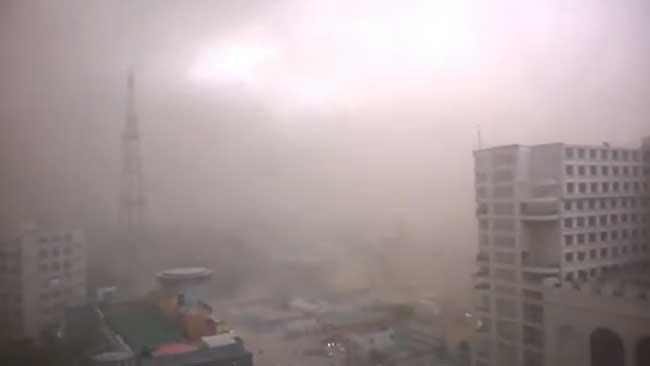
(Hot Dust. A dust storm rolls through New Delhi on Friday amidst furnace-like 113 degree heat snarling traffic and resulting in the tragic loss of 9 more lives. Image source: Gaurav Karoliwal/YouTube Screenshot.)

Today the heatwave continued to gain ground, with Kota and Rajasthan reaching an all-time record of 116 degree F (46.5 C) as New Delhi’s mercury hit 113 degrees F in the midst of a drought-induced dust storm. Dust shrouding the city spurred traffic chaos and in the heat, darkness, and confusion nine more souls were lost.

After two months of growing disruption due to heat and drought, the lands and peoples of India cry out for a Monsoon that is running later and later with each new weather report.

Climate Change + El Nino: Adding Heat and Beating Back the Monsoon

As systems approach tipping points, they are more likely to tilt toward the extremes.

For India this year, its seasonally warmest period from April to May found severe heat amplification from a number of global factors. First, climate change seeded the ground for the current Indian heatwave by adding general heat and evaporation to already hot conditions. With global average heating of +0.8 C above 1880s levels amplifying in the hot zones, early moisture loss due to higher-than-normal temperatures produces a kind of snowball effect for still more warming. Essentially, the cooling effect of water evaporation is baked out early allowing for heat to hit harder just as typical seasonal maximums are reached. More

Originally published by robertscribbler.wordpress.com/


Thursday, May 22, 2014

Challenge in Sao Paulo: Overcoming Water Scarcity in South America’s Largest City

Last March, one of Brazil’s most important newspapers, O Estado de S. Paulo, published a version of the article below, which summarizes the Conservancy’s efforts to help secure Sao Paulo’s water supply. It is translated and reprinted here with permission.

By João Campari and Samuel Barrêto, The Nature Conservancy

The inhabitants of Sao Paulo have been dealing with discouraging images of cracked riverbeds where they used to see flowing water, making this temperate part of Brazil look more like the country’s semi-arid region. Unfortunately, these stark images show the worsening struggles of the Cantareira system, one of the greatest water supply systems in the world.

Right now, the Cantareira’s reservoirs — responsible for providing water for more than 12 million inhabitants of the Sao Paulo Metropolitan Region (RMSP) and Campinas — are operating at less than 15% capacity*, the lowest level recorded since the Cantareira’s creation in the early 1970s.

The images, the symbol of the current crisis, show that water doesn’t really come from the taps in our houses. It comes from nature, and in Sao Paulo much of that nature is the Atlantic Forest. While water rationing gets peoples’ attention and is one of the necessary responses to water scarcity, rationing alone is not enough to solve the long-term problem of securing lasting access to fresh water.

We must look beyond the tap and work to take care of our water supplies at their sources. We need a systemic response for the management of watersheds to restore the sources of our water that have been degraded, polluted and deforested. Forests are very important for healthy fresh water supplies. Unfortunately, the Cantareira system alone has lost 70% of its original forest cover, aggravating the sedimentation of rivers and dams, and decreasing their ability to supply water.The degradation of native vegetation also worsens the effects of erosion and drought.

The interaction of all these factors — deforestation, sedimentation, erosion and drought — leads to a situation of extreme risk and represents an environmental, social and economic threat not just to Sao Paulo, but to the entire country of Brazil. The Sao Paulo Metropolitan Region and Campinas together are responsible for more then 22% of the country’s GDP. Therefore, it is a priority to create a strong and strategic response to the increasing and urgent problems of water quantity, quality, access and supply for urban centers.

Protecting Water Supplies at their Sources

We must go beyond conventional interventions, such as engineering works — more dams or aqueducts are not the answer. Wider, systemic responses are necessary, and the responsibility to act is not limited to the government. We all need water and it is the shared responsibility of businesses, communities and civil society as a whole to search for solutions together. The government’s role is to foster and implement multiple solutions that reach multiple stakeholders at once.

The Conservancy’s work shows that one of the highest priorities for securing Sao Paulo’s water supplies is strengthening the Cantareira system’s “green infrastructure” by restoring the degraded forests of the Atlantic Forest, as well as conserving existing forest remnants. Such initiatives ensure the health of a watershed. This type of solution, when well managed, minimizes the risk of extreme events and reduces the vulnerability of populations to floods and prolonged droughts. Healthy forests also store water and reduce erosion and provide environmental services of water regulation and security to the population.

New York City illustrates this equation quite clearly. Decades ago, the city’s administration compared the costs of both natural and built infrastructure for protecting and providing water. Preserving the forests that were source of the city’s drinking water cost US $1 to 1.5 billion over 10 years. That amount was seven times lessthan the estimated US $6 to 8 billion needed to build a traditional, engineered water treatment and distribution network. (That amount doesn’t include the additional and ongoing operational and maintenance costs of $300 to $500 million a year that would have been necessary.) Obviously, nature was the better buy for the people of New York.

It is something for Sao Paulo to consider. A recent study by the Conservancy showed that restoring about 35,000 acres of deforested areas and preventing erosion on 5000 acres within the basins of the Piracicaba, Capivari, Jundiaí and Alto Tietê rivers would decrease the level of sediments that clog the rivers by 50%. Reducing erosion would increase the capacity of water reservoirs and simultaneously decrease the cost of treatment for the removal of sediments.

What the Conservancy is doing in Sao Paulo

To help accomplish restoration goals in the lands around Sao Paulo’s Cantareira system, the Conservancy-led Water Producers Project provides payments to farmers and ranchers who conserve forests on properties that are part of the watershed that feeds the Cantareira reservoirs. This payment-for-environmental-services program recognizes and compensates landowners for the water-producing value their lands provide.

The Conservancy also leads the Water for Sao Paulo Movement. This initiative fosters conversation and working relationships between different stakeholders and focuses on the importance of both water conservation and nature-based solutions for securing the water supply of the region. Because healthy forests are so important for healthy rivers and water supplies, Water for Sao Paulo seeks to restore degraded forests near the urban area.

Finally, Sao Paulo must strengthen the existing Watersheds Committees. Created by the Brazilian Legislature, Watersheds Committees discuss and make decisions about the use of water from specific river basins and are some of the most important collaborations for achieving a balance between water supply and demand.Committees include representatives of local governments, water supply companies and civil society, who are responsible for tasks such as approving water management plans, defining actions for conservation of biodiversity and mediating conflicts about the use of water resources. There are more than 200 of these groups in Brazil.

The current crisis in the Cantareira system is both a challenge and an opportunity to learn from the past and make better decisions for the future. If we have the discernment to act in a systemic way and the political and institutional capacity for change, we will be able to reduce the risks of a permanent cycle of water shortage. In addition to this, we have the opportunity to show how healthy watersheds contribute to water security, which is indispensable for Sao Paulo’s social and economic stability into the future.

To learn more about how the Conservancy is helping to secure Brazil’s water supplies, please visit Where Does Your Water Come From?

*Since this article was published in March, the need for concerted action in Sao Paulo has become even more urgent. The level of water in the Cantareira system has now dropped – to about 8% of its overall capacity. As an emergency stopgap to provide water to the city, the government of Sao Paulo spent US$36 million on emergency constructions to allow access to water stored below the level of the pumps. Known to water managers as “dead volume,” this water was never intended to be part of the water supply, and the reservoirs are now, essentially, operating at a deficit. More